
 |
Canaan Dog |
|
FCI standard Nº 273 |
||
Origin |
Israël | |
Group |
Group 5 Spitz and primitive type | |
Section |
Section 6 Primitive type | |
Working |
Without working trial | |
Acceptance on a definitive basis by the FCI |
Wednesday 23 November 1966 | |
Publication of the official valid standard |
Thursday 28 November 1985 | |
Last update |
Wednesday 16 June 1999 | |
En français, cette race se dit |
 |
Chien de Canaan |
Diese Norm ist in deutscher Sprache sichtbar |
 |
Kanaan hund |
En español, esta raza se dice |
 |
Canaan Dog |
In het Nederlands, wordt dit ras gezegd |
 |
Canaan Dog |
Usage |
| Watch- and security Dog. |
Brief historical summary |
| We meet this dog in the Middle East since the earliest times. Pariah dog originally, it was however used as a guard dog for the nomads. It was in the 30s that this breed became known in Europe, where it is appreciated more for the versatility of its features. It has, for example, trained to detect mines during the 2nd World War and, more recently, the work of guide dogs or rescue. |
General appearance |
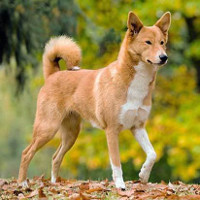
| A medium sized, well balanced, strong and square dog resembling the wild dog type. Strong distinction between the sexes. |
Behaviour / temperament |
| Alert, quick to react, distrustful of strangers, strongly defensive but not naturally aggressive. Vigilant not only against man but other animals as well. Extraordinarily devoted and amenable to training. |
Head |
||
Cranial region |
||
Head |
Well proportioned, blunt wedge shape of medium length, appearing broader due to low set ears. | |
Skull |
Somewhat flattened. Some width allowed in powerful male heads. | |
Stop |
Shallow but defined. | |
Facial region |
||
Nose |
Black. | |
Muzzle |
Sturdy, of moderate length and breadth. | |
Lips |
Tight. | |
Jaws and teeth |
Jaws should be strong. Full dentition with scissor or level bite. | |
Eyes |
Dark brown, slightly slanted, almond-shaped. Dark rims essential. | |
Ears |
Erect, relatively short and broad, slightly rounded at the tip and set low. | |
Neck |
| Muscular, of medium length. |
Body |
||
Body |
Square. | |
Withers |
Well developed. | |
Back |
Level. | |
Loin |
Muscular. | |
Chest |
Deep and of moderate breadth. | |
Ribs |
Ribs well sprung. | |
Underline and belly |
Well tucked up. | |
Tail |
| Set high, thick brush carried curled over the back. |
Limbs |
Forequarters |
||
Generality |
Moderate angulations. Balance is essential. Forelegs perfectly straight. | |
Shoulders |
Oblique and muscular. | |
Elbows |
Close to the body. | |
Hindquarters |
||
Generality |
Moderate angulations. Balance is essential. Powerful. | |
Upper thigh |
Strong, lightly feathered at the rearside. | |
Stifle |
Well bent. | |
Hock |
Well let down. | |
Feet |
| Strong, round and cat-like with hard pads. |
Gait and movement |
| Quick, light and energetic trot. Should demonstrate marked agility and stamina. Correct movement is essential. |
Coat |
||
Hair |
Outer coat dense, harsh and straight, of short to medium length. Undercoat close and profuse. | |
Colour |
Sand to red-brown, white, black, or spotted, with or without mask. If masked, mask must be symmetrical. Black mask permitted on all colours. White markings are permitted on all colours : « Boston Terrier » patterns are common. Grey, brindle, black-and-tan, or tricolour are unacceptable. Desert colours-sand, gold, red, cream- are most typical of the breed. | |
Size and weight |
||
Height at withers |
50-60 cm. Males can be considerably larger than females. | |
Weight |
18-25 kg. | |
Faults |
| • Any departure from the foregoing points should be considered a fault and the seriousness with which the fault should be regarded should be in exact proportion to its degree and its effect upon the health and welfare of the dog and its ability to perform its traditional work. • Faults listed should be in degree of seriousness. |
Disqualifying faults |
 Aggressive or overly shy dogs. Aggressive or overly shy dogs. |
NB : |
| • Any dog clearly showing physical or behavioural abnormalities shall be disqualified. • The above mentioned faults when occurring to a highly marked degree or frequently are disqualifying. • Male animals should have two apparently normal testicles fully descended into the scrotum. • Only functionally and clinically healthy dogs, with breed typical conformation should be used for breeding. |
Bibliography |
| https://www.fci.be/ |



 English (United Kingdom)

Comments