 |
Pug |
|
FCI Standard No. 253 |
Origin |
China, patronage Great Britain | |
Group |
Group 9 Companion and Toy Dogs | |
Section |
Section 11 Small Molossian type dogs | |
Working |
Without working trial | |
Date of acceptance on a definitive basis by the FCI |
Friday 04 November 1966 | |
Date of publication of the official valid standard |
Tuesday 08 September 2026 | |
Date of the last update |
Tuesday 06 October 2026 | |
En français, cette race se dit |
 |
Carlin |
Diese Norm ist in deutscher Sprache sichtbar |
 |
Mops |
En español, esta raza se dice |
 |
Doguillo |
In het Nederlands, wordt dit ras gezegd |
 |
Mopshond |
Usage |
| Companion Dog. |
Brief historical summary |
| A certain amount of speculation has taken place regarding the origin of this breed, which would seem to have come from the Orient. His home country is listed as China, where snub-nosed dogs have always been in favour. He found his way to Europe with traders of the Dutch East India Company and as far back as the 1500s was being admired in the Netherlands. In fact, the Pug became the symbol for the royal patriots. The Pug arrived in England when William III came to the throne. Until 1877 the breed was seen here only in fawn but in that year a black pair was introduced from the Orient. |
General appearance |
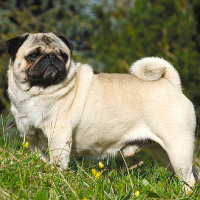
| Decidedly square and cobby, it is "multum in parvo" shown in compactness of form, well knit proportions and hardness of muscle, but never to appear either low on legs, nor lean and leggy. |
Important proportions |
| Decidedly square and cobby. |
Behaviour / temperament |
| Great charm, dignity and intelligence. Even-tempered, happy and lively disposition. |
Head |
||
Cranial region |
||
Head |
Relatively large and in proportion to body, round, not apple-headed. | |
Skull |
With no indentation. Wrinkles on forehead clearly defined without exaggeration. | |
Facial region |
||
Nose |
Black with fairly large well opened nostrils. Pinched nostrils and heavy over nose wrinkle is unacceptable and should be heavily penalised. | |
Muzzle |
Relatively short, blunt, square, not upfaced. Eyes or nose never adversely affected or obscured by over nose wrinkle. | |
Jaws and teeth |
Slightly undershot. Wide lower jaw with incisors almost in a straight line. Wry mouth, teeth or tongue showing all highly undesirable and should be heavily penalised. | |
Eyes |
Dark, relatively large, round in shape, soft and solicitous in expression, very lustrous, and when excited, full of fire. Never protruding, exaggerated or showing white when looking straight ahead. Free from obvious eye problems. | |
Ears |
Thin, small, soft like black velvet. Two kinds – "Rose ear" - small drop-ear which folds over and back to reveal the burr. "Button ear" - ear flap folding forward, tip lying close to skull to cover opening. Preference given to latter. | |
Neck |
| Slightly arched to resemble a crest, strong, thick with enough length to carry head proudly. |
Body |
||
Body |
Short and cobby. Should be hard of muscle. Substance must not be confused with obesity which is unacceptable | |
Topline |
Level, neither roached nor dipping. | |
Chest |
Broad in chest. | |
Ribs |
Ribs well sprung and carried well back. | |
Tail |
| High-set, tightly curled over hip. Double curl highly desirable. |
Limbs |
Forequarters |
||
Shoulders |
Well sloped. | |
Forearm |
Legs very strong, straight, of moderate length, and well under body. | |
Hindquarters |
||
Generality |
Legs very strong, of moderate length, well under body, straight and parallel when viewed from rear. | |
Stifle |
With good turn of stifle. | |
Feet |
| Neither so long as the foot of the hare, nor so round as that of the cat; well split up toes; the nails black. |
Gait and movement |
| Viewed from in front should rise and fall with legs well under shoulder, feet keeping directly to front, not turning in or out. From behind action just as true. Using forelegs strongly putting them well forward with hindlegs moving freely and using stifles well. A slight roll of hindquarters typifies gait. Capable of purposeful and steady movement. |
Coat |
||
Hair |
Fine, smooth, soft, short and glossy, neither harsh, off standing nor woolly. Any stripping or trimming of the coat which alters the length, texture or outline should be penalised. | |
Colour |
Silver, apricot, fawn or black. Each clearly defined, to make contrast complete between colour, trace (black line extending from occiput to tail) and mask. Markings clearly defined. Muzzle or mask, ears, moles on cheeks, thumb mark or diamond on forehead and trace as black as possible. Any other colour or combination of colours unacceptable. |
|
Size and weight |
||
Weight |
Ideal weight 6.3 - 8.1 kgs. Should be hard of muscle but substance must not be confused with overweight. | |
Faults |
| • Any departure from the foregoing points should be considered a fault and the seriousness with which the fault should be regarded should be in exact proportion to its degree and its effect upon the health and welfare of the dog and its ability to perform its traditional work. • Faults listed should be in degree of seriousness. |
Disqualifying faults |
 Aggressive or overly shy. Aggressive or overly shy. |
NB : |
| • Any dog clearly showing physical or behavioural abnormalities shall be disqualified. • The above mentioned faults when occurring to a highly marked degree or frequently are disqualifying. • Male animals should have two apparently normal testicles fully descended into the scrotum. • Only functionally and clinically healthy dogs, with breed typical conformation should be used for breeding. |



 English (United Kingdom)

Comments