 |
Australian Silky Terrier |
|
FCI standard Nº 236 |
||
Origin |
Australia | |
Group |
Group 3 Terriers | |
Section |
Section 4 Toy Terriers | |
Working |
Without working trial | |
Acceptance on a definitive basis by the FCI |
Wednesday 03 October 1962 | |
Publication of the official valid standard |
Monday 08 October 2012 | |
Last update |
Wednesday 05 December 2012 | |
En français, cette race se dit |
 |
Terrier australien à poil soyeux |
Diese Norm ist in deutscher Sprache sichtbar |
 |
Australian Silky Terrier |
En español, esta raza se dice |
 |
Terrier sedoso australiano |
In het Nederlands, wordt dit ras gezegd |
 |
Australische Silky Terrier |
Usage |
| Toy Terrier / companion dog. |
Brief historical summary |
| The two main ancestors of this breed were the Australian Terrier and the Yorkshire Terrier. During the period 1820-1830 a Broken Coated Terrier bitch of a blue sheen colour, which was bred in Tasmania, was taken to England and mated to a Dandy Dinmont Terrier. A Mr Macarthur Little of London purchased some puppies from this litter and experimented with further breeding to produce the soft silky coat. Later Mr Little migrated to Sydney Australia and continued his breeding programme using both Australian Terriers and Yorkshire Terriers. These dogs soon spread though out the Colonies of Australia and the Australian Silky Terrier was establishes as a breed. A standard for the breed was first drawn up in the early 1900’s. |
General appearance |
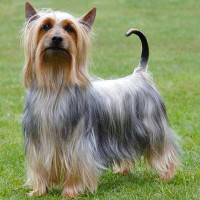
| The dog is compact, moderately low set, of medium length with a refined structure but of sufficient substance to suggest the ability to hunt and kill domestic rodents. The parted, straight silky hair presents a well-groomed appearance. |
Behaviour / temperament |
| It should display Terrier characteristics, embodying keen alertness, activity and soundness. A courageous and dignified Toyterrier, that is second to none as a companion. |
Head |
||
Cranial region |
||
Head |
Of moderate length, slightly shorter from the tip of the nose to between the eyes than from the same position to the occiput. The head must be strong and of Terrier character, being moderately broad between the ears. | |
Skull |
Flat and without fullness between the eyes, with fine silky top-knot, not falling over the eyes, (a long fall of hair on the foreface or cheeks is very objectionable). | |
Stop |
Defined but moderate. | |
Facial region |
||
Nose |
Black. | |
Lips |
Tight and clean. | |
Jaws and teeth |
Strong jaws, teeth even and not cramped, the upper incisors fitting closely over the lower (scissor bite). | |
Eyes |
Shall be small, oval never round or prominent, dark as possible in colour with a keen intelligent expression. | |
Ears |
Should be small, V-shaped with fine leather, set high on the skull, pricked, and entirely free from long hair. | |
Neck |
| Medium length, refined and slightly crested, fitting gracefully into the shoulders. Well covered with long silky hair. |
Body |
||
Body |
Should be moderately long in proportion to the height of the dog. | |
Topline |
Level topline at all times (both standing and moving). | |
Loin |
Strong. | |
Chest |
Of moderate depth and breadth. Ribs well sprung extending back to strong loins. | |
Tail |
| If docked, set on high and carried erect but not over-gay. Should be free of feathering. Undocked: the first three vertebrae to be carried erect or slightly curved but not curved over back. Must not be curled. The length to give an overall balanced appearance. In accordance with the description of the docked tail the undocked tail also to be free of feathering. |
Limbs |
Forequarters |
||
Generality |
The forelegs have refined, round bone and are straight and set well under the body with no weakness in the pasterns. | |
Shoulders |
Fine and well laid back, fitting with well angulated upper arms snugly to the ribs. | |
Elbows |
Turned neither in nor out. | |
Hindquarters |
||
Upper thigh |
Must be well developed. | |
Stifle |
Should be well turned. | |
Hock |
Well bent. When viewed from behind the hocks should be well let down and parallel with each other. | |
Feet |
| Small, well padded, cat-like with closely knit toes, the toenails must be black or very dark. |
Gait and movement |
| The movement should be free and true without slackness at shoulders or elbows, there should be no turning in or out of the feet or pasterns. The hindquarters should have strong propelling power with ample flexibility at stifles and hocks. Viewed from behind the movement should be neither too close nor too wide. |
Coat |
||
Hair |
Must be flat, fine and glossy and of a silky texture. The length of coat must not be so long as to impede the dog’s action and should allow daylight to be seen under the dog. The front and rear feet to be free from long hair. | |
Colour |
All shades of blue and tan are acceptable, the richer these colours and more clearly defined the better. Silver and white not acceptable. Blue on the tail to be very dark. Silver blue or fawn top-knot desirable. Distribution of blue and tan as follows : tan around the base of the ears, muzzle and on the sides of the cheeks; blue from the base of the skull to tip of tail, running down the forelegs to near the wrists and down the thighs to the hocks; tan line showing down the stifles and from the wrists and hocks to the toes and around the vent. The blue body colour must be free from tan or bronzing. Tan markings must be free from smuttiness. Black colouring is permissible in puppies, blue colour must be established by 18 months of age. | |
Size and weight |
||
Height at withers |
Males : 23 to 26 cms. Females can be slightly less. | |
Weight |
Weight in proportion to height. | |
Faults |
| • Any departure from the foregoing points should be considered a fault and the seriousness with which the fault should be regarded should be in exact proportion to its degree and its effect upon the health and welfare of the dog and its ability to perform its traditional work. • Faults listed should be in degree of seriousness. |
Serious faults |
 Topline showing roach or dip. Topline showing roach or dip. |
Disqualifying faults |
| Aggressive or overly shy dogs. |
NB : |
| • Any dog clearly showing physical or behavioural abnormalities shall be disqualified. • The above mentioned faults when occurring to a highly marked degree or frequently are disqualifying. • Male animals should have two apparently normal testicles fully descended into the scrotum. • Only functionally and clinically healthy dogs, with breed typical conformation should be used for breeding. |
Bibliography |
| https://www.fci.be/ |



 English (United Kingdom)

Comments