 |
Japanese Spaniel |
|
FCI standard Nº 206 |
||
Origin |
China | |
Translation |
Revised by Renée Sporre-Willes | |
Group |
Group 9 Companion and Toy Dogs | |
Section |
Section 8 Japan Chin and Pekingese | |
Working |
Without working trial | |
Acceptance on a definitive basis by the FCI |
Monday 02 December 1957 | |
Publication of the official valid standard |
Monday 04 April 2016 | |
Last update |
Friday 03 June 2016 | |
En français, cette race se dit |
 |
Epagneul japonais |
Diese Norm ist in deutscher Sprache sichtbar |
 |
Japanische Spaniel |
En español, esta raza se dice |
 |
Spaniel japonés |
In het Nederlands, wordt dit ras gezegd |
 |
Japanse Spaniel |
In his country of origin, his name is |
Chin |
Usage |
| Companion dog. |
Brief historical summary |
| According to ancient documents it is assumed that the ancestors of the Chin were presented as a gift from the rulers of Korea (during the Silla Dynasty age 377-935) to the Japanese court in 732. For a successive 100 years, there appears to have been a large number of Chins coming into Japan. Historical records also indicate that envoys sent to China (during the Tung Dynasty age 618-910) and North Korea (during the Po H’ai Dynasty age 698-926) brought back dogs of this breed directly. During the reign of the Shogunate Tsunayoshi Tokugawa (1680-1709) the breed was raised as an indoor toy dog in the Castle of Edo. In 1613 a Britisher, Captain Searles, brought a Chin to England and in 1853 Commodore Perry from the U.S. brought several to the U.S. of which two were presented to Queen Victoria of England. Since 1868, the Chin has been favored as a lapdog by ladies of the upper classes, and currently is being widely spread as a companion dog. |
General appearance |
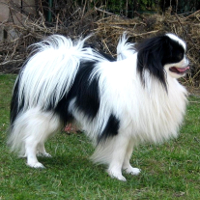
| Small sized dog with broad face, covered with profuse coat, with elegant and graceful figure. |
Important proportions |
| The ratio of height at withers to length of the body is equal. The body of bitches slightly longer. |
Behaviour / temperament |
| Clever, mild and lovely. |
Head |
||
Cranial region |
||
Skull |
Broad and rounded. | |
Stop |
Deep and indented. | |
Facial region |
||
Nose |
Nasal bridge very short and wide, the nose on a straight line with the eyes; the nose colour black or deep flesh colour, according to dog’s markings. Well opened nostrils. | |
Jaws and teeth |
Teeth white and strong; level bite desirable, but scissor bite or undershot mouth permitted. | |
Eyes |
Large, round, set wide apart and lustrous black in colour. | |
Ears |
Long, triangular, hanging, covered with long hair; set wide apart. | |
Neck |
| Rather short, and held high. |
Body |
||
Back |
Short and straight. | |
Loin |
Broad and slightly round. | |
Chest |
Moderately broad and deep, with ribs moderately sprung. | |
Underline and belly |
Belly well drawn up. | |
Tail |
| Covered with beautiful, profuse and long hair, being carried up over back. |
Limbs |
Forequarters |
||
Forearm |
Forearms straight, fine boned; backside of forearms below the elbows feathered. | |
Hindquarters |
||
Generality |
Hindlegs moderately angulated, rear of the rump covered with feather. | |
Feet |
| Small and hare-shaped, preferably feathered between the toes. |
Gait and movement |
| Elegant, light and proud. |
Coat |
||
Hair |
Silky, straight and long. Whole body except face covered with profuse hair. The ears, neck, thighs and tail have profuse feather. | |
Colour |
White with markings of black or red. Markings symmetrically distributed from around eyes over ears as on whole body desirable. Especially white and wide blaze from muzzle to crown desirable. | |
Size and weight |
||
Height at withers |
Dogs approximately 25 cm. Bitches slightly smaller than dogs. | |
Faults |
| • Any departure from the foregoing points should be considered a fault and the seriousness with which the fault should be regarded should be in exact proportion to its degree and its effect upon the health and welfare of the dog and its ability to perform its traditional work. • Faults listed should be in degree of seriousness. |
General faults |
 Nose : Any colour other than black for white dogs with black markings. Overshot mouth, wry underjaw. Solid white coat with no markings; single marking on face. Shyness. Nose : Any colour other than black for white dogs with black markings. Overshot mouth, wry underjaw. Solid white coat with no markings; single marking on face. Shyness. |
Disqualifying faults |
| Aggressive or overly shy dogs. Wry lower jaw. Tricolour. |
NB : |
| • Any dog clearly showing physical or behavioural abnormalities shall be disqualified. • The above mentioned faults when occurring to a highly marked degree or frequently are disqualifying. • Male animals should have two apparently normal testicles fully descended into the scrotum. • Only functionally and clinically healthy dogs, with breed typical conformation should be used for breeding. |
Bibliography |
| https://www.fci.be/ |



 English (United Kingdom)

Comments