Poodle

FCI standard Nº 172

Effective from 01/08/2024
Origin
France
Translation
Jennifer Mulholland, in collaboration with Raymond Triquet
Group
Group 9 Companion and Toy dogs
Section
Section 2 Poodle
Working
Without working trial
Acceptance on a definitive basis by the FCI
Saturday 01 January 1955
Publication of the official valid standard
Wednesday 20 March 2024
Last update
Friday 05 April 2024
En français, cette race se dit
Caniche
Diese Norm ist in deutscher Sprache sichtbar
Pudel
En español, esta raza se dice
Caniche
In het Nederlands, wordt dit ras gezegd
Poedel

Usage

Companion dog

Brief historical summary

Etymologically, the French word "caniche" (Poodle) comes from "cane", the French word for a female duck. In other countries, the name of the breed is associated with splashing around in water. Originally, this dog was used for wildfowling. It descends from the Barbet of which it has conserved many characteristics. In 1743, it was called the "caniche": the female of the barbet in French. Thereafter the Barbet and the Caniche (Poodle) were gradually separated. Breeders worked hard to obtain original subjects of uniform colour. The Poodle became very popular as a companion dog because of its friendly, joyful and loyal character and also because of its four sizes and different colours which everyone can choose according to preference.

General appearance

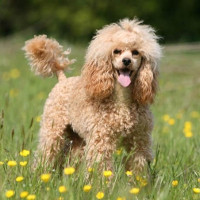
Dog of medium proportions, with a characteristic frizzy coat which is either curly or corded. The appearance is that of an intelligent dog, constantly alert and active, harmoniously built, giving an impression of elegance and pride.

Important proportions

• The length of the muzzle is approximately 9/10ths of that of the skull.
• The length of the body (scapular ischial) is slightly superior to the height at withers.
• The height at withers is practically equal to the height at the croup.
• The height at the elbow is 5/9ths of the height at withers.

Behaviour / temperament

A dog renowned for its loyalty, capable of learning and being trained thus making it a particularly pleasant companion dog.

Head

Cranial region

Head
Distinguished, rectilinear and in proportion to the body. The head must be well chiselled and neither heavy nor excessively fine.
Skull
Skull: Its width is less than half the length of the head. The entire skull, seen from above, appears oval and seen from the side slightly convex. The axes of skull and muzzle are slightly divergent.
Superciliary arches: Moderately pronounced and covered with long hair.
Frontal furrow: Wide between the eyes, narrowing towards the occiput ,which is very pronounced. (In Miniatures it can be slightly less pronounced). 
Stop
Only slightly pronounced.

Facial region

Nose
Developed, vertical profile; open nostrils. Black nose in black, white and grey subjects; in two-coloured black, two-coloured grey, black and fawn and in tricoloured subjects; brown nose in brown subjects, in two-coloured brown and brown and fawn. In fawn (apricot/red) and in two-coloured fawn subjects, the nose should be black or brown according to the intensity of the fawn colour. In light fawn subjects the nose should be as dark as possible.
Muzzle
Upper profile is perfectly straight; its length is approximately 9/10ths of that of the skull. The branches of the lower jaw are almost parallel. The muzzle is strong. The lower profile of the muzzle is determined by the lower jaw and not by the edge of the upper lip.
Lips
Moderately developed, rather tight, of medium thickness with the upper lip resting on the lower lip without hanging over it. Black in black, white and grey subjects; brown in brown subjects. In orange fawn (apricot) and red fawn subjects, the lips are more or less dark brown or black. The corner of the lips must not be pronounced.
Jaws and teeth
Scissor bite. Strong teeth.
Cheeks
Not prominent, shaped on the bones. The sub-orbital regions are chiselled and very slightly filled. Zygomatic arches very slightly pronounced.
Eyes
Keen expression, placed at the level of the stop and slightly oblique. Almond shaped. Black or dark brown colour. In brown subjects the colour may be dark amber.
Eyelids: The rims are black in black, white and grey subjects. In orange fawn (apricot) or red fawn subjects they may be brown or black.
Ears
Rather long, falling along the cheeks, set on in the prolongation of a line going from the top of the nose and passing under the outer corner of the eye; flat, widening after the attachment and rounded at the tip, they are covered with very long, wavy hair. The leather should reach the corner of the lips.

Neck

Strong ,slightly arched after the nape, of medium length and well porportioned. The head is carried high and proudly. The neck, without dewlap, is of oval cross section. Its length is slightly less than that of the head.

Body

Body
Well porprotioned. The length is slightly superior to height at withers.
Withers
Moderately developed.
Back
Short. Topline harmonious and taut. The height at withers is practically equal to the height from the top of the croup to the ground.
Loin
Firm and muscled.
Croup
Rounded but not falling away.
Chest
Reaching the elbow; its width is equal to 2/3 of depth. In Standard Poodles, the perimeter of the thorax, measured behind the shoulders, should be superior by 10 cms to the height at withers. Oval cross section, broad at dorsal part.
Side
Belly and Flanks tucked up but not excessively so.
Underline and belly
The point of the sternum should be slightly prominent and set rather high.

Tail

Set on quite high at the level of the loin (ideally carried at “ten past nine” compared to the topline). Tail docking is no longer authorized.

Limbs

Forequarters

Generality
Perfectly upright and parallel, well muscled with good bone. The height from the elbow to the ground is slightly more than half the height at withers.
Shoulders
Sloping, muscular. The shoulder blade forms an angle of approximately 110° to the humerus.
Upper arm
The length of the humerus corresponds to that of the shoulder blade.
Carpal
In continuous line with front of forearm.
Pastern
Strong and almost upright seen in profile.
Forefeet
Rather small, firm, of short oval shape. Toes are well arched and tight fitting. The pads are hard and thick. The nails are black in black and grey subjects. They are black or brown in brown subjects. In whites the nails may be any colour in the range from horn colour to black. In the fawns they are brown or black; according to coat colour, as dark as possible

Hindquarters

Generality
Hind legs parallel seen from behind; muscles developed and very apparent. The hock joint is relatively well angulated; the coxal-femoral, tibial-femoral and tibial-tarsal angles should be pronounced.
Upper thigh
Well muscled and strong.
Metatarsus
Rather short and upright. The Poodle should be born without dewclaws on the hind legs.
Hind feet
Rather small, firm, of short oval shape. Toes are well arched and tight fitting. The pads are hard and thick. The nails are black in black and grey subjects. They are black or brown in brown subjects. In whites the nails may be any colour in the range from horn colour to black. In the fawns they are brown or black, according to coat colour, as dark as possible.

Gait and movement

The Poodle has a light and springy gait.

Skin

Supple, not loose, pigmented.
Black, brown, grey and orange fawn or red fawn Poodles must be pigmented in accordance with the colour of their coat. In white Poodles, a silver coloured skin is sought after.

Coat

Hair
Curly Coats : Profuse of fine, woolly texture, very frizzy, elastic and resistant to pressure of the hand. It should be thick, well furnished, of equal length and form even curls.
Corded Coats : Profuse of fine, woolly texture and dense, forming characteristic cords which should measure at least 20 cm.
Colour
Solid colours :
Black, white, brown.
Brown should be deep, rather dark, uniform and warm.
Any white marking in black and brown coats is highly undesirable.

Grey, fawn Beige and its paler derivatives are not admitted. Grey must be uniform, deep, neither blackish nor whitish, but depending on age may present some shades of grey. Fawn must be uniform. Can go from pale fawn to red fawn or even be orange fawn (apricot). Eyelids, nose, lips, gums, palate, natural orifices, scrotum and pads are well pigmented.
For light fawn subjects, all pigmentation should be as dark as possible. Any white marking in grey and fawn coats is highly undesirable.

Other colours :
Parti-coloured dogs, two colours
Predominance of white colour, with the other being distributed irregularly :
Black and white.
Blue/grey and white.
Fawn and white.
Brown and white.
(Some patches can appear on the white parts on the legs or the body, but they are not sought after)

Predominance of a clear colour with white parts on the legs, forechest and sometimes a mask on the muzzle and/or tip of the tail (dogs with mantle, tuxedo)
Brown coloured back
Black coloured back

Dogs with fawn coat colour : (predominance of one colour, with clearly defined fawn markings of a clear fawn colour) :

Brown with fawn markings
Black with fawn markings

Mandatory fawn markings :
• above each eye
• on the cheeks and inside the ears

• on the side of the muzzle
• at the end of each limb and inside
• on the chest, around the scrotum in males and around the vulva in females
Fawn markings should not be charcoal or too pale.
Any white marking is highly undesirable.

Tricoloured :
Black, white and marked with fawn. Fawn markings present at least on the eyebrows and around the scrotum in males and on the vulva in females.

Other pluricoloured dogs :
Brindle and white
Brindle

Size and weight

Height at withers
• Standard Poodles: Over 45 cm up to 60 cm with a tolerance of +2 cm. The Standard Poodle must be the enlarged and developed replica of the Medium Poodle of which it retains the same characteristics.
• Medium Poodles: Over 35 cm up to 45 cm.
• Miniature Poodles: Over 28 cm up to 35 cm. The Miniature Poodle must display the apprearance of a reduced Medium Poodle, retaining as much as possible the same proportions and without presenting any sign of dwarfism.
• Toy Poodles: Over 24 cm up to 28 cm (sought after ideal: 25 cm) (with a tolerance of -1 cm). The Toy Poodle maintains, in its ensemble, the aspect of a Miniature Poodle and the same general proportions complying with all the points of the standard. Any sign of dwarfism is excluded; only the occipital protuberance may be less pronounced.

Faults

• Any departure from the foregoing points should be considered a fault and the seriousness with which the fault should be regarded should be in exact proportion to its degree and its effect upon the health and welfare of the dog and its ability to perform its traditional work.
• Faults listed should be in degree of seriousness.

General faults

 Roach or sway back.
 Tail set on too low.
 Too restless subject.
 Absence of 2PM1 is not taken into account.
 Absence of one or two PM2, if symmetrical.
 Absence of M3 is not taken into account.

Serious faults

 Partially depigmented nose.
 Snipey nose.
 Pointed muzzle.
 Arched bridge of nose.
 Absence of two PM2 if not symmetrical.
 Eyes too big or sunken, not dark enough.
 Ears too short.
 Croup falling away.
 Tail curved over the back.
 Rear anuglations too straight.
 Flowing or extended gait.
 Sparse, soft or harsh hair.
 Colour not clearly defined or not uniform: blackish grey or whitish grey, washed out fawn, cream, beige in browns or very dark brown.
 Subjects with solid coloured coat : undefined or not solid colour.

Disqualifying faults

 Aggressive or overly shy.
 Nose completely depigmented.
 Lack of type, particularly in head.
 Overshot or undershot.
 Absence of 1 incisor or 1 canine or 1 carnassial (P4 upper jaw, M1 lower jaw).
 Absence of one PM3 or of one PM4.
 Absence of three or more PM (except PM1).
 Absence of tail or naturally short tail.
 Dewclaws or evidence of dewclaws on rear limbs.
 Coat which is not solid colour.
 White marks.
 White hairs on feet.
 Height exceeding 62 cm in Standards and inferior to 23 cm in Toys.
 Any subject displaying signs of dwarfism, globulous skull, absence of occipital protuberance, very pronounced stop, prominent eyes muzzle too short and turned up, receding chin.
 Median furrow practically inexistant.
 Very light bone in Toys.
 Tail curled with the tip falling over the flank or the croup.
 For dogs with solid colour : any white marking on body and/or legs for all subjects other than the white ones.
 For dogs of another colour :
o Dogs with coat of one colour, with a single isolated mark (mismarking).

o Lack of harmony in the distribution of colours on the head.
o White patch surrounding the eye (pirate marking).
o White patch surrounding both eyes.

Important

Addition to standard
Judging a Poodle in a show does not mean it is judged in a grooming contest. It is not encouraged to stimulate over-grooming one’s dog.

AUTHORIZED SHOW CLIPS

The wearing of a moustache is authorized in all clips.

“Lion Clip” : The Poodle, whether curly or corded, shall be clipped on the hindquarters up to the ribs.
Also clipped : the muzzle, above and underneath from the lower eyelids; the cheeks; the forelegs and hindlegs, except for the cuffs or bracelets and optional motifs on the hindquarters; the tail, except for round or oblong terminal pompom. A moustache is required for all subjects. Leaving hair, called “trousers”, on the forelegs is admitted.

“Modern Clip” : Leaving hair on all four legs is only admitted on condition that the following norms are respected :
1.Shall be clipped :
a) The lower part of the forelegs, from the nails to the tip of the dewclaw, the lower part of the hindlegs to the same height. Machine clipping, limited to the toes only, is admitted.
b) The head and the tail in compliance with rules described above.
Shall be exceptionally admitted in this clip :
• The presence, under the lower jaw, of short hair no longer than 1cm the lower line of which should be cut parallel to the lower jaw. A beard, called “goat’s beard”, is not permitted.
• The suppression of the pompom on the tail.
2. Shortened coat :
Over the body, in order to give “shot silk” effect on the line of the back, more or less long but at least 1cm. The length shall be gradually increased over the ribs and above the limbs.
3. Neatened coat :
a) On the head which keeps a topknot of reasonable height as well as down behind the neck to the withers and the front, without discontinuity, to the shaven part of the foot following a slightly slanting line from the top of the forechest downwards. On the top of the ears and for a maximum of one third of their length, the coat may be cut with scissors or clipped in the direction of the hair. The lower part shall be left covered in hair whose length shall increase gradually, from top to bottom, to end in fringes which may be levelled.
b) On the limbs, “trousers” making a distinct transition from the shaven part of the feet. The length of the hair increases gradually towards the top to display, on the shoulder and likewise the thigh, a length of 4 to 7 cm measured by pulling the hair to straighten it, in proportion to the size of the exhibit while avoiding any “fluffy” effect. The hind “trousers” must allow for the typical angulation of the Poodle to be seen.
All other fancy clips which do not comply with these norms are eliminatory. Whatever the standard outline obtained by grooming, it should have no influence whatsoever on the placements in shows, all exhibits in the same class should be judged and placed together.

“English Clip” :
To the “Lion Clip” add motifs on the hindquarters, i.e. bracelets and cuffs. On the head: a topknot. For this clip the moustache is optional. The absence of demarcation on the hair of the hindquarters is tolerated. The topknot is optional (it is forbidden to use lacquer or any other substance to keep the topknot in place).

“Puppy Clip” :
Takes over the several shaven parts which characterize the Modern clip. On the head: a topknot of a reasonable height. The coat on the forequarters should form a ball, comparable to an ‘egg’ seen from the forechest up to the topknot. The so-called ‘trousers’ on the forequarters is preserved, accentuating the typical poodle angulation.
The tail – save for a pompon – should have an oval or oblong shape.
It should be clipped longer than wide with rounded angles.

“Scandinavian clip or Terrier clip” :
The clip is similar to that of the Modern clip, the difference being that the ears and tail may be shaven.

NB :

• Any dog clearly showing physical or behavioural abnormalities shall be disqualified.
• The above mentioned faults when occurring to a highly marked degree or frequently are disqualifying.
• Male animals should have two apparently normal testicles fully descended into the scrotum.
• Only functionally and clinically healthy dogs, with breed typical conformation should be used for breeding.

Bibliography

https://www.fci.be/

Comments

Latest page updates

  • Yorkshire Terrier

    Yorkshire Terrier FCI Standard No. 86 Origin Great Britain Group Group 3 Terriers Section Section 4 Toy Terriers Working Without working trial Date of acceptance on a definitive basis by the FCI Saturday 30 October 1954 Date of publication of the official valid standard Tuesday 08 September 2026 Date of the last update Tuesday 06 October 2026 En...
  • West Highland White Terrier

    West Highland White Terrier FCI Standard No. 85 Origin Great Britain Group Group 3 Terriers Section Section 2 Small-sized Terriers Working Without working trial Date of acceptance on a definitive basis by the FCI Friday 29 October 1954 Date of publication of the official valid standard Tuesday 08 September 2026 Date of the last update Tuesday 06...
  • Welsh Terrier

    Welsh Terrier FCI Standard No. 78 Origin Great Britain Group Group 3 Terriers Section Section 1 Large- and medium sized Terriers Working Without working trial Date of acceptance on a definitive basis by the FCI Saturday 23 October 1954 Date of publication of the official valid standard Tuesday 08 September 2026 Date of the last update Tuesday 06...
  • Welsh Springer Spaniel

    Welsh Springer Spaniel FCI Standard No. 126 Origin Great Britain Group Group 8 Retrievers-Flushing Dogs-Water Dogs Section Section 2 Flushing Dogs Working With working trial Date of acceptance on a definitive basis by the FCI Thursday 30 December 1954 Date of publication of the official valid standard Tuesday 08 September 2026 Date of the last...
  • Welsh Corgi Pembroke

    Welsh Corgi Pembroke FCI Standard No. 39 Origin Great Britain Group Group 1 Sheepdogs and Cattle Dogs (except Swiss Cattle Dogs) Section Section 2 Cattledogs (except Swiss Cattledogs) Working Without working trial Date of acceptance on a definitive basis by the FCI Wednesday 13 November 1963 Date of publication of the official valid standard Tuesday 08...
  • Welsh Corgi Cardigan

    Welsh Corgi Cardigan FCI Standard No. 38 Origin Great Britain Group Group 1 Sheepdogs and Cattle Dogs (except Swiss Cattle Dogs) Section Section 2 Cattledogs (except Swiss Cattledogs) Working Without working trial Date of acceptance on a definitive basis by the FCI Tuesday 12 November 1963 Date of publication of the official valid standard Tuesday 08...
  • Sussex Spaniel

    Sussex Spaniel FCI Standard No. 127 Origin Great Britain Group Group 8 Retrievers, Flushing dogs, Water dogs. Section Section 2 Flushing dogs Working With working trial Date of acceptance on a definitive basis by the FCI Friday 31 December 1954 Date of publication of the official valid standard Tuesday 08 September 2026 Date of the last update Tuesday 06...
  • Staffordshire Bull Terrier

    Staffordshire Bull Terrier FCI Standard No. 76 Origin Great Britain Group Group 3 Terriers Section Section 3 Bull type Terriers Working Without working trial Date of acceptance on a definitive basis by the FCI Thursday 21 October 1954 Date of publication of the official valid standard Tuesday 08 September 2026 Date of the last update Tuesday 06...
  • Skye Terrier

    Skye Terrier FCI Standard No. 75 Origin Great Britain Group Group 3 Terriers Section Section 2 Small-sized Terriers Working Without working trial Date of acceptance on a definitive basis by the FCI Wednesday 20 October 1954 Date of publication of the official valid standard Tuesday 08 September 2026 Date of the last update Tuesday 06 October 2026 En...
  • Shetland Sheepdog

    Shetland Sheepdog FCI Standard No. 88 Origin Great Britain Group Group 1 Sheepdogs and Cattle Dogs Section Section 1 Sheepdogs Working Without working trial Date of acceptance on a definitive basis by the FCI Tuesday 09 November 1954 Date of publication of the official valid standard Tuesday 08 September 2026 Date of the last update Tuesday 06...
  • Sealyham Terrier

    Sealyham Terrier FCI Standard No. 74 Origin Great Britain Group Group 3 Terriers Section Section 2 Small sized Terriers Working Without working trial Date of acceptance on a definitive basis by the FCI Tuesday 19 October 1954 Date of publication of the official valid standard Tuesday 08 September 2026 Date of the last update Tuesday 06 October...
  • Scottish Terrier

    Scottish Terrier FCI Standard No. 73 Origin Great Britain Group Group 3 Terriers Section Section 2 Small-sized Terriers Working Without working trial Date of acceptance on a definitive basis by the FCI Monday 18 October 1954 Date of publication of the official valid standard Tuesday 08 September 2026 Date of the last update Tuesday 06 October...
  • Old English Sheepdog (Bobtail)

      Old English Sheepdog (Bobtail) FCI Standard No. 16     Origin   Great Britain Group   Group 1 Sheepdogs and Cattle Dogs (except Swiss Cattle Dogs) Section   Section 1 Sheepdogs Working   Without working trial Date of acceptance on a definitive basis by the FCI   Monday 25 November 1963 Date of publication of the official valid standard   Tuesday 08 September...
  • Norwich Terrier

    Norwich Terrier FCI Standard No. 72 Origin Great Britain Group Group 3 Terriers Section Section 2 Small-sized Terriers Working Without working trial Date of acceptance on a definitive basis by the FCI Saturday 16 October 1954 Date of publication of the official valid standard Tuesday 08 September 2026 Date of the last update Tuesday 06 October...
  • Norfolk Terrier

    Norfolk Terrier FCI Standard No. 272 Origin Great Britain Group Group 3 Terriers Section Section 2 Small-sized Terriers Working Without working trial Date of acceptance on a definitive basis by the FCI Saturday 01 October 1966 Date of publication of the official valid standard Tuesday 08 September 2026 Date of the last update Tuesday 06 October...
  • Manchester Terrier

    Manchester Terrier FCI Standard No. 71 Origin Great Britain Group Group 3 Terriers Section Section 1 Large and medium sized Terriers Working Without working trial Date of acceptance on a definitive basis by the FCI Friday 15 October 1954 Date of publication of the official valid standard Tuesday 08 September 2026 Date of the last update Tuesday 06 October...
  • Lakeland Terrier

    Lakeland Terrier FCI Standard No. 70 Origin Great Britain Group Group 3 Terriers Section Section 1 Large and medium-sized Terriers Working Without working trial Date of acceptance on a definitive basis by the FCI Thursday 14 October 1954 Date of publication of the official valid standard Tuesday 08 September 2026 Date of the last update Tuesday 06 October...
  • Labrador Retriever

      Labrador Retriever FCI Standard No. 122     Origin   Canada Group   Group 8 Retrievers, Flushing dogs, Water dogs Section   Section 1 Retrievers Working   With working trial Date of acceptance on a definitive basis by the FCI   Friday 24 December 1954 Date of publication of the official valid standard   Tuesday 08 September 2026 Date of the last update   Tuesday 06...
  • King Charles Spaniel

    King Charles Spaniel FCI Standard No. 128 Origin Great Britain Group Group 9 Companion and Toy Dogs Section Section 7 English Toy Spaniels Working Without working trial Date of acceptance on a definitive basis by the FCI Monday 03 January 1955 Date of publication of the official valid standard Tuesday 08 September 2026 Date of the last update Tuesday 06...
  • Harrier

      Harrier FCI Standard No. 295     Origin   Great Britain Translation   Mrs. Peggy Davis, brought up to day by Dr. Paschoud Group   Group 6 Scenthounds and related breeds Section   Section 1.2 Medium-sized Hounds Working   With working trial Date of acceptance on a definitive basis by the FCI   Wednesday 27 November 1974 Date of publication of the official valid...
  • Greyhound

    Greyhound FCI Standard No. 158 Origin Great Britain Group Group 10 Sighthounds Section Section 3 Short-haired sighthounds Working Without working trial Date of acceptance on a definitive basis by the FCI Saturday 23 April 1955 Date of publication of the official valid standard Tuesday 08 September 2026 Date of the last update Tuesday 06 October...
  • Gordon Setter

    Gordon Setter FCI Standard No. 6 Origin Great Britain Group Group 7 Pointing Dogs Section Section 2.2 British and Irish Pointers and Setters; Setters Working With working trial Date of acceptance on a definitive basis by the FCI Tuesday 28 May 1963 Date of publication of the official valid standard Tuesday 08 September 2026 Date of the last...
  • Golden Retriever

    Golden Retriever FCI Standard No. 111 Origin Great Britain Group Group 8 Retrievers, Flushing Dogs, Water Dogs Section Section 1 Retrievers Working With working trial Date of acceptance on a definitive basis by the FCI Thursday 02 December 1954 Date of publication of the official valid standard Tuesday 28 July 2009 Date of the last update Wednesday...
  • Fox Terrier Wire

    Fox Terrier Wire FCI Standard No. 169 Origin Great Britain Group Group 3 Terriers Section Section 1 Large and medium-sized Terriers Working Working trial optional Date of acceptance on a definitive basis by the FCI Friday 13 May 1955 Date of publication of the official valid standard Tuesday 08 September 2026 Date of the last update Tuesday 06...
  • Fox Terrier Smooth

    Fox Terrier Smooth FCI Standard No. 12 Origin Great Britain Group Group Terriers Section Section 1 Large and medium sized Terriers Working Working trial optional Date of acceptance on a definitive basis by the FCI Wednesday 26 June 1963 Date of publication of the official valid standard Tuesday 08 September 2026 Date of the last update Tuesday 06...
  • Flat Coated Retriever

    Flat Coated Retriever FCI Standard No. 121 Origin Great Britain Group Group 8 Retrievers-Flushing Dogs-Water Dogs Section Section 1 Retrievers Working With working trial Date of acceptance on a definitive basis by the FCI Thursday 23 December 1954 Date of publication of the official valid standard Tuesday 08 September 2026 Date of the last update Tuesday...
  • Field Spaniel

    Field Spaniel FCI Standard No. 123 Origin Great-Britain Group Group 8 Retrievers, Flushing Dogs, Water Dogs Section Section 2 Flushing Dogs Working With working trial Date of acceptance on a definitive basis by the FCI Monday 27 December 1954 Date of publication of the official valid standard Tuesday 08 September 2026 Date of the last update Tuesday...
  • English Toy Terrier

    English Toy Terrier FCI Standard No. 13 Origin Great Britain Group Group 3 Terriers Section Section 4 Toy Terriers Working Without working trial Date of acceptance on a definitive basis by the FCI Tuesday 17 September 1963 Date of publication of the official valid standard Tuesday 08 September 2026 Date of the last update Tuesday 06 October 2026 En...
  • English Springer Spaniel

    English Springer Spaniel FCI Standard No. 125 Origin Great Britain Group Group 8 Retrievers-Flushing Dogs-Water Dogs Section Section 2 Flushing Dogs Working With working trial Date of acceptance on a definitive basis by the FCI Wednesday 29 December 1954 Date of publication of the official valid standard Tuesday 08 September 2026 Date of the last...
  • English Setter

    English Setter FCI Standard No. 2 Origin Great Britain Group Group 7 Pointing Dogs Section Section 2.2 British and Irish Pointers and Setters, Setter Working With working trial Date of acceptance on a definitive basis by the FCI Wednesday 06 March 1963 Date of publication of the official valid standard Tuesday 08 September 2026 Date of the last...
  • English Pointer

    English Pointer FCI Standard No. 1 Origin Great Britain Group Group 7 Pointing Dogs Section Section 2.1 British and Irish Pointers and Setters, Pointer Working With working trial Date of acceptance on a definitive basis by the FCI Tuesday 05 March 1963 Date of publication of the official valid standard Tuesday 08 September 2026 Date of the last...
  • English Foxhound

    English Foxhound FCI Standard No. 159 Origin Great Britain Group Group 6 Scenthounds and related breeds Section Section 1.1 Large-sized Scent hounds Working With working trial Date of acceptance on a definitive basis by the FCI Monday 25 April 1955 Date of publication of the official valid standard Thursday 26 March 2009 Date of the last update Wednesday...
  • English Cocker Spaniel

    English Cocker Spaniel FCI Standard No. 5 Origin Great Britain Group Group 8 Retrievers, Flushing Dogs, Water Dogs Section Section 2 Flushing dogs Working With working trial Date of acceptance on a definitive basis by the FCI Wednesday 10 April 1963 Date of publication of the official valid standard Tuesday 08 September 2026 Date of the last...
  • Tibetan Mastiff

    Tibetan Mastiff FCI Standard No. 230 Origin Tibet (China)Patronage FCI Group Group 2 Pinscher and Schnauzer- Molossoid breeds- Swiss Mountain and Cattle Dogs Section Section 2.2 Molossoid breeds, Mountain type Working Without working trial Date of acceptance on a definitive basis by the FCI Tuesday 22 August 1961 Date of publication of the...
  • Deerhound

    Deerhound FCI Standard No. 164 Origin Great Britain Group Group 10 Sighthounds Section Section 2 Rough-haired Sighthounds Working Without working trial Date of acceptance on a definitive basis by the FCI Friday 29 April 1955 Date of publication of the official valid standard Tuesday 08 September 2026 Date of the last update Tuesday 06 October...
  • Dandie Dinmont Terrier

    Dandie Dinmont Terrier FCI Standard No. 168 Origin Great Britain Group Group 3 Terriers Section Section 2 Small-sized Terriers Working Without working trial Date of acceptance on a definitive basis by the FCI Thursday 12 May 1955 Date of publication of the official valid standard Tuesday 08 September 2026 Date of the last update Tuesday 06...
  • Curly Coated Retriever

    Curly Coated Retriever FCI Standard No. 110 Origin Great Britain Group Group 8 Retrievers, Flushing Dogs, Water Dogs Section Section 1 Retrievers Working With working trial Date of acceptance on a definitive basis by the FCI Friday 10 December 1954 Date of publication of the official valid standard Tuesday 08 September 2026 Date of the last...
  • Collie Smooth

    Collie Smooth FCI Standard No. 296 Origin Great Britain Group Group 1 Sheepdogs and Cattle Dogs (except Swiss Cattle Dogs) Section Section 1 Sheepdogs Working Without working trial Date of acceptance on a definitive basis by the FCI Wednesday 18 December 1974 Date of publication of the official valid standard Tuesday 08 September 2026 Date of the...
  • Collie Rough

    Collie Rough FCI Standard No. 156 Origin Great Britain Group Group 1 Sheepdogs and Cattle Dogs (except Swiss Cattle Dogs) Section Section 1 Sheepdogs Working Without working trial Date of acceptance on a definitive basis by the FCI Wednesday 13 April 1955 Date of publication of the official valid standard Tuesday 08 September 2026 Date of the...
  • Clumber Spaniel

    Clumber Spaniel FCI Standard No. 109 Origin Great Britain Group Group 8 Retrievers, Flushing dogs, Water dogs Section Section 2 Flushing dogs Working With working trial Date of acceptance on a definitive basis by the FCI Thursday 09 December 1954 Date of publication of the official valid standard Tuesday 08 September 2026 Date of the last update Tuesday...
  • Chow Chow

    Chow Chow FCI Standard No. 205 Origin China, patronage : Great Britain Group Group 5 Spitz and primitive type Section Section 5 Asian Spitz and related breeds Working Without working trial Date of acceptance on a definitive basis by the FCI Tuesday 10 December 1957 Date of publication of the official valid standard Tuesday 08 September 2026 Date...
  • Chinese Crested Dog

    Chinese Crested Dog FCI Standard No. 288 Origin China, patronage Great Britain Group Group 9 Companion and Toy Dogs Section Section 4 Hairless breeds Working Without working trial Date of acceptance on a definitive basis by the FCI Monday 17 July 1972 Date of publication of the official valid standard Tuesday 08 September 2026 Date of the last...
  • Cairn Terrier

    Cairn Terrier FCI Standard No. 4 Origin Great Britain Group Group 3 Terriers Section Section 2 Small-sized Terriers Working Without working trial Date of acceptance on a definitive basis by the FCI Saturday 06 April 1963 Date of publication of the official valid standard Tuesday 08 September 2026 Date of the last update Tuesday 06 October 2026 En...
  • Bullmastiff

    Bullmastiff FCI Standard No. 157 Origin Great Britain Group Group 2 Pinscher and Schnauzer Molossoid breeds - Swiss Mountain and Cattle Dogs Section Section 2.1 Molossoid breeds, Mastiff Type Working Without working trial Date of acceptance on a definitive basis by the FCI Saturday 23 April 1955 Date of publication of the official valid standard Tuesday...
  • English Bulldog

    English Bulldog FCI Standard No. 149 Origin Great Britain Group Group 2 Pinscher and Schnauzer Molossoid breeds-Swiss Mountain and Cattle Dogs Section Section 2.1 Molossoid breeds, Mastiff Type Working Without working trial Date of acceptance on a definitive basis by the FCI Monday 14 March 1955 Date of publication of the official valid standard Tuesday...
  • Bull Terrier

    Bull Terrier FCI Standard No. 11 Origin Grande-Bretagne Group Group 3 Terriers Section Section 3 Bull type Terriers Working Working trial optional Date of acceptance on a definitive basis by the FCI Saturday 26 June 1993 Date of publication of the official valid standard Tuesday 08 September 2026 Date of the last update Tuesday 06 October 2026 En...
  • Border Terrier

    Border Terrier FCI Standard No. 10 Origin Great Britain Group Group 3 Terriers Section Section 1 Large and medium-sized terriers Working Without working trial Date of acceptance on a definitive basis by the FCI Wednesday 26 June 1963 Date of publication of the official valid standard Tuesday 08 September 2026 Date of the last update Tuesday 06...
  • Bedlington Terrier

    Bedlington Terrier FCI Standard No. 9 Origin Great Britain Group Group 3 Terriers Section Section 1 Large and medium sized Terriers Working Without working trial Date of acceptance on a definitive basis by the FCI Thursday 20 June 1963 Date of publication of the official valid standard Tuesday 08 September 2026 Date of the last update Tuesday 06...
  • Bearded Collie

    Bearded Collie FCI Standard No. 271 Origin Great-Britain Group Group 1 Sheepdogs and Cattle Dogs (except Swiss Cattle Dogs) Section Section 1 Sheepdogs Working Without working trial Date of acceptance on a definitive basis by the FCI Wednesday 30 August 1967 Date of publication of the official valid standard Tuesday 08 September 2026 Date of the...
  • Beagle

    Beagle FCI Standard No. 161 Origin Great Britain Translation Prof. R. Triquet Group Group 6 Scent hounds and related breeds Section Section 1.3 Small-sized hounds Date of acceptance on a definitive basis by the FCI Tuesday 26 April 1955 Date of publication of the official valid standard Tuesday 08 September 2026 Date of the last update Tuesday 06...
  • Basset Hound

    Basset Hound FCI Standard No. 163 Origin Great Britain Group Group 6 Scent hounds and related breeds Section Section 1.3 Small-sized hounds Working With working trial Date of acceptance on a definitive basis by the FCI Thursday 28 April 1955 Date of publication of the official valid standard Tuesday 08 September 2026 Date of the last update Tuesday...
  • Basenji

    Basenji FCI Standard No. 43 Origin Democratic Republic of Congo, under the patronage of Great Britain Group Group 5 Spitz and primitive types Section Section 6 Primitive type Working Without working trial Date of acceptance on a definitive basis by the FCI Thursday 26 March 1964 Date of publication of the official valid standard Tuesday 08...
  • Airedale Terrier

    Airedale Terrier FCI Standard No. 7 Origin Great Britain Group Group 3 Terriers Section Section 1 Large and medium sized Terriers Working Working trial optional Date of acceptance on a definitive basis by the FCI Tuesday 28 May 1963 Date of publication of the official valid standard Tuesday 08 September 2026 Date of the last update Tuesday 06...
  • Afghan Hound

    Afghan Hound FCI Standard No. 228 Origin AfghanistanPatronage Great Britain Group Group 10 Sighthounds Section Section 1 Long-haired or fringed sighthounds Working Without working trial Date of acceptance on a definitive basis by the FCI Tuesday 12 December 1961 Date of publication of the official valid standard Tuesday 08 September 2026 Date of the...
  • Romagna Water Dog

    Romagna Water Dog FCI Standard No. 298 Origin Italy Translation Antonio Morsiani, Renée Sporre-Willes and Prof. R. TriquetRevised by ENCI and Renée Sporre-WillesRevised by the FCI Head OfficeOfficial language (EN). Group Group 8 Retrievers –Flushing Dogs –Water Dogs Section Section 3 Water Dogs Working Working trial optional Date of acceptance on a...
  • Whippet

    Whippet FCI Standard No. 162 Origin Great Britain Group Group 10 Sighthounds Section Section 3 Short-haired Sighthounds Working Without working trial Date of acceptance on a definitive basis by the FCI Wednesday 27 April 1955 Date of publication of the official valid standard Tuesday 08 September 2026 Date of the last update Tuesday 06 October...
  • Tibetan Terrier

    Tibetan Terrier FCI Standard No. 209 Origin Tibet, patronage Great Britain Group Group 9 Companion and Toy Dogs Section Section 5 Tibetan breeds Working Without working trial Date of acceptance on a definitive basis by the FCI Wednesday 18 December 1957 Date of publication of the official valid standard Tuesday 08 September 2026 Date of the last...
  • Tibetan Spaniel

    Tibetan Spaniel FCI Standard No. 231 Origin Tibet (China)Patronage Great Britain Group Group 9 Companion and Toy Dogs Section Section 5 Tibetan breeds Working Without working trial Date of acceptance on a definitive basis by the FCI Tuesday 22 August 1961 Date of publication of the official valid standard Tuesday 08 September 2026 Date of the...
  • Shih Tzu

    Shih Tzu FCI Standard No. 208 Origin Tibet, patronage Great Britain Group Group 9 Companion and Toy Dogs Section Section 5 Tibetan breeds Working Without working trial Date of acceptance on a definitive basis by the FCI Monday 16 December 1957 Date of publication of the official valid standard Tuesday 08 September 2026 Date of the last update Tuesday 06...
  • Pug

    Pug FCI Standard No. 253 Origin China, patronage Great Britain Group Group 9 Companion and Toy Dogs Section Section 11 Small Molossian type dogs Working Without working trial Date of acceptance on a definitive basis by the FCI Friday 04 November 1966 Date of publication of the official valid standard Tuesday 08 September 2026 Date of the last...
  • Pharaoh Hound

    Pharaoh Hound FCI Standard No. 248 Origin Malta, patronage Great Britain Group Group 5 Spitz and primitive types Section Section 6 Primitive type Working Without working trial Date of acceptance on a definitive basis by the FCI Friday 09 August 1963 Date of publication of the official valid standard Tuesday 08 September 2026 Date of the last...
  • Pekingese

    Pekingese FCI Standard No. 207 Origin China, patronage Great Britain Group Group 9 Companion and Toy Dogs Section Section 8 Japan Chin and Pekingese Working Without working trial Date of acceptance on a definitive basis by the FCI Thursday 03 November 1966 Date of publication of the official valid standard Tuesday 08 September 2026 Date of the last...
  • Parson Russell Terrier

    Parson Russell Terrier FCI Standard No. 339 Origin Great Britain Group Group 3 Terriers Section Section 1 Large and medium sized Terriers Working Working trial optional Date of acceptance on a definitive basis by the FCI Monday 04 June 2001 Date of acceptance on a provisional basis by the FCI Monday 02 July 1990 Date of publication of the...
  • Otterhound

    Otterhound FCI Standard No. 294 Origin Great Britain Group Group 6 Scenthounds and related breeds Section Section 1.1 Large-sized hounds Working Without working trial Date of acceptance on a definitive basis by the FCI Thursday 12 September 1974 Date of publication of the official valid standard Tuesday 08 September 2026 Date of the last update Tuesday 06...
  • Miniature Bull Terrier

    Miniature Bull Terrier FCI Standard No. 359 Origin Grande-Bretagne Group Group 3 Terriers Section Section 3 Bull type Terriers Working Working trial optional Date of acceptance on a definitive basis by the FCI Tuesday 05 July 2011 Date of acceptance on a provisional basis by the FCI Tuesday 05 July 2011 Date of publication of the official valid...
  • Mastiff

    Mastiff FCI Standard No. 264 Origin Great Britain Group Group 2 Pinscher and Schnauzer – Molossoid breeds - Swiss Mountain and Cattle Dogs Section Section 2.1 Molossoid breeds, Mastiff Type Working Without working trial Date of acceptance on a definitive basis by the FCI Thursday 05 November 1964 Date of publication of the official valid standard Tuesday 08...
  • Lhassa Apso

    Lhassa Apso FCI Standard No. 227 Origin Tibet (China)Patronage Great Britain Group Group 9 Companion and Toy Dogs Section Section 5 Tibetan breeds Working Without working trial Date of acceptance on a definitive basis by the FCI Saturday 19 November 1960 Date of publication of the official valid standard Tuesday 08 September 2026 Date of the last...
  • Lancashire-Heeler

    Lancashire-Heeler FCI Standard No. 360 Origin England, patronage : FCI Group Group 1 Sheepdogs and Cattle Dogs (except Swiss Cattle Dogs) Section Section 1 Sheepdogs Working Without working trial Date of acceptance on a provisional basis by the FCI Sunday 01 May 2016 Date of publication of the official valid standard Tuesday 08 September 2026 Date...

© 2026 Groupe Milouchouchou ASBL. Tous droits réservés. En savoir plus

Protected by Copyright01
