
 |
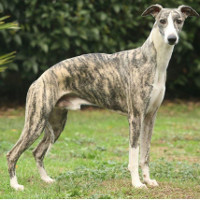
Whippet |
|
FCI Standard No. 162 |
Origin |
Great Britain | |
Group |
Group 10 Sighthounds | |
Section |
Section 3 Short-haired Sighthounds | |
Working |
Without working trial | |
Date of acceptance on a definitive basis by the FCI |
Wednesday 27 April 1955 | |
Date of publication of the official valid standard |
Tuesday 08 September 2026 | |
Date of the last update |
Tuesday 06 October 2026 | |
En français, cette race se dit |
 |
Whippet |
Diese Norm ist in deutscher Sprache sichtbar |
 |
Whippet |
En español, esta raza se dice |
 |
Whippet |
In het Nederlands, wordt dit ras gezegd |
 |
Whippet |
Usage |
| Breeds originally used for hunting either by scent or by sight. |
General appearance |
| Balanced combination of muscular power and strength with elegance and grace of outline. Built for speed and work. All forms of exaggeration should be avoided. |
Behaviour / temperament |
| An ideal companion. Highly adaptable in domestic and sporting surroundings. Gentle, affectionate, even disposition. |
Head |
||
Cranial region |
||
Skull |
Long and lean, flat on top, tapering to muzzle with slight stop, rather wide between the eyes. | |
Stop |
Slight. | |
Facial region |
||
Nose |
Nose black or blue depending on coat colour. Liver nose in creams. In whites or parti-colours a butterfly nose is permissible. | |
Jaws and teeth |
Jaws strong, powerful and clean cut with a perfect scissor bite, i.e. the upper teeth closely overlapping the lower teeth and set square to the jaws. | |
Eyes |
Oval, bright, expression very alert. | |
Ears |
Rose shaped, small, fine in texture. | |
Neck |
| Long, muscular, elegantly arched. |
Body |
||
Topline |
Showing a graceful arch over loin but the dog is not humped. | |
Back |
Broad, well muscled, firm, somewhat long. | |
Loin |
Giving impression of strength and power. | |
Chest |
Very deep with plenty of heart room, brisket deep, well defined. Ribs well sprung, muscled on back. | |
Underline and belly |
With definite tuck up. | |
Tail |
| No feathering. Long, tapering, when in action carried in a delicate curve but not higher than the level of the back. |
Limbs |
Forequarters |
||
Generality |
Forearms straight and upright with moderate bladed bone, front not too wide. | |
Shoulders |
Well laid back with flat muscles. Moderate between the shoulder blades at the withers. | |
Upper arm |
Approximately of equal length to the shoulder blade. | |
Elbows |
Falls directly under the withers when viewed in profile. | |
Pastern |
Strong with slight spring. | |
Forefeet |
Oval, well split up between toes, knuckles well arched,pads thick, nails strong. | |
Hindquarters |
||
Generality |
Strong. Dog able to stand naturally over a lot of ground. | |
Upper thigh |
Broad across. | |
Lower thigh |
Well developed. | |
Stifle |
Well bent. | |
Hock |
Well bent without exaggeration. | |
Hind feet |
Oval, well split up between toes, knuckles well arched,pads thick, nails strong. | |
Gait and movement |
| Should possess great freedom of action. In profile should move with a long easy stride whilst holding topline. The forelegs should be thrown forward and low over the ground. Hind legs should come well under the body giving greatpropelling power. General movement not to lookstilted, high stepping, short or mincing. True coming and going. |
Coat |
||
Hair |
Fine, short, close in texture. | |
Colour |
Any colour or mixture of colours. Merle unacceptable. | |
Size and weight |
||
Height at withers |
Desirable : Dogs 47-51 cm. Bitches 44-47 cm. | |
Faults |
| • Any departure from the foregoing points should be considered a fault and the seriousness with which the fault should be regarded should be in exact proportion to its degree and its effect upon the health and welfare of the dog and its ability to perform its traditional work. • Faults listed should be in degree of seriousness. |
Disqualifying faults |
 Aggressive or overly shy. Aggressive or overly shy. |
NB : |
| • Any dog clearly showing physical or behavioural abnormalities shall be disqualified. • The above mentioned faults when occurring to a highly marked degree or frequently are disqualifying. • Male animals should have two apparently normal testicles fully descended into the scrotum. • Only functionally and clinically healthy dogs, with breed typical conformation should be used for breeding. |



 English (United Kingdom)

Comments