Rhodesian Ridgeback

FCI standard Nº 146

Origin
Southern Africa
Standard supplied by the Kennel Union of Southern Africa and the Zimbabwe Kennel Club
Group
Group 6 Scenthounds and related breeds
Section
Section 3 Related breeds
Working
Without working trial
Acceptance on a definitive basis by the FCI
Monday 21 February 1955
Publication of the official valid standard
Thursday 15 May 2025
Last update
Friday 6 June 2025
En français, cette race se dit
Chien de Rhodésie à crête dorsale
Diese Norm ist in deutscher Sprache sichtbar
Rhodesian Ridgeback
En español, esta raza se dice
Perro crestado rodesiano
In het Nederlands, wordt dit ras gezegd
Rhodesische pronkrug

Usage

The Rhodesian Ridgeback is still used to hunt game in many parts of the world, but is especially prized as watch- dog and family pet.

Brief historical summary

The Rhodesian Ridgeback is presently the only registered breed indigenous to southern Africa. Its forbears can be traced to the Cape Colony of Southern Africa, where they crossed with the early pioneer’s dogs and the semi- domesticated, ridged Hottentot hunting dogs. Hunting mainly in groups of two or three, the original function of the Rhodesian Ridgeback or Lion dog was to track game, especially lion, and, with great agility, keep it at bay until the arrival of the hunter.
The original standard, which was drafted by F.R.Barnes, in Bulawayo, Rhodesia, in 1922, was based on that of the Dalmatian and was approved by the South African Kennel Union in 1926.

General appearance

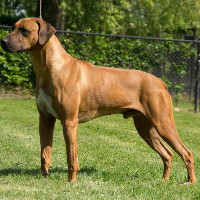
The Rhodesian Ridgeback should represent a well balanced, strong, muscular, agile and active dog, symmetrical in outline, and capable of great endurance with a fair amount of speed. The emphasis is on agility, elegance and soundness with no tendency towards massiveness. The peculiarity of the breed is the ridge on the back, which is formed by the hair growing in the opposite direction to the rest of the coat. The ridge is the escutcheon of the breed.
The ridge must be clearly defined, symmetrical and tapering towards the haunch. It must start immediately behind the shoulders and continue to the hip (haunches) bones. The ridge must contain only two crowns, identical and opposite each other. The lower edges of the crowns must not extend further down the ridge than one-third of its length. A good average width of the ridge is 5cm (2”).

Behaviour / temperament

Dignified, intelligent, aloof with strangers, but showing no aggression or shyness.

Head

Cranial region

Skull
Should be of a hair length (width of head between ears, distance from occiput to stop, stop to end of nose, should be equal), flat and broad between the ears; the head should be free from wrinkles when in repose. 
Stop
The stop should be reasonably well defined and not in one straight line from the nose to the occipital bone.

Facial region

Nose
The nose should be black or brown. A black nose should be accompanied by dark eyes, a brown nose by amber eyes.
Muzzle
The muzzle should be long, deep and powerful.
Lips
The lips should be clean, closely fitting the jaws.
Jaws and teeth
Jaws strong, with a perfect and complete scissor bite, i.e. the upper teeth closely overlapping the lower teeth and set square to the jaws. The teeth must be well developed, especially the canines or holders.
Cheeks
Cheeks should be clean.
Eyes
Should be moderately well apart, round, bright and sparkling, with intelligent expression, their colour harmonising with the colour of the coat.
Ears
Should be set rather high, of medium size, rather wide at base, and gradually tapering to a rounded point. They should be carried close to the head.

Neck

Should be fairly long, strong and free from throatiness.

Body

Back
Powerful.
Loin
Strong, muscular and slightly arched.
Chest
Should not be too wide, but very deep and capacious; the brisket should reach to the elbow. Forechest should be visible when viewed from the side. Ribs moderately well sprung, never rounded like barrel-hoops.

Tail

Should be strong at the root and gradually tapering towards the end, free form coarseness. It should be of moderate length. It should not be attached too high nor too low, and should be carried with a slight curve upwards, never curled.

Limbs

Forequarters

Generality
The forelegs should be perfectly straight, strong and well boned, with the elbows close to the body. When viewed from the side, the forelegs should be wider than viewed from the front.
Shoulders
The shoulders should be sloping, clean and muscular.
Pastern
Should be strong with light spring.

Hindquarters

Generality
In the hind legs the muscles should be clean and well defined.
Stifle
Good turn of stifle.
Hock
Strong, well let down.

Feet

The feet should be compact and round, with well arched toes and tough, elastic pads, protected by hair between the toes and pads.

Gait and movement

Straight forward, free and active.

Coat

Hair
Should be short and dense, sleek and glossy in appearance, but neither woolly nor silky.
Colour
Light wheaten to red wheaten. A little white on the chest and toes is permissible, but excessive white hairs here, on belly, or above toes is undesirable. A dark muzzle and ears permissible. Excessive black hairs throughout the coat are highly undesirable.

Size and weight

Height at withers
Dogs : 63-69 cm (25” -27”). Bitches : 61-66 cm (24” -26”).
Weight
Dogs : 36,5 kg (80 lbs). Bitches : 32 kg (70 lbs).

Faults

• Any departure from the foregoing points should be considered a fault and the seriousness with which the fault should be regarded should be in exact proportion to its degree and its effect upon the health and welfare of the dog and its ability to perform its traditional work.
• Faults listed should be in degree of seriousness.

General faults

 Incorrect crowns on ridge.

Disqualifying faults

 Aggressive or overly shy dogs.
 Dogs without ridge.

NB :

• Any dog clearly showing physical or behavioural abnormalities shall be disqualified.
• The above mentioned faults when occurring to a highly marked degree or frequently are disqualifying.
• Male animals should have two apparently normal testicles fully descended into the scrotum.
• Only functionally and clinically healthy dogs, with breed typical conformation should be used for breeding.

Bibliography

https://www.fci.be/


Detailed history

Apart from a very visible feature, which is its dorsal ridge with hairs implanted in the opposite direction to those of the body, the appearance of the Rhodesian Ridgeback leaves nothing to predict that banal. But if we look more closely, this dog, in the image, of this exclusive ridge, appears quite original.

And first of all, how to classify it? European specialists have always been embarrassed to answer this question. Only the British were able to put it away in one of their "catch-all" groups, in this case that of the "hounds", where there are pell-mell, greyhounds, running dogs, Nordic hunting dogs, Basenji. The Continentals, meanwhile, have put a time in the sixth group, that of "Common Dogs for small game". The Rhodesian Ridgeback, dog running or hound, that is curious. The lion would be a small game, which one could see off-track, pursued by a pack of Rhodesian.

The new official nomenclature now places it in the eighth group, among the "Hunting dogs of game or bushmen". It may seem equally strange to have the great African next to the Cocker and the other Spaniels; but this situation seems more logical, because the role of the Rhodesian is to look for the lion in the bush and make it go to the rifle of the hunter, exactly what a bushman and game hunter does. What game, certainly, and what an imposing bushman, this dog is really special in its category.

Another solution might have been to classify him as a "primitive type", which his origins might justify. But his general appearance hardly approaches that of the other "primitives", Basenji and Dog of Canaan, and in this group he would have been the only one to show falling ears.

Should not we finally create a section for him? While this dog is rare in most countries, it would be an unprecedented and equally curious fact. The Rhodesian is really a dog apart. His name even bears witness to particular events in his history, as he is more likely to be of South African descent.

It is certain that his ancestors were already there, in 1652, when the first European colonists founded Cape Town. From that moment, attention was drawn to these hunting dogs used by the natives (Bushmen, Zulus and Hottentots), who, it was also remarked very quickly, had a curious "crest" of bristly hairs on the top of the back. . It also appears from the descriptions of the time that these dogs should be considered not as truly domestic, but as human half-wild commensals, remaining only in the vicinity of the villages because they found part of them. their food, accompanying the hunters in their expeditions and, in fact, helping them to track the game or big cats. In addition, they were portrayed as small, hungry and rather ferocious, but excellent hunters.

The Ridgebacks then received blood from European dogs accompanying Dutch (Boer) and German (and also French Huguenot) settlers. It is impossible to know exactly which types of dogs were used for these crossings: undoubtedly, there were various common dogs, strong mastiffs, even hunting dogs (we often mention the Great Dane, Saint-Hubert or dogs like).

In reality, it was not really a definite selection problem that presided over the passage of the half-wild dog to the South African hunting dog. We can imagine the process of this transformation. As they did in the native villages, the dogs first settled near camps and settler farms, removing garbage and signaling the arrival of intruders or wild beasts. The alliance was sealed when the settler adopted a puppy, which he tamed to keep him at home. He realized that he possessed hunter's gifts, stamina and speed. In other cases, the adoption of a baby was facilitated by the fact that it resulted from the union between the farmer's dog (or dog) and a wild dog (or dog). It is likely that some of these colonists favored these mating, to combine the qualities of native dogs with the easier character of their dogs. These taming and successive crossings led to the constitution of a local canine type, whose essential qualities were resistance, speed, hunting instinct, and whose distinctive sign often remained the "crest".

In the meantime, the Hottentots had been decimated (95%) by an epidemic of smallpox, so the fate of the race was entirely in the hands of the settlers. The appearance of the Ridgeback in the nineteenth century can be seen, for example, in an engraving depicting Livingstone's work, Missionnary Travels in South Africa, published in 1857: in broad outline, the dog represented corresponds to the present race. It is now necessary to relate the circumstances which motivated his denomination of Rhodesia. The second half of the last century was the time of expeditions to the areas of open forest and savannah which in 1895 were to be called Rhodesia (named after Cecil Rhodes). Explorers, missionaries and settlers were soon helped by the race best suited to this country, the Ridgeback. It is said that it was a South African missionary who, about 1875, imported into these territories the first couple of these dogs. In these wild areas, the Ridgeback was noted for many exploits during safaris, big game, panther and lion, and it is this newly acquired rhodesian "halo" that earned him its name.

His reputation also owes much to a famous hunter of the time, Cornelius van Ruyen, who praised loudly the courage of this dog facing the lion and his physical skills that made him the "safari dog" par excellence. As a result, any South African big game hunter had to own a specimen of Rhodesian Ridgeback, soon to be considered a national dog.

Around 1920, South African dog-fighting began to organize itself: one of his first concerns was, of course, the only indigenous breed. The formation of a special club allowed in 1922 in particular the drafting of a standard, modeled on that of Dalmatian.

If, today, the safari dog, very valorous but of rather variable forms, has become a show dog and a companion dog, it is thanks to the choice of some of the most representative subjects as a starting point for the programs. breeding. A light contribution of tawny Great Dane has also been mentioned, but this is questionable.

The "lion dog" is no longer the ferocious and somewhat wild animal of yesteryear. One of the first breeders to have introduced it in France, around 1975, still described him as a "special" dog: a little difficult, very reserved and distant, to say anything quite fierce. However, the character of the Ridgeback does not correspond to this portrait, which could only result from a fault of breeding. If, every year, several hundred Ridgebacks find buyers across the Channel, it is certainly not because they are asocial or wild animals. His role as a "safari dog" is a thing of the past, even in his homeland. His current duties are to be a family dog fit to guard.

It is still worth mentioning his former task. He tracked and flushed big game (antelopes, wildebeest, zebras) in small packs, and tried to bring him near the rifle (s). Given the velocity of these animals (whose speed peaks can reach 60 or 80 km / h), it is immediately apparent that dogs had to demonstrate physical abilities (speed and resistance) unusual. It should be noted that the current standard always insists on a conformation allowing a high speed. Sometimes he tracked the wounded game with blood, which proves its olfactory qualities (especially since the conditions, heat and drought, were most often unfavorable).

But it is especially in hunting wild cats that the Ridgeback has built its reputation. His job was to bring the tawny animal out of his retreat, and even to attract him, by harrowing, uncovered, to the hunters. Naturally, he did not directly attack big cats, but one must nevertheless recognize him a strong character to dare to provoke the wildcat into his lair.

Today, the Ridgeback's activities are more civil. It is a magnificent guard dog, assured and calm, of great presence with its size around or exceeding the 65 centimeters at the withers and its weight between 30 and 40 kilos. That a stranger wants to enter the property, the Ridgeback then hears a dull growl, impressive, he proudly plants his eyes in that of the intruder, then his loud voice resonates until the arrival of the master: that is who is completely dissuasive.

The Ridgeback is not a barker, nor nervous. On the contrary, in the house, it is quite discreet, can even seem a little indolent. What is certain is that he appreciates the softness of a carpet or an armchair to take a nap. The English books consulted portray him as an excellent playmate for children. This calm character goes hand in hand with a very sporty temperament, when it comes to walks or, better, free gallops. The handsome goalkeeper turns into an athlete cut for the race. In addition, he has kept the hunting instinct, in general, so the master must have it in hand to be able to walk long hours in the forest or in the countryside without leash. In the Vosges, he was recently called upon to track the lynx (a cat that one tries to relocate in its natural setting), a task in which he gave complete satisfaction.

As he comes from a hot country, one might think he is a bit chilly. It is not so: its hair, though short, is very dense and protects it from bad weather. In addition, it is said that it is not bothered by insect bites, in South Africa. The Rhodesian Ridgeback remains a breed to discover: good size, strong but not heavy, there is no exaggeration at home, even if its dorsal ridge ensures an indisputable originality. Good guard, rather calm, it is a dog of house of all rest. In his education, however, we will take care very early to take into account his often independent temperament. Finally, its hunting qualities are still unexplored. So, he could certainly make an excellent dog of red.

Comments

Latest page updates

  • Yorkshire Terrier

    Yorkshire Terrier FCI Standard No. 86 Origin Great Britain Group Group 3 Terriers Section Section 4 Toy Terriers Working Without working trial Date of acceptance on a definitive basis by the FCI Saturday 30 October 1954 Date of publication of the official valid standard Tuesday 08 September 2026 Date of the last update Tuesday 06 October 2026 En...
  • West Highland White Terrier

    West Highland White Terrier FCI Standard No. 85 Origin Great Britain Group Group 3 Terriers Section Section 2 Small-sized Terriers Working Without working trial Date of acceptance on a definitive basis by the FCI Friday 29 October 1954 Date of publication of the official valid standard Tuesday 08 September 2026 Date of the last update Tuesday 06...
  • Welsh Terrier

    Welsh Terrier FCI Standard No. 78 Origin Great Britain Group Group 3 Terriers Section Section 1 Large- and medium sized Terriers Working Without working trial Date of acceptance on a definitive basis by the FCI Saturday 23 October 1954 Date of publication of the official valid standard Tuesday 08 September 2026 Date of the last update Tuesday 06...
  • Welsh Springer Spaniel

    Welsh Springer Spaniel FCI Standard No. 126 Origin Great Britain Group Group 8 Retrievers-Flushing Dogs-Water Dogs Section Section 2 Flushing Dogs Working With working trial Date of acceptance on a definitive basis by the FCI Thursday 30 December 1954 Date of publication of the official valid standard Tuesday 08 September 2026 Date of the last...
  • Welsh Corgi Pembroke

    Welsh Corgi Pembroke FCI Standard No. 39 Origin Great Britain Group Group 1 Sheepdogs and Cattle Dogs (except Swiss Cattle Dogs) Section Section 2 Cattledogs (except Swiss Cattledogs) Working Without working trial Date of acceptance on a definitive basis by the FCI Wednesday 13 November 1963 Date of publication of the official valid standard Tuesday 08...
  • Welsh Corgi Cardigan

    Welsh Corgi Cardigan FCI Standard No. 38 Origin Great Britain Group Group 1 Sheepdogs and Cattle Dogs (except Swiss Cattle Dogs) Section Section 2 Cattledogs (except Swiss Cattledogs) Working Without working trial Date of acceptance on a definitive basis by the FCI Tuesday 12 November 1963 Date of publication of the official valid standard Tuesday 08...
  • Sussex Spaniel

    Sussex Spaniel FCI Standard No. 127 Origin Great Britain Group Group 8 Retrievers, Flushing dogs, Water dogs. Section Section 2 Flushing dogs Working With working trial Date of acceptance on a definitive basis by the FCI Friday 31 December 1954 Date of publication of the official valid standard Tuesday 08 September 2026 Date of the last update Tuesday 06...
  • Staffordshire Bull Terrier

    Staffordshire Bull Terrier FCI Standard No. 76 Origin Great Britain Group Group 3 Terriers Section Section 3 Bull type Terriers Working Without working trial Date of acceptance on a definitive basis by the FCI Thursday 21 October 1954 Date of publication of the official valid standard Tuesday 08 September 2026 Date of the last update Tuesday 06...
  • Skye Terrier

    Skye Terrier FCI Standard No. 75 Origin Great Britain Group Group 3 Terriers Section Section 2 Small-sized Terriers Working Without working trial Date of acceptance on a definitive basis by the FCI Wednesday 20 October 1954 Date of publication of the official valid standard Tuesday 08 September 2026 Date of the last update Tuesday 06 October 2026 En...
  • Shetland Sheepdog

    Shetland Sheepdog FCI Standard No. 88 Origin Great Britain Group Group 1 Sheepdogs and Cattle Dogs Section Section 1 Sheepdogs Working Without working trial Date of acceptance on a definitive basis by the FCI Tuesday 09 November 1954 Date of publication of the official valid standard Tuesday 08 September 2026 Date of the last update Tuesday 06...
  • Sealyham Terrier

    Sealyham Terrier FCI Standard No. 74 Origin Great Britain Group Group 3 Terriers Section Section 2 Small sized Terriers Working Without working trial Date of acceptance on a definitive basis by the FCI Tuesday 19 October 1954 Date of publication of the official valid standard Tuesday 08 September 2026 Date of the last update Tuesday 06 October...
  • Scottish Terrier

    Scottish Terrier FCI Standard No. 73 Origin Great Britain Group Group 3 Terriers Section Section 2 Small-sized Terriers Working Without working trial Date of acceptance on a definitive basis by the FCI Monday 18 October 1954 Date of publication of the official valid standard Tuesday 08 September 2026 Date of the last update Tuesday 06 October...
  • Old English Sheepdog (Bobtail)

      Old English Sheepdog (Bobtail) FCI Standard No. 16     Origin   Great Britain Group   Group 1 Sheepdogs and Cattle Dogs (except Swiss Cattle Dogs) Section   Section 1 Sheepdogs Working   Without working trial Date of acceptance on a definitive basis by the FCI   Monday 25 November 1963 Date of publication of the official valid standard   Tuesday 08 September...
  • Norwich Terrier

    Norwich Terrier FCI Standard No. 72 Origin Great Britain Group Group 3 Terriers Section Section 2 Small-sized Terriers Working Without working trial Date of acceptance on a definitive basis by the FCI Saturday 16 October 1954 Date of publication of the official valid standard Tuesday 08 September 2026 Date of the last update Tuesday 06 October...
  • Norfolk Terrier

    Norfolk Terrier FCI Standard No. 272 Origin Great Britain Group Group 3 Terriers Section Section 2 Small-sized Terriers Working Without working trial Date of acceptance on a definitive basis by the FCI Saturday 01 October 1966 Date of publication of the official valid standard Tuesday 08 September 2026 Date of the last update Tuesday 06 October...
  • Manchester Terrier

    Manchester Terrier FCI Standard No. 71 Origin Great Britain Group Group 3 Terriers Section Section 1 Large and medium sized Terriers Working Without working trial Date of acceptance on a definitive basis by the FCI Friday 15 October 1954 Date of publication of the official valid standard Tuesday 08 September 2026 Date of the last update Tuesday 06 October...
  • Lakeland Terrier

    Lakeland Terrier FCI Standard No. 70 Origin Great Britain Group Group 3 Terriers Section Section 1 Large and medium-sized Terriers Working Without working trial Date of acceptance on a definitive basis by the FCI Thursday 14 October 1954 Date of publication of the official valid standard Tuesday 08 September 2026 Date of the last update Tuesday 06 October...
  • Labrador Retriever

      Labrador Retriever FCI Standard No. 122     Origin   Canada Group   Group 8 Retrievers, Flushing dogs, Water dogs Section   Section 1 Retrievers Working   With working trial Date of acceptance on a definitive basis by the FCI   Friday 24 December 1954 Date of publication of the official valid standard   Tuesday 08 September 2026 Date of the last update   Tuesday 06...
  • King Charles Spaniel

    King Charles Spaniel FCI Standard No. 128 Origin Great Britain Group Group 9 Companion and Toy Dogs Section Section 7 English Toy Spaniels Working Without working trial Date of acceptance on a definitive basis by the FCI Monday 03 January 1955 Date of publication of the official valid standard Tuesday 08 September 2026 Date of the last update Tuesday 06...
  • Harrier

      Harrier FCI Standard No. 295     Origin   Great Britain Translation   Mrs. Peggy Davis, brought up to day by Dr. Paschoud Group   Group 6 Scenthounds and related breeds Section   Section 1.2 Medium-sized Hounds Working   With working trial Date of acceptance on a definitive basis by the FCI   Wednesday 27 November 1974 Date of publication of the official valid...
  • Greyhound

    Greyhound FCI Standard No. 158 Origin Great Britain Group Group 10 Sighthounds Section Section 3 Short-haired sighthounds Working Without working trial Date of acceptance on a definitive basis by the FCI Saturday 23 April 1955 Date of publication of the official valid standard Tuesday 08 September 2026 Date of the last update Tuesday 06 October...
  • Gordon Setter

    Gordon Setter FCI Standard No. 6 Origin Great Britain Group Group 7 Pointing Dogs Section Section 2.2 British and Irish Pointers and Setters; Setters Working With working trial Date of acceptance on a definitive basis by the FCI Tuesday 28 May 1963 Date of publication of the official valid standard Tuesday 08 September 2026 Date of the last...
  • Golden Retriever

    Golden Retriever FCI Standard No. 111 Origin Great Britain Group Group 8 Retrievers, Flushing Dogs, Water Dogs Section Section 1 Retrievers Working With working trial Date of acceptance on a definitive basis by the FCI Thursday 02 December 1954 Date of publication of the official valid standard Tuesday 28 July 2009 Date of the last update Wednesday...
  • Fox Terrier Wire

    Fox Terrier Wire FCI Standard No. 169 Origin Great Britain Group Group 3 Terriers Section Section 1 Large and medium-sized Terriers Working Working trial optional Date of acceptance on a definitive basis by the FCI Friday 13 May 1955 Date of publication of the official valid standard Tuesday 08 September 2026 Date of the last update Tuesday 06...
  • Fox Terrier Smooth

    Fox Terrier Smooth FCI Standard No. 12 Origin Great Britain Group Group Terriers Section Section 1 Large and medium sized Terriers Working Working trial optional Date of acceptance on a definitive basis by the FCI Wednesday 26 June 1963 Date of publication of the official valid standard Tuesday 08 September 2026 Date of the last update Tuesday 06...
  • Flat Coated Retriever

    Flat Coated Retriever FCI Standard No. 121 Origin Great Britain Group Group 8 Retrievers-Flushing Dogs-Water Dogs Section Section 1 Retrievers Working With working trial Date of acceptance on a definitive basis by the FCI Thursday 23 December 1954 Date of publication of the official valid standard Tuesday 08 September 2026 Date of the last update Tuesday...
  • Field Spaniel

    Field Spaniel FCI Standard No. 123 Origin Great-Britain Group Group 8 Retrievers, Flushing Dogs, Water Dogs Section Section 2 Flushing Dogs Working With working trial Date of acceptance on a definitive basis by the FCI Monday 27 December 1954 Date of publication of the official valid standard Tuesday 08 September 2026 Date of the last update Tuesday...
  • English Toy Terrier

    English Toy Terrier FCI Standard No. 13 Origin Great Britain Group Group 3 Terriers Section Section 4 Toy Terriers Working Without working trial Date of acceptance on a definitive basis by the FCI Tuesday 17 September 1963 Date of publication of the official valid standard Tuesday 08 September 2026 Date of the last update Tuesday 06 October 2026 En...
  • English Springer Spaniel

    English Springer Spaniel FCI Standard No. 125 Origin Great Britain Group Group 8 Retrievers-Flushing Dogs-Water Dogs Section Section 2 Flushing Dogs Working With working trial Date of acceptance on a definitive basis by the FCI Wednesday 29 December 1954 Date of publication of the official valid standard Tuesday 08 September 2026 Date of the last...
  • English Setter

    English Setter FCI Standard No. 2 Origin Great Britain Group Group 7 Pointing Dogs Section Section 2.2 British and Irish Pointers and Setters, Setter Working With working trial Date of acceptance on a definitive basis by the FCI Wednesday 06 March 1963 Date of publication of the official valid standard Tuesday 08 September 2026 Date of the last...
  • English Pointer

    English Pointer FCI Standard No. 1 Origin Great Britain Group Group 7 Pointing Dogs Section Section 2.1 British and Irish Pointers and Setters, Pointer Working With working trial Date of acceptance on a definitive basis by the FCI Tuesday 05 March 1963 Date of publication of the official valid standard Tuesday 08 September 2026 Date of the last...
  • English Foxhound

    English Foxhound FCI Standard No. 159 Origin Great Britain Group Group 6 Scenthounds and related breeds Section Section 1.1 Large-sized Scent hounds Working With working trial Date of acceptance on a definitive basis by the FCI Monday 25 April 1955 Date of publication of the official valid standard Thursday 26 March 2009 Date of the last update Wednesday...
  • English Cocker Spaniel

    English Cocker Spaniel FCI Standard No. 5 Origin Great Britain Group Group 8 Retrievers, Flushing Dogs, Water Dogs Section Section 2 Flushing dogs Working With working trial Date of acceptance on a definitive basis by the FCI Wednesday 10 April 1963 Date of publication of the official valid standard Tuesday 08 September 2026 Date of the last...
  • Tibetan Mastiff

    Tibetan Mastiff FCI Standard No. 230 Origin Tibet (China)Patronage FCI Group Group 2 Pinscher and Schnauzer- Molossoid breeds- Swiss Mountain and Cattle Dogs Section Section 2.2 Molossoid breeds, Mountain type Working Without working trial Date of acceptance on a definitive basis by the FCI Tuesday 22 August 1961 Date of publication of the...
  • Deerhound

    Deerhound FCI Standard No. 164 Origin Great Britain Group Group 10 Sighthounds Section Section 2 Rough-haired Sighthounds Working Without working trial Date of acceptance on a definitive basis by the FCI Friday 29 April 1955 Date of publication of the official valid standard Tuesday 08 September 2026 Date of the last update Tuesday 06 October...
  • Dandie Dinmont Terrier

    Dandie Dinmont Terrier FCI Standard No. 168 Origin Great Britain Group Group 3 Terriers Section Section 2 Small-sized Terriers Working Without working trial Date of acceptance on a definitive basis by the FCI Thursday 12 May 1955 Date of publication of the official valid standard Tuesday 08 September 2026 Date of the last update Tuesday 06...
  • Curly Coated Retriever

    Curly Coated Retriever FCI Standard No. 110 Origin Great Britain Group Group 8 Retrievers, Flushing Dogs, Water Dogs Section Section 1 Retrievers Working With working trial Date of acceptance on a definitive basis by the FCI Friday 10 December 1954 Date of publication of the official valid standard Tuesday 08 September 2026 Date of the last...
  • Collie Smooth

    Collie Smooth FCI Standard No. 296 Origin Great Britain Group Group 1 Sheepdogs and Cattle Dogs (except Swiss Cattle Dogs) Section Section 1 Sheepdogs Working Without working trial Date of acceptance on a definitive basis by the FCI Wednesday 18 December 1974 Date of publication of the official valid standard Tuesday 08 September 2026 Date of the...
  • Collie Rough

    Collie Rough FCI Standard No. 156 Origin Great Britain Group Group 1 Sheepdogs and Cattle Dogs (except Swiss Cattle Dogs) Section Section 1 Sheepdogs Working Without working trial Date of acceptance on a definitive basis by the FCI Wednesday 13 April 1955 Date of publication of the official valid standard Tuesday 08 September 2026 Date of the...
  • Clumber Spaniel

    Clumber Spaniel FCI Standard No. 109 Origin Great Britain Group Group 8 Retrievers, Flushing dogs, Water dogs Section Section 2 Flushing dogs Working With working trial Date of acceptance on a definitive basis by the FCI Thursday 09 December 1954 Date of publication of the official valid standard Tuesday 08 September 2026 Date of the last update Tuesday...
  • Chow Chow

    Chow Chow FCI Standard No. 205 Origin China, patronage : Great Britain Group Group 5 Spitz and primitive type Section Section 5 Asian Spitz and related breeds Working Without working trial Date of acceptance on a definitive basis by the FCI Tuesday 10 December 1957 Date of publication of the official valid standard Tuesday 08 September 2026 Date...
  • Chinese Crested Dog

    Chinese Crested Dog FCI Standard No. 288 Origin China, patronage Great Britain Group Group 9 Companion and Toy Dogs Section Section 4 Hairless breeds Working Without working trial Date of acceptance on a definitive basis by the FCI Monday 17 July 1972 Date of publication of the official valid standard Tuesday 08 September 2026 Date of the last...
  • Cairn Terrier

    Cairn Terrier FCI Standard No. 4 Origin Great Britain Group Group 3 Terriers Section Section 2 Small-sized Terriers Working Without working trial Date of acceptance on a definitive basis by the FCI Saturday 06 April 1963 Date of publication of the official valid standard Tuesday 08 September 2026 Date of the last update Tuesday 06 October 2026 En...
  • Bullmastiff

    Bullmastiff FCI Standard No. 157 Origin Great Britain Group Group 2 Pinscher and Schnauzer Molossoid breeds - Swiss Mountain and Cattle Dogs Section Section 2.1 Molossoid breeds, Mastiff Type Working Without working trial Date of acceptance on a definitive basis by the FCI Saturday 23 April 1955 Date of publication of the official valid standard Tuesday...
  • English Bulldog

    English Bulldog FCI Standard No. 149 Origin Great Britain Group Group 2 Pinscher and Schnauzer Molossoid breeds-Swiss Mountain and Cattle Dogs Section Section 2.1 Molossoid breeds, Mastiff Type Working Without working trial Date of acceptance on a definitive basis by the FCI Monday 14 March 1955 Date of publication of the official valid standard Tuesday...
  • Bull Terrier

    Bull Terrier FCI Standard No. 11 Origin Grande-Bretagne Group Group 3 Terriers Section Section 3 Bull type Terriers Working Working trial optional Date of acceptance on a definitive basis by the FCI Saturday 26 June 1993 Date of publication of the official valid standard Tuesday 08 September 2026 Date of the last update Tuesday 06 October 2026 En...
  • Border Terrier

    Border Terrier FCI Standard No. 10 Origin Great Britain Group Group 3 Terriers Section Section 1 Large and medium-sized terriers Working Without working trial Date of acceptance on a definitive basis by the FCI Wednesday 26 June 1963 Date of publication of the official valid standard Tuesday 08 September 2026 Date of the last update Tuesday 06...
  • Bedlington Terrier

    Bedlington Terrier FCI Standard No. 9 Origin Great Britain Group Group 3 Terriers Section Section 1 Large and medium sized Terriers Working Without working trial Date of acceptance on a definitive basis by the FCI Thursday 20 June 1963 Date of publication of the official valid standard Tuesday 08 September 2026 Date of the last update Tuesday 06...
  • Bearded Collie

    Bearded Collie FCI Standard No. 271 Origin Great-Britain Group Group 1 Sheepdogs and Cattle Dogs (except Swiss Cattle Dogs) Section Section 1 Sheepdogs Working Without working trial Date of acceptance on a definitive basis by the FCI Wednesday 30 August 1967 Date of publication of the official valid standard Tuesday 08 September 2026 Date of the...
  • Beagle

    Beagle FCI Standard No. 161 Origin Great Britain Translation Prof. R. Triquet Group Group 6 Scent hounds and related breeds Section Section 1.3 Small-sized hounds Date of acceptance on a definitive basis by the FCI Tuesday 26 April 1955 Date of publication of the official valid standard Tuesday 08 September 2026 Date of the last update Tuesday 06...
  • Basset Hound

    Basset Hound FCI Standard No. 163 Origin Great Britain Group Group 6 Scent hounds and related breeds Section Section 1.3 Small-sized hounds Working With working trial Date of acceptance on a definitive basis by the FCI Thursday 28 April 1955 Date of publication of the official valid standard Tuesday 08 September 2026 Date of the last update Tuesday...
  • Basenji

    Basenji FCI Standard No. 43 Origin Democratic Republic of Congo, under the patronage of Great Britain Group Group 5 Spitz and primitive types Section Section 6 Primitive type Working Without working trial Date of acceptance on a definitive basis by the FCI Thursday 26 March 1964 Date of publication of the official valid standard Tuesday 08...
  • Airedale Terrier

    Airedale Terrier FCI Standard No. 7 Origin Great Britain Group Group 3 Terriers Section Section 1 Large and medium sized Terriers Working Working trial optional Date of acceptance on a definitive basis by the FCI Tuesday 28 May 1963 Date of publication of the official valid standard Tuesday 08 September 2026 Date of the last update Tuesday 06...
  • Afghan Hound

    Afghan Hound FCI Standard No. 228 Origin AfghanistanPatronage Great Britain Group Group 10 Sighthounds Section Section 1 Long-haired or fringed sighthounds Working Without working trial Date of acceptance on a definitive basis by the FCI Tuesday 12 December 1961 Date of publication of the official valid standard Tuesday 08 September 2026 Date of the...
  • Romagna Water Dog

    Romagna Water Dog FCI Standard No. 298 Origin Italy Translation Antonio Morsiani, Renée Sporre-Willes and Prof. R. TriquetRevised by ENCI and Renée Sporre-WillesRevised by the FCI Head OfficeOfficial language (EN). Group Group 8 Retrievers –Flushing Dogs –Water Dogs Section Section 3 Water Dogs Working Working trial optional Date of acceptance on a...
  • Whippet

    Whippet FCI Standard No. 162 Origin Great Britain Group Group 10 Sighthounds Section Section 3 Short-haired Sighthounds Working Without working trial Date of acceptance on a definitive basis by the FCI Wednesday 27 April 1955 Date of publication of the official valid standard Tuesday 08 September 2026 Date of the last update Tuesday 06 October...
  • Tibetan Terrier

    Tibetan Terrier FCI Standard No. 209 Origin Tibet, patronage Great Britain Group Group 9 Companion and Toy Dogs Section Section 5 Tibetan breeds Working Without working trial Date of acceptance on a definitive basis by the FCI Wednesday 18 December 1957 Date of publication of the official valid standard Tuesday 08 September 2026 Date of the last...
  • Tibetan Spaniel

    Tibetan Spaniel FCI Standard No. 231 Origin Tibet (China)Patronage Great Britain Group Group 9 Companion and Toy Dogs Section Section 5 Tibetan breeds Working Without working trial Date of acceptance on a definitive basis by the FCI Tuesday 22 August 1961 Date of publication of the official valid standard Tuesday 08 September 2026 Date of the...
  • Shih Tzu

    Shih Tzu FCI Standard No. 208 Origin Tibet, patronage Great Britain Group Group 9 Companion and Toy Dogs Section Section 5 Tibetan breeds Working Without working trial Date of acceptance on a definitive basis by the FCI Monday 16 December 1957 Date of publication of the official valid standard Tuesday 08 September 2026 Date of the last update Tuesday 06...
  • Pug

    Pug FCI Standard No. 253 Origin China, patronage Great Britain Group Group 9 Companion and Toy Dogs Section Section 11 Small Molossian type dogs Working Without working trial Date of acceptance on a definitive basis by the FCI Friday 04 November 1966 Date of publication of the official valid standard Tuesday 08 September 2026 Date of the last...
  • Pharaoh Hound

    Pharaoh Hound FCI Standard No. 248 Origin Malta, patronage Great Britain Group Group 5 Spitz and primitive types Section Section 6 Primitive type Working Without working trial Date of acceptance on a definitive basis by the FCI Friday 09 August 1963 Date of publication of the official valid standard Tuesday 08 September 2026 Date of the last...
  • Pekingese

    Pekingese FCI Standard No. 207 Origin China, patronage Great Britain Group Group 9 Companion and Toy Dogs Section Section 8 Japan Chin and Pekingese Working Without working trial Date of acceptance on a definitive basis by the FCI Thursday 03 November 1966 Date of publication of the official valid standard Tuesday 08 September 2026 Date of the last...
  • Parson Russell Terrier

    Parson Russell Terrier FCI Standard No. 339 Origin Great Britain Group Group 3 Terriers Section Section 1 Large and medium sized Terriers Working Working trial optional Date of acceptance on a definitive basis by the FCI Monday 04 June 2001 Date of acceptance on a provisional basis by the FCI Monday 02 July 1990 Date of publication of the...
  • Otterhound

    Otterhound FCI Standard No. 294 Origin Great Britain Group Group 6 Scenthounds and related breeds Section Section 1.1 Large-sized hounds Working Without working trial Date of acceptance on a definitive basis by the FCI Thursday 12 September 1974 Date of publication of the official valid standard Tuesday 08 September 2026 Date of the last update Tuesday 06...
  • Miniature Bull Terrier

    Miniature Bull Terrier FCI Standard No. 359 Origin Grande-Bretagne Group Group 3 Terriers Section Section 3 Bull type Terriers Working Working trial optional Date of acceptance on a definitive basis by the FCI Tuesday 05 July 2011 Date of acceptance on a provisional basis by the FCI Tuesday 05 July 2011 Date of publication of the official valid...
  • Mastiff

    Mastiff FCI Standard No. 264 Origin Great Britain Group Group 2 Pinscher and Schnauzer – Molossoid breeds - Swiss Mountain and Cattle Dogs Section Section 2.1 Molossoid breeds, Mastiff Type Working Without working trial Date of acceptance on a definitive basis by the FCI Thursday 05 November 1964 Date of publication of the official valid standard Tuesday 08...
  • Lhassa Apso

    Lhassa Apso FCI Standard No. 227 Origin Tibet (China)Patronage Great Britain Group Group 9 Companion and Toy Dogs Section Section 5 Tibetan breeds Working Without working trial Date of acceptance on a definitive basis by the FCI Saturday 19 November 1960 Date of publication of the official valid standard Tuesday 08 September 2026 Date of the last...
  • Lancashire-Heeler

    Lancashire-Heeler FCI Standard No. 360 Origin England, patronage : FCI Group Group 1 Sheepdogs and Cattle Dogs (except Swiss Cattle Dogs) Section Section 1 Sheepdogs Working Without working trial Date of acceptance on a provisional basis by the FCI Sunday 01 May 2016 Date of publication of the official valid standard Tuesday 08 September 2026 Date...

© 2026 Groupe Milouchouchou ASBL. Tous droits réservés. En savoir plus

Protected by Copyright01
