Boxer

FCI standard Nº 144

Origin
Germany
Translation
Mrs C. Seidler, revised by Mrs Sporre-Willes and R. Triquet. Revised by J. Mulholland 2008.
Group
Group 2 Pinscher and Schnauzer- Molossoid breeds- Swiss Mountain and Cattle Dogs
Section
Section 2.1 Molossoid breeds, mastiff type
Working
With working trial
Acceptance on a definitive basis by the FCI
Saturday 01 January 1955
Publication of the official valid standard
Tuesday 01 April 2008
Last update
Wednesday 09 July 2008
En français, cette race se dit
Boxer
Diese Norm ist in deutscher Sprache sichtbar
Deutscher Boxer
En español, esta raza se dice
Boxer
In het Nederlands, wordt dit ras gezegd
Boxer

Usage

Companion, Guard and Working Dog.

Brief historical summary

The small, so called Brabant Bullenbeisser is regarded as the immediate ancestor of the Boxer. In the past, the breeding of these Bullenbeissers was in the hands of the huntsmen, whom they assisted during the hunt. Their task was to seize the game put up by the hounds and hold it firmly until the huntsman arrived and put an end to the prey. For this job the dog had to have jaws as wide as possible with widely spaced teeth, in order to bite firmly and hold on tightly. A Bullenbeisser which had these characteristics was best suited to this job and was used for breeding. Previously, only the ability to work and utilization were considered. Selective breeding was carried out which produced a dog with a wide muzzle and an upturned nose.

General appearance

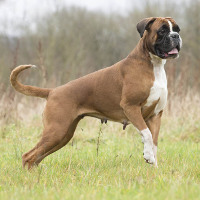
The Boxer is a medium sized, smooth coated, sturdy dog of compact, square build and strong bone. His muscles are taut, strongly developed and moulded in appearance. His movement is lively, powerful with noble bearing. The Boxer must be neither cumbersome nor heavy, nor light or lacking in body substance.

Important proportions

Length of body / Height at withers : Square build, which means that the horizontal line of the back is perpendicular to the vertical line passing through the point of shoulder and to the other vertical line passing through the point of buttock, thus defining a square outline.
Depth of brisket / Height at withers : The chest reaches to the elbows. Depth of chest is half the height at withers.
Length of nose bridge / Length of head : Length of nose bridge in relation to skull should be 1 : 2 (measured respectively from tip of nose to inner corner of eye and from inner corner of eye to occiput).

Behaviour / temperament

The Boxer should be fearless self-confident, calm and equable. Temperament is of the utmost importance and requires careful attention. Devotion and loyalty towards his master and his entire household, his watchfulness and self-assured courage as a defender are famous. He is harmless with his family but distrustful of strangers. Happy and friendly in play, yet fearless in a serious situation. Easy to train on account of his willingness to obey, his pluck and courage, natural keenness and scent capability. Undemanding and clean, he is just as agreeable and appreciated in the family circle as he is as a guard, companion and working dog. His character is trustworthy, with no guile or cunning, even in old age.

Head

Cranial region

Head
This gives the Boxer his characteristic look. Must be in good proportion to the body and appear neither too light nor too heavy. Muzzle should be as broad and powerful as possible. The harmony of the head depends on the balance between muzzle and skull. From whichever direction the head is viewed, from front, above or sideways, the muzzle must always be in the right proportion to the skull i.e. it must never appear too small. It should be clean, not showing any wrinkle. However, natural folds are formed in the cranial region when alerted. From root of nose, folds are always indicated running in a downward direction on both sides. The dark mask is confined to the muzzle and must be in sharp contrast to the colour of the head so that the face does not appear sombre.
Skull
The cranial region should be as lean and angular as possible. It is slightly arched, neither too round and short, nor flat; nor should it be too broad. Occiput not too pronounced. Furrow in forehead only slightly marked, must not be too deep, especially between the eyes. 
Stop
The forehead forms a distinct stop with the bridge of nose.

Facial region

Nose
Nose is broad and black and only slightly turned up with wide nostrils. Tip of nose is placed slightly higher than root of nose.
Muzzle
The muzzle is powerfully developed in three dimensional volume, neither pointed nor narrow, nor short or shallow. Its appearance is influenced by :
a) Shape of jaw.
b) Position of canine teeth.
c) Shape of lips. The canines must be placed as far apart as possible and must be of good length, making the front of the muzzle broad, almost square and forming a blunt angle with bridge of nose.
In front, the edge of the upper lip rests on the edge of the lower lip. The part of the lower jaw with lower lip curved upwards, called the chin, must not markedly protrude over upper lip, seen from front. Nor should it be hidden by the upper lip but should be well defined from front and side.
The canines and incisors of the lower jaw must not be visible when mouth is closed, neither should the tongue show. Median groove in the upper lip (philtrum) is clearly visible.
Lips
The lips complete the shape of the muzzle. The upper lip is thick and padded and fills the space formed by the undershot lower jaw; it is supported by the lower canines.
Nasal bridge
Bridge of nose must not be forced back into the forehead as in the Bulldog, nor should it be downfaced.
Jaws and teeth
The lower jaw protrudes beyond the upper jaw and is curved slightly upwards. The Boxer is undershot. The upper jaw is broad where it joins the cranial region, tapering only slightly towards the front. The teeth are strong and healthy. The incisors are as even as possible, set in a straight line. Canines wide apart and of good size.
Cheeks
Cheeks are developed in proportion with the strong jaws without markedly bulging. They merge with the muzzle in a slight curve.
Eyes
The dark eyes are neither too small nor protruding or deep set. Their expression conveys energy and intelligence and must not be threatening or piercing. Eye rims must be dark.
Ears
The natural ears are of appropriate size. They are set on wide apart on highest part of skull. In repose they lie close to the cheeks and turn forward with a definite crease, especially when the dog is alert.

Neck

Topline runs in an elegant arch from the clearly marked nape to the withers. It should be of ample length, round, strong and muscular.

Body

Body
Square body resting on sturdy, straight legs.
Withers
Should be marked.
Back
Including loin should be short, firm, straight, broad and muscular.
Croup
Slightly sloping, broad and only slightly arched. Pelvis should be long and broad, especially in bitches.
Chest
Deep, reaching to elbows. Depth of chest is half the height at withers. Well developed forechest.
Ribs
Ribs well sprung but not barrel-shaped, extending well to the rear.
Underline and belly
Running towards rear in elegant curve. Short, taut flanks slightly tucked up.

Tail

Set on high rather than low. The tail is of normal length and left natural.

Limbs

Forequarters

Generality
Front legs, seen from front, must stand parallel and have strong bone.
Shoulders
Long and sloping, connected firmly to body. Should not be too loaded.
Upper arm
Long, making a right angle to shoulder blade.
Elbows
Neither too close to side of chest nor turned out.
Forearm
Vertical, long, lean and muscled.
Carpal
Strong, well defined, but not exaggerated.
Pastern
Short, almost perpendicular to ground.
Forefeet
Small, round, tight, well cushioned and hard pads.

Hindquarters

Generality
Very muscular, the muscles brick hard and visible under the skin. Hindlegs Seen from rear : straight.
Upper thigh
Long and broad. Angles of hip and knee are open but as little as possible.
Lower thigh
Very muscular.
Stifle
When dog is standing, should reach sufficiently forward so that it would touch a perpendicular line from point of hip to ground.
Metatarsus
Short with slight inclination, 95-100 degrees to the ground.
Hock
Strong and well defined but not exaggerated. Angle approximately 140 degrees.
Hind feet
Slightly longer than front feet, tight; well cushioned and hard pads.

Gait and movement

Lively, full of strength and nobility.

Skin

Dry, elastic without any wrinkles.

Coat

Hair
Short, hard, glossy and close fitting.
Colour
Fawn or brindle : Fawn comes in various shades from light fawn to dark deer red but the most attractive shades are in the middle range (red fawn). Black mask. The brindle variety : fawn background of varying shades has dark or black stripes running parallel to ribs. Stripes must contrast distinctly to ground colour. White markings should not be discarded. They can be quite pleasant.

Size and weight

Height at withers
Dogs 57-63 cm, females 53-59 cm.
Weight
Dogs over 30 kg when height at withers is ca 60 cm. Bitches about 25 kg when height at withers is ca 56 cm.

Faults

• Any departure from the foregoing points should be considered a fault and the seriousness with which the fault should be regarded should be in exact proportion to its degree and its effect upon the health and welfare of the dog and its ability to perform its traditional work.
• Faults listed should be in degree of seriousness.

General faults

Behaviour / Temperament
 Lack of spirit.
Head
 Lack of nobility and typical expression, sombre face, Pinscher or Bulldog type head.
 Dribbling, showing of teeth or tongue.
 Muzzle too pointed or slight.
 Bridge of nose falling away.
 Leather or weather nose, pale nose leather.
 So called, “hawk eye”, lack of pigment in haw.
 In uncropped ears : Flying, half erect or erect ears, rose ears.
 Wry jaw, slanting teeth, incorrect position of teeth, poorly developed teeth and unsound teeth due to illness.
Neck
 Short, thick and throaty.
Body
 Front too broad or low to the ground.
 Sagging body, roach or sway back.
 Lean, long, narrow, sagging loin, loosely coupled body.
 Arched loin, croup falling away.
 Narrow pelvis, hollow flanks, pendulous belly.
Tail
 Low set on, kink tail.
Forequarters
 French front, loose shoulders, loose elbows, weak pastern, hare foot, flat, splayed feet.
Hindquarters
 Weak muscles.
 Too much or too little angulation, down on hocks, barrel hocks, cow hocks, narrow hocks, dewclaws, hare foot, flat, splayed feet.
Movement
 Waddling, insufficient reach, pacing, stilted gait.
Colour of coat
 Mask extending beyond muzzle.
 Stripes (brindling) too close together or too sparse.
 Sooty ground colour.
 Mingled colours.
 Unattractive white markings such as a entirely white head or white on one side of the head.
 Other colours and white markings exceeding one third of the ground colour.

Disqualifying faults

 Aggressive or overly shy.
 Naturally stumpy tail.

NB :

• Any dog clearly showing physical or behavioural abnormalities shall be disqualified.
• The above mentioned faults when occurring to a highly marked degree or frequently are disqualifying.
• Male animals should have two apparently normal testicles fully descended into the scrotum.
• Only functionally and clinically healthy dogs, with breed typical conformation should be used for breeding.

Bibliography

https://www.fci.be/


Detailed history

The Boxer is a German race whose creation dates only from the end of the 19th century. Yet its origins go back to the dawn of time, when the man hunted and waged war with Molosses.

From Antiquity, indeed, then in the Middle Ages, one finds the trace of dogs powerfully constructed, very heterogeneous of type, used for their strength and their aggressiveness. Most of the ancient peoples and great military strategists constituted true canine legions, useful in their conquests. It is thus, in particular, that the Hyksos, populations from Asia, imported into Egypt formidable Molossians, or that Philip of Macedon, father of Alexander the Great, used Mastins to win battles. In 101 BC, the Romans themselves had to fight against powerful dogs that had brought with them the Cimbri, a tribe from Northern Europe. Much later, finally, at the time of the Renaissance, Henry VIII of England managed to beat the armies of Charles V thanks to phalanges of more than five hundred Mastiffs armed with iron-tipped necklaces, steel blades covered with metal armor or leather.

This type of dog-soldier was also used to force big game, like the wild bear or bull. Then, over the centuries, when the man did not really need to hunt to live and that, at the same time, fighting techniques evolved, these animals had to adapt to new tasks. Thus, according to the habits and customs of the populations, different types of dogs gradually became established throughout Europe, most of them turning into guard dogs, the others becoming, despite themselves, the stars of fair fights during which they were forced to face bulls and wild animals. These Mastiffs were to give birth to the ancestors of the Mastiff and Bulldog in Great Britain, the Dogue de Bordeaux in the south-west of France and, in Germany, the Great Dane and the Bullenbeisser, the latter being at the origin of the Boxer we know today.

The Bullenbeisser, formerly also called; according to ancient Germanic texts; canis ursiritus (bear dog), canis porcatoris (wild boar dog), was soon to cross the borders, and in the second half of the nineteenth century it was encountered in the Netherlands, Belgium and the eastern part of the world. La France. The Danzig Bullenbeisser and the smaller Bullenbeisser Brabant were distinguished, as two breeders described in 1877 in the newspaper Der Hund und seine fagd: "He is an imposing dog, strong, serious. It represents the most intelligent dog of the race of the Dogs and measures nearly 55 cm. He has a short, wide, turned-up snout, with furrows and drooping chins. The head is wide, its diameter is wider than that of any other race. The eyes are slightly oblique and slightly covered by the skin of the forehead. He has wrinkles on his forehead and cheeks. The ears are not cut. The back is straight. The color is fawn, with wolf stripes. "

Obviously, this description is reminiscent of a dog Dogue type, but can be as much to the English Mastiff as to the future Boxer and, why not, the Bulldog. And it is besides in Great Britain that we must look for the other origin of the contemporary Boxer. The British often remind that it is thanks to a Bulldog answering to the name of Tom that the first Boxer was born. Elizabeth Sommerfield, famous breeder from across the Channel, presents this illustrious ancestor in his book The Boxer: "In 1890 Dr. Toennissen lived in Munich and owned an English Bulldog named Tom. Unfortunately no one has a portrait of this dog, but one thing is certain: it was as white as snow. It is also established that it looked like the Bulldogs of the late nineteenth century. In fact, he looked a lot more like the current Boxer than the Bulldog we meet today at the show. "

A Bullenbeisser-type white dog named Alts was then mated to Tom, and from this union was born Flocki, the first Boxer listed under that name in the Boxer's Origins Book. Still, Flocki was probably not an exceptional dog. In Dogues and Bulldogs, Dr. Maurice Luquet went so far as to write that he was in fact a "kind of Bulldog bastard".

In 1895, on the occasion of the dog show held in Munich, a few amateurs imposed both the breed and the name it bears today. Elizabeth Sommerfield tells how a certain Friedrich Roberth, a native of Vienna, Austria, a breeder of Airedales but also a short-haired dog lover, came to Munich in 1895 with two friends, Elard Kônig and R. Hopner, and how all three were successful. to convince the German Club of the Saint Bernard to present a class "Boxer" during the dog demonstration that was held in this city. Four dogs were entered in this category, but only Flocki passed on to posterity.

The creation of the Deutscher Boxer Klub and the first exhibition organized under its auspices made it possible to gather about twenty subjects the following year. And even if they were relatively heterogeneous; some are white, others wild with brindle marks; a significant number of these animals were evidently similar to the Bulldogs, that is, they were larger, lighter than today's Boxers.

In the aftermath of the Munich exhibition, German amateurs decided to write the first standard of the breed. It took them no less than six years to come up with an acceptable text, which was finally officially adopted in 1905. Meanwhile, the first boxer-only magazine was created in 1904, just as breeding had begun. a significant boom.

The First World War was unfortunately going to cause a great prejudice to the German breeding, and it was not until the beginning of the twenties that, under the leadership of Fritz Muller, the Boxer was recognized as a working dog. The progression of the breed in Germany was therefore regular until the Second World War: while 30,000 inscriptions had been recorded in the Book of origins in 1933, there were 38,000 in 1938. The usefulness of the Boxer was now allowed so that at the end of the conflict, a number of breeders were bought by the Allied forces installed in Europe, notably by the American troops, who introduced them across the Atlantic. Conscious of the harm that such a haemorrhage could cause, German dog owners limited exports and endeavored to favor national breeding; which prevented the Americans from buying one of the finest specimens of the breed, Heiner von Zwergeck, for which they were, however, ready to spend two thousand dollars. In 1968, the breeding book held by the German Club totaled 80,000 registrations. This workforce is today over 150000.

Since the founding of the Boxer Club de France in Strasbourg in 1922, the Boxer is known around the world, confirming the success of German breeding. The unprecedented vogue of the German Shepherd and the Boxer has shown that with a standard studied and a good adaptation to the needs of the public, a race could be everywhere. Dogs who were looking for a Dogue dog, but not too bulky and as elegant as possible, found in Boxer the fulfillment of their aspirations, which Elizabeth Sommerfield, with a British humor, describes in these terms: "They do not not want any dog, not a dog too difficult to treat, not too difficult to feed, not a dog too big, not too small. He must also love children, be faithful and good guardian. The Boxer can meet all these expectations. "

The Boxer naturally inherited from his ancestor Bullenbeisser a courage and an energy very clearly above the average. Nowadays, however, it is no longer a fighting dog, because, from the beginning of the century, German breeders have sought to soften its character to make it an animal perfectly adapted to our modern civilization. Today's subjects are asked to be sociable and docile, while being able to defend their teacher at any time, in any place and under any circumstances. And if the Boxer is a very nice pet, he also knows, when the situation requires it, to turn into a formidable dog.

Elizabeth Sommerfield cites a Boxer exported to Kenya to be used as a guardian, and who died there defending his master, after the knives of the attackers had seriously injured him without diverting him from his duty; example that perfectly illustrates the personality of this dog. In everyday life, fortunately, it is rare for the Boxer to face such a situation, but he is good; and comforting; to know that he is able to show such great courage. Especially since its athletic morphology, its powerful musculature and its uncomfortable facies are enough to make the most reckless think.

The Boxer's attachment to his master is just as legendary as the pleasure he feels in sharing children's games. His exuberance is well known, and he sometimes even struggles to stay in place; this is one of the reasons why, even if his passion is friendlier than truly embarrassing, he is hardly the right companion for the elderly. In principle, however, if the animal is educated very early and if its master knows how to be firm, no major difficulty is to be feared, and one can obtain the best results. It is certainly not a question of making it a dangerous beast, that is to say an uncontrollable animal, but, in. Passing a patent as a defense dog will teach him to master himself, to acquire certain reflexes, to obey a precise order and, of course, to protect his master. After a specialized training, all Boxers can undergo these tests, without becoming combat dogs. There is sometimes confusion in the minds of the public about this, and it is important to restore the truth: all patented boxers "defense dogs" are perfectly fit to live with family, play with children and walk around; they simply have a know-how that does not necessarily have all their congeners.

In Germany, selection tests are obviously based on morphological characters but are supplemented by severe character assessment tests. This ensures that the dog has the defense instinct, the bite and a good nervous balance. He must be able to hear a shot without departing from his task (this test also exists in France during the passage of the patent dog defense). It is only after he has passed these tests that he can be used by the police, as well as the German Shepherd, the Dobermann or the Rottweiler.

The Boxer is not made to live in an apartment. He needs space, a garden where he can spend all day, before returning at night in the family home. The master of such a dog must in any case offer him long walks during which he can run, walk, externalize fully. Attention all the same! he may tend to be uncomfortable with other animals, and the master must always be able to call him back if he wants to assert his domination too much: the Boxer is certainly civilized, but he is a Dogue still.

Fortunately, this animal stands easily because it is intelligent. And, if he likes to be entertained, to jump, to jump, to bring back a stick that is thrown at him, to play ball with his young masters, in a word to show that he exists and that he adores that one s' take care of him, that's no reason to give in to all his whims. The Boxer is very muscular, very sure of himself, but it must not be allowed to risk hurting a child, an elderly person, or breaking the furniture, on the pretext that he is having fun.

Jean Batot, former president of the Boxer Club of France, wrote several years ago: "If it is true that the aristocracy is in the blood and not in the rank, the Boxer is the proud and worthy heir of a millennial nobility. This eulogistic remark, which reminds us of a glorious past, rightly also emphasizes that, under the racy animal of today, the intrepid Moloss of old did not completely disappear.

Comments

Latest page updates

  • Yorkshire Terrier

    Yorkshire Terrier FCI Standard No. 86 Origin Great Britain Group Group 3 Terriers Section Section 4 Toy Terriers Working Without working trial Date of acceptance on a definitive basis by the FCI Saturday 30 October 1954 Date of publication of the official valid standard Tuesday 08 September 2026 Date of the last update Tuesday 06 October 2026 En...
  • West Highland White Terrier

    West Highland White Terrier FCI Standard No. 85 Origin Great Britain Group Group 3 Terriers Section Section 2 Small-sized Terriers Working Without working trial Date of acceptance on a definitive basis by the FCI Friday 29 October 1954 Date of publication of the official valid standard Tuesday 08 September 2026 Date of the last update Tuesday 06...
  • Welsh Terrier

    Welsh Terrier FCI Standard No. 78 Origin Great Britain Group Group 3 Terriers Section Section 1 Large- and medium sized Terriers Working Without working trial Date of acceptance on a definitive basis by the FCI Saturday 23 October 1954 Date of publication of the official valid standard Tuesday 08 September 2026 Date of the last update Tuesday 06...
  • Welsh Springer Spaniel

    Welsh Springer Spaniel FCI Standard No. 126 Origin Great Britain Group Group 8 Retrievers-Flushing Dogs-Water Dogs Section Section 2 Flushing Dogs Working With working trial Date of acceptance on a definitive basis by the FCI Thursday 30 December 1954 Date of publication of the official valid standard Tuesday 08 September 2026 Date of the last...
  • Welsh Corgi Pembroke

    Welsh Corgi Pembroke FCI Standard No. 39 Origin Great Britain Group Group 1 Sheepdogs and Cattle Dogs (except Swiss Cattle Dogs) Section Section 2 Cattledogs (except Swiss Cattledogs) Working Without working trial Date of acceptance on a definitive basis by the FCI Wednesday 13 November 1963 Date of publication of the official valid standard Tuesday 08...
  • Welsh Corgi Cardigan

    Welsh Corgi Cardigan FCI Standard No. 38 Origin Great Britain Group Group 1 Sheepdogs and Cattle Dogs (except Swiss Cattle Dogs) Section Section 2 Cattledogs (except Swiss Cattledogs) Working Without working trial Date of acceptance on a definitive basis by the FCI Tuesday 12 November 1963 Date of publication of the official valid standard Tuesday 08...
  • Sussex Spaniel

    Sussex Spaniel FCI Standard No. 127 Origin Great Britain Group Group 8 Retrievers, Flushing dogs, Water dogs. Section Section 2 Flushing dogs Working With working trial Date of acceptance on a definitive basis by the FCI Friday 31 December 1954 Date of publication of the official valid standard Tuesday 08 September 2026 Date of the last update Tuesday 06...
  • Staffordshire Bull Terrier

    Staffordshire Bull Terrier FCI Standard No. 76 Origin Great Britain Group Group 3 Terriers Section Section 3 Bull type Terriers Working Without working trial Date of acceptance on a definitive basis by the FCI Thursday 21 October 1954 Date of publication of the official valid standard Tuesday 08 September 2026 Date of the last update Tuesday 06...
  • Skye Terrier

    Skye Terrier FCI Standard No. 75 Origin Great Britain Group Group 3 Terriers Section Section 2 Small-sized Terriers Working Without working trial Date of acceptance on a definitive basis by the FCI Wednesday 20 October 1954 Date of publication of the official valid standard Tuesday 08 September 2026 Date of the last update Tuesday 06 October 2026 En...
  • Shetland Sheepdog

    Shetland Sheepdog FCI Standard No. 88 Origin Great Britain Group Group 1 Sheepdogs and Cattle Dogs Section Section 1 Sheepdogs Working Without working trial Date of acceptance on a definitive basis by the FCI Tuesday 09 November 1954 Date of publication of the official valid standard Tuesday 08 September 2026 Date of the last update Tuesday 06...
  • Sealyham Terrier

    Sealyham Terrier FCI Standard No. 74 Origin Great Britain Group Group 3 Terriers Section Section 2 Small sized Terriers Working Without working trial Date of acceptance on a definitive basis by the FCI Tuesday 19 October 1954 Date of publication of the official valid standard Tuesday 08 September 2026 Date of the last update Tuesday 06 October...
  • Scottish Terrier

    Scottish Terrier FCI Standard No. 73 Origin Great Britain Group Group 3 Terriers Section Section 2 Small-sized Terriers Working Without working trial Date of acceptance on a definitive basis by the FCI Monday 18 October 1954 Date of publication of the official valid standard Tuesday 08 September 2026 Date of the last update Tuesday 06 October...
  • Old English Sheepdog (Bobtail)

      Old English Sheepdog (Bobtail) FCI Standard No. 16     Origin   Great Britain Group   Group 1 Sheepdogs and Cattle Dogs (except Swiss Cattle Dogs) Section   Section 1 Sheepdogs Working   Without working trial Date of acceptance on a definitive basis by the FCI   Monday 25 November 1963 Date of publication of the official valid standard   Tuesday 08 September...
  • Norwich Terrier

    Norwich Terrier FCI Standard No. 72 Origin Great Britain Group Group 3 Terriers Section Section 2 Small-sized Terriers Working Without working trial Date of acceptance on a definitive basis by the FCI Saturday 16 October 1954 Date of publication of the official valid standard Tuesday 08 September 2026 Date of the last update Tuesday 06 October...
  • Norfolk Terrier

    Norfolk Terrier FCI Standard No. 272 Origin Great Britain Group Group 3 Terriers Section Section 2 Small-sized Terriers Working Without working trial Date of acceptance on a definitive basis by the FCI Saturday 01 October 1966 Date of publication of the official valid standard Tuesday 08 September 2026 Date of the last update Tuesday 06 October...
  • Manchester Terrier

    Manchester Terrier FCI Standard No. 71 Origin Great Britain Group Group 3 Terriers Section Section 1 Large and medium sized Terriers Working Without working trial Date of acceptance on a definitive basis by the FCI Friday 15 October 1954 Date of publication of the official valid standard Tuesday 08 September 2026 Date of the last update Tuesday 06 October...
  • Lakeland Terrier

    Lakeland Terrier FCI Standard No. 70 Origin Great Britain Group Group 3 Terriers Section Section 1 Large and medium-sized Terriers Working Without working trial Date of acceptance on a definitive basis by the FCI Thursday 14 October 1954 Date of publication of the official valid standard Tuesday 08 September 2026 Date of the last update Tuesday 06 October...
  • Labrador Retriever

      Labrador Retriever FCI Standard No. 122     Origin   Canada Group   Group 8 Retrievers, Flushing dogs, Water dogs Section   Section 1 Retrievers Working   With working trial Date of acceptance on a definitive basis by the FCI   Friday 24 December 1954 Date of publication of the official valid standard   Tuesday 08 September 2026 Date of the last update   Tuesday 06...
  • King Charles Spaniel

    King Charles Spaniel FCI Standard No. 128 Origin Great Britain Group Group 9 Companion and Toy Dogs Section Section 7 English Toy Spaniels Working Without working trial Date of acceptance on a definitive basis by the FCI Monday 03 January 1955 Date of publication of the official valid standard Tuesday 08 September 2026 Date of the last update Tuesday 06...
  • Harrier

      Harrier FCI Standard No. 295     Origin   Great Britain Translation   Mrs. Peggy Davis, brought up to day by Dr. Paschoud Group   Group 6 Scenthounds and related breeds Section   Section 1.2 Medium-sized Hounds Working   With working trial Date of acceptance on a definitive basis by the FCI   Wednesday 27 November 1974 Date of publication of the official valid...
  • Greyhound

    Greyhound FCI Standard No. 158 Origin Great Britain Group Group 10 Sighthounds Section Section 3 Short-haired sighthounds Working Without working trial Date of acceptance on a definitive basis by the FCI Saturday 23 April 1955 Date of publication of the official valid standard Tuesday 08 September 2026 Date of the last update Tuesday 06 October...
  • Gordon Setter

    Gordon Setter FCI Standard No. 6 Origin Great Britain Group Group 7 Pointing Dogs Section Section 2.2 British and Irish Pointers and Setters; Setters Working With working trial Date of acceptance on a definitive basis by the FCI Tuesday 28 May 1963 Date of publication of the official valid standard Tuesday 08 September 2026 Date of the last...
  • Golden Retriever

    Golden Retriever FCI Standard No. 111 Origin Great Britain Group Group 8 Retrievers, Flushing Dogs, Water Dogs Section Section 1 Retrievers Working With working trial Date of acceptance on a definitive basis by the FCI Thursday 02 December 1954 Date of publication of the official valid standard Tuesday 28 July 2009 Date of the last update Wednesday...
  • Fox Terrier Wire

    Fox Terrier Wire FCI Standard No. 169 Origin Great Britain Group Group 3 Terriers Section Section 1 Large and medium-sized Terriers Working Working trial optional Date of acceptance on a definitive basis by the FCI Friday 13 May 1955 Date of publication of the official valid standard Tuesday 08 September 2026 Date of the last update Tuesday 06...
  • Fox Terrier Smooth

    Fox Terrier Smooth FCI Standard No. 12 Origin Great Britain Group Group Terriers Section Section 1 Large and medium sized Terriers Working Working trial optional Date of acceptance on a definitive basis by the FCI Wednesday 26 June 1963 Date of publication of the official valid standard Tuesday 08 September 2026 Date of the last update Tuesday 06...
  • Flat Coated Retriever

    Flat Coated Retriever FCI Standard No. 121 Origin Great Britain Group Group 8 Retrievers-Flushing Dogs-Water Dogs Section Section 1 Retrievers Working With working trial Date of acceptance on a definitive basis by the FCI Thursday 23 December 1954 Date of publication of the official valid standard Tuesday 08 September 2026 Date of the last update Tuesday...
  • Field Spaniel

    Field Spaniel FCI Standard No. 123 Origin Great-Britain Group Group 8 Retrievers, Flushing Dogs, Water Dogs Section Section 2 Flushing Dogs Working With working trial Date of acceptance on a definitive basis by the FCI Monday 27 December 1954 Date of publication of the official valid standard Tuesday 08 September 2026 Date of the last update Tuesday...
  • English Toy Terrier

    English Toy Terrier FCI Standard No. 13 Origin Great Britain Group Group 3 Terriers Section Section 4 Toy Terriers Working Without working trial Date of acceptance on a definitive basis by the FCI Tuesday 17 September 1963 Date of publication of the official valid standard Tuesday 08 September 2026 Date of the last update Tuesday 06 October 2026 En...
  • English Springer Spaniel

    English Springer Spaniel FCI Standard No. 125 Origin Great Britain Group Group 8 Retrievers-Flushing Dogs-Water Dogs Section Section 2 Flushing Dogs Working With working trial Date of acceptance on a definitive basis by the FCI Wednesday 29 December 1954 Date of publication of the official valid standard Tuesday 08 September 2026 Date of the last...
  • English Setter

    English Setter FCI Standard No. 2 Origin Great Britain Group Group 7 Pointing Dogs Section Section 2.2 British and Irish Pointers and Setters, Setter Working With working trial Date of acceptance on a definitive basis by the FCI Wednesday 06 March 1963 Date of publication of the official valid standard Tuesday 08 September 2026 Date of the last...
  • English Pointer

    English Pointer FCI Standard No. 1 Origin Great Britain Group Group 7 Pointing Dogs Section Section 2.1 British and Irish Pointers and Setters, Pointer Working With working trial Date of acceptance on a definitive basis by the FCI Tuesday 05 March 1963 Date of publication of the official valid standard Tuesday 08 September 2026 Date of the last...
  • English Foxhound

    English Foxhound FCI Standard No. 159 Origin Great Britain Group Group 6 Scenthounds and related breeds Section Section 1.1 Large-sized Scent hounds Working With working trial Date of acceptance on a definitive basis by the FCI Monday 25 April 1955 Date of publication of the official valid standard Thursday 26 March 2009 Date of the last update Wednesday...
  • English Cocker Spaniel

    English Cocker Spaniel FCI Standard No. 5 Origin Great Britain Group Group 8 Retrievers, Flushing Dogs, Water Dogs Section Section 2 Flushing dogs Working With working trial Date of acceptance on a definitive basis by the FCI Wednesday 10 April 1963 Date of publication of the official valid standard Tuesday 08 September 2026 Date of the last...
  • Tibetan Mastiff

    Tibetan Mastiff FCI Standard No. 230 Origin Tibet (China)Patronage FCI Group Group 2 Pinscher and Schnauzer- Molossoid breeds- Swiss Mountain and Cattle Dogs Section Section 2.2 Molossoid breeds, Mountain type Working Without working trial Date of acceptance on a definitive basis by the FCI Tuesday 22 August 1961 Date of publication of the...
  • Deerhound

    Deerhound FCI Standard No. 164 Origin Great Britain Group Group 10 Sighthounds Section Section 2 Rough-haired Sighthounds Working Without working trial Date of acceptance on a definitive basis by the FCI Friday 29 April 1955 Date of publication of the official valid standard Tuesday 08 September 2026 Date of the last update Tuesday 06 October...
  • Dandie Dinmont Terrier

    Dandie Dinmont Terrier FCI Standard No. 168 Origin Great Britain Group Group 3 Terriers Section Section 2 Small-sized Terriers Working Without working trial Date of acceptance on a definitive basis by the FCI Thursday 12 May 1955 Date of publication of the official valid standard Tuesday 08 September 2026 Date of the last update Tuesday 06...
  • Curly Coated Retriever

    Curly Coated Retriever FCI Standard No. 110 Origin Great Britain Group Group 8 Retrievers, Flushing Dogs, Water Dogs Section Section 1 Retrievers Working With working trial Date of acceptance on a definitive basis by the FCI Friday 10 December 1954 Date of publication of the official valid standard Tuesday 08 September 2026 Date of the last...
  • Collie Smooth

    Collie Smooth FCI Standard No. 296 Origin Great Britain Group Group 1 Sheepdogs and Cattle Dogs (except Swiss Cattle Dogs) Section Section 1 Sheepdogs Working Without working trial Date of acceptance on a definitive basis by the FCI Wednesday 18 December 1974 Date of publication of the official valid standard Tuesday 08 September 2026 Date of the...
  • Collie Rough

    Collie Rough FCI Standard No. 156 Origin Great Britain Group Group 1 Sheepdogs and Cattle Dogs (except Swiss Cattle Dogs) Section Section 1 Sheepdogs Working Without working trial Date of acceptance on a definitive basis by the FCI Wednesday 13 April 1955 Date of publication of the official valid standard Tuesday 08 September 2026 Date of the...
  • Clumber Spaniel

    Clumber Spaniel FCI Standard No. 109 Origin Great Britain Group Group 8 Retrievers, Flushing dogs, Water dogs Section Section 2 Flushing dogs Working With working trial Date of acceptance on a definitive basis by the FCI Thursday 09 December 1954 Date of publication of the official valid standard Tuesday 08 September 2026 Date of the last update Tuesday...
  • Chow Chow

    Chow Chow FCI Standard No. 205 Origin China, patronage : Great Britain Group Group 5 Spitz and primitive type Section Section 5 Asian Spitz and related breeds Working Without working trial Date of acceptance on a definitive basis by the FCI Tuesday 10 December 1957 Date of publication of the official valid standard Tuesday 08 September 2026 Date...
  • Chinese Crested Dog

    Chinese Crested Dog FCI Standard No. 288 Origin China, patronage Great Britain Group Group 9 Companion and Toy Dogs Section Section 4 Hairless breeds Working Without working trial Date of acceptance on a definitive basis by the FCI Monday 17 July 1972 Date of publication of the official valid standard Tuesday 08 September 2026 Date of the last...
  • Cairn Terrier

    Cairn Terrier FCI Standard No. 4 Origin Great Britain Group Group 3 Terriers Section Section 2 Small-sized Terriers Working Without working trial Date of acceptance on a definitive basis by the FCI Saturday 06 April 1963 Date of publication of the official valid standard Tuesday 08 September 2026 Date of the last update Tuesday 06 October 2026 En...
  • Bullmastiff

    Bullmastiff FCI Standard No. 157 Origin Great Britain Group Group 2 Pinscher and Schnauzer Molossoid breeds - Swiss Mountain and Cattle Dogs Section Section 2.1 Molossoid breeds, Mastiff Type Working Without working trial Date of acceptance on a definitive basis by the FCI Saturday 23 April 1955 Date of publication of the official valid standard Tuesday...
  • English Bulldog

    English Bulldog FCI Standard No. 149 Origin Great Britain Group Group 2 Pinscher and Schnauzer Molossoid breeds-Swiss Mountain and Cattle Dogs Section Section 2.1 Molossoid breeds, Mastiff Type Working Without working trial Date of acceptance on a definitive basis by the FCI Monday 14 March 1955 Date of publication of the official valid standard Tuesday...
  • Bull Terrier

    Bull Terrier FCI Standard No. 11 Origin Grande-Bretagne Group Group 3 Terriers Section Section 3 Bull type Terriers Working Working trial optional Date of acceptance on a definitive basis by the FCI Saturday 26 June 1993 Date of publication of the official valid standard Tuesday 08 September 2026 Date of the last update Tuesday 06 October 2026 En...
  • Border Terrier

    Border Terrier FCI Standard No. 10 Origin Great Britain Group Group 3 Terriers Section Section 1 Large and medium-sized terriers Working Without working trial Date of acceptance on a definitive basis by the FCI Wednesday 26 June 1963 Date of publication of the official valid standard Tuesday 08 September 2026 Date of the last update Tuesday 06...
  • Bedlington Terrier

    Bedlington Terrier FCI Standard No. 9 Origin Great Britain Group Group 3 Terriers Section Section 1 Large and medium sized Terriers Working Without working trial Date of acceptance on a definitive basis by the FCI Thursday 20 June 1963 Date of publication of the official valid standard Tuesday 08 September 2026 Date of the last update Tuesday 06...
  • Bearded Collie

    Bearded Collie FCI Standard No. 271 Origin Great-Britain Group Group 1 Sheepdogs and Cattle Dogs (except Swiss Cattle Dogs) Section Section 1 Sheepdogs Working Without working trial Date of acceptance on a definitive basis by the FCI Wednesday 30 August 1967 Date of publication of the official valid standard Tuesday 08 September 2026 Date of the...
  • Beagle

    Beagle FCI Standard No. 161 Origin Great Britain Translation Prof. R. Triquet Group Group 6 Scent hounds and related breeds Section Section 1.3 Small-sized hounds Date of acceptance on a definitive basis by the FCI Tuesday 26 April 1955 Date of publication of the official valid standard Tuesday 08 September 2026 Date of the last update Tuesday 06...
  • Basset Hound

    Basset Hound FCI Standard No. 163 Origin Great Britain Group Group 6 Scent hounds and related breeds Section Section 1.3 Small-sized hounds Working With working trial Date of acceptance on a definitive basis by the FCI Thursday 28 April 1955 Date of publication of the official valid standard Tuesday 08 September 2026 Date of the last update Tuesday...
  • Basenji

    Basenji FCI Standard No. 43 Origin Democratic Republic of Congo, under the patronage of Great Britain Group Group 5 Spitz and primitive types Section Section 6 Primitive type Working Without working trial Date of acceptance on a definitive basis by the FCI Thursday 26 March 1964 Date of publication of the official valid standard Tuesday 08...
  • Airedale Terrier

    Airedale Terrier FCI Standard No. 7 Origin Great Britain Group Group 3 Terriers Section Section 1 Large and medium sized Terriers Working Working trial optional Date of acceptance on a definitive basis by the FCI Tuesday 28 May 1963 Date of publication of the official valid standard Tuesday 08 September 2026 Date of the last update Tuesday 06...
  • Afghan Hound

    Afghan Hound FCI Standard No. 228 Origin AfghanistanPatronage Great Britain Group Group 10 Sighthounds Section Section 1 Long-haired or fringed sighthounds Working Without working trial Date of acceptance on a definitive basis by the FCI Tuesday 12 December 1961 Date of publication of the official valid standard Tuesday 08 September 2026 Date of the...
  • Romagna Water Dog

    Romagna Water Dog FCI Standard No. 298 Origin Italy Translation Antonio Morsiani, Renée Sporre-Willes and Prof. R. TriquetRevised by ENCI and Renée Sporre-WillesRevised by the FCI Head OfficeOfficial language (EN). Group Group 8 Retrievers –Flushing Dogs –Water Dogs Section Section 3 Water Dogs Working Working trial optional Date of acceptance on a...
  • Whippet

    Whippet FCI Standard No. 162 Origin Great Britain Group Group 10 Sighthounds Section Section 3 Short-haired Sighthounds Working Without working trial Date of acceptance on a definitive basis by the FCI Wednesday 27 April 1955 Date of publication of the official valid standard Tuesday 08 September 2026 Date of the last update Tuesday 06 October...
  • Tibetan Terrier

    Tibetan Terrier FCI Standard No. 209 Origin Tibet, patronage Great Britain Group Group 9 Companion and Toy Dogs Section Section 5 Tibetan breeds Working Without working trial Date of acceptance on a definitive basis by the FCI Wednesday 18 December 1957 Date of publication of the official valid standard Tuesday 08 September 2026 Date of the last...
  • Tibetan Spaniel

    Tibetan Spaniel FCI Standard No. 231 Origin Tibet (China)Patronage Great Britain Group Group 9 Companion and Toy Dogs Section Section 5 Tibetan breeds Working Without working trial Date of acceptance on a definitive basis by the FCI Tuesday 22 August 1961 Date of publication of the official valid standard Tuesday 08 September 2026 Date of the...
  • Shih Tzu

    Shih Tzu FCI Standard No. 208 Origin Tibet, patronage Great Britain Group Group 9 Companion and Toy Dogs Section Section 5 Tibetan breeds Working Without working trial Date of acceptance on a definitive basis by the FCI Monday 16 December 1957 Date of publication of the official valid standard Tuesday 08 September 2026 Date of the last update Tuesday 06...
  • Pug

    Pug FCI Standard No. 253 Origin China, patronage Great Britain Group Group 9 Companion and Toy Dogs Section Section 11 Small Molossian type dogs Working Without working trial Date of acceptance on a definitive basis by the FCI Friday 04 November 1966 Date of publication of the official valid standard Tuesday 08 September 2026 Date of the last...
  • Pharaoh Hound

    Pharaoh Hound FCI Standard No. 248 Origin Malta, patronage Great Britain Group Group 5 Spitz and primitive types Section Section 6 Primitive type Working Without working trial Date of acceptance on a definitive basis by the FCI Friday 09 August 1963 Date of publication of the official valid standard Tuesday 08 September 2026 Date of the last...
  • Pekingese

    Pekingese FCI Standard No. 207 Origin China, patronage Great Britain Group Group 9 Companion and Toy Dogs Section Section 8 Japan Chin and Pekingese Working Without working trial Date of acceptance on a definitive basis by the FCI Thursday 03 November 1966 Date of publication of the official valid standard Tuesday 08 September 2026 Date of the last...
  • Parson Russell Terrier

    Parson Russell Terrier FCI Standard No. 339 Origin Great Britain Group Group 3 Terriers Section Section 1 Large and medium sized Terriers Working Working trial optional Date of acceptance on a definitive basis by the FCI Monday 04 June 2001 Date of acceptance on a provisional basis by the FCI Monday 02 July 1990 Date of publication of the...
  • Otterhound

    Otterhound FCI Standard No. 294 Origin Great Britain Group Group 6 Scenthounds and related breeds Section Section 1.1 Large-sized hounds Working Without working trial Date of acceptance on a definitive basis by the FCI Thursday 12 September 1974 Date of publication of the official valid standard Tuesday 08 September 2026 Date of the last update Tuesday 06...
  • Miniature Bull Terrier

    Miniature Bull Terrier FCI Standard No. 359 Origin Grande-Bretagne Group Group 3 Terriers Section Section 3 Bull type Terriers Working Working trial optional Date of acceptance on a definitive basis by the FCI Tuesday 05 July 2011 Date of acceptance on a provisional basis by the FCI Tuesday 05 July 2011 Date of publication of the official valid...
  • Mastiff

    Mastiff FCI Standard No. 264 Origin Great Britain Group Group 2 Pinscher and Schnauzer – Molossoid breeds - Swiss Mountain and Cattle Dogs Section Section 2.1 Molossoid breeds, Mastiff Type Working Without working trial Date of acceptance on a definitive basis by the FCI Thursday 05 November 1964 Date of publication of the official valid standard Tuesday 08...
  • Lhassa Apso

    Lhassa Apso FCI Standard No. 227 Origin Tibet (China)Patronage Great Britain Group Group 9 Companion and Toy Dogs Section Section 5 Tibetan breeds Working Without working trial Date of acceptance on a definitive basis by the FCI Saturday 19 November 1960 Date of publication of the official valid standard Tuesday 08 September 2026 Date of the last...
  • Lancashire-Heeler

    Lancashire-Heeler FCI Standard No. 360 Origin England, patronage : FCI Group Group 1 Sheepdogs and Cattle Dogs (except Swiss Cattle Dogs) Section Section 1 Sheepdogs Working Without working trial Date of acceptance on a provisional basis by the FCI Sunday 01 May 2016 Date of publication of the official valid standard Tuesday 08 September 2026 Date...

© 2026 Groupe Milouchouchou ASBL. Tous droits réservés. En savoir plus

Protected by Copyright01
