Boston Terrier

FCI standard Nº 140

Origin
U.S.A.
Group
Group 9 Companion and Toy Dogs
Section
Section 1.1 Small Molossian Dogs
Working
Without working trial
Acceptance on a definitive basis by the FCI
Saturday 29 January 1955
Publication of the official valid standard
Monday 28 January 2013
Last update
Tuesday 24 June 2014
En français, cette race se dit
Terrier de Boston
Diese Norm ist in deutscher Sprache sichtbar
Boston Terrier
En español, esta raza se dice
Boston Terrier
In het Nederlands, wordt dit ras gezegd
Boston Terrier

Usage

Companion.

General appearance

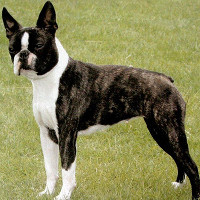
The Boston Terrier is a lively, highly intelligent, smooth coated, short-headed, compactly built, short-tailed, well balanced dog, brindle, seal or black in colour and evenly marked with white. The head is in proportion to the size of the dog and the expression indicates a high degree of intelligence. The body is rather short and well knit, the limbs strong and neatly turned, the tail is short and no feature is so prominent that the dog appears badly proportioned. The dog conveys an impression of determination, strength and activity, with style of a high order; carriage easy and graceful. A proportionate combination of « Colour and White Markings » is a particularly distinctive feature of a representative specimen. « Balance, Expression, Colour and White Markings » should be given particular consideration in determining the relative value of general appearance to other points. The clean-cut short backed body of the Boston Terrier coupled with the unique characteristics of his square head and jaw, and his striking markings have resulted in a most dapper and charming American original : The Boston Terrier. In a comparison of specimens of each sex, the only evident difference is a slight refinement in the bitch’s conformation.

Important proportions

The length of leg must balance with the length of body to give the Boston Terrier its striking square appearance. The Boston Terrier is a sturdy dog and must not appear to be either spindly or coarse. The bone and muscle must be in proportion as well as an enhancement to the dog’s weight and structure.

Behaviour / temperament

The Boston Terrier is a friendly and lively dog. The breed has an excellent disposition and a high degree of intelligence, which makes the Boston Terrier an incomparable companion.

Head

Cranial region

Skull
Square, flat on top, free from wrinkles; brow abrupt. 
Stop
Well defined.

Facial region

Nose
Black and wide, with a well defined line between the nostrils. Well opened nostrils.
Muzzle
Short, square, wide and deep and in proportion to the skull. It is free from wrinkles, shorter in length than in width or depth; not exceeding in length approximately one-third of the length of the skull. The muzzle from stop to end of the nose is parallel to the top of the skull.
Lips
The chops are of good depth, but not pendulous, completely covering the teeth when the mouth is closed.
Jaws and teeth
Jaws broad and square with short, regular teeth. The bite is even or sufficiently undershot to square the muzzle.
Cheeks
Flat.
Eyes
Wide apart, large, round and dark in colour. Set square in the skull and the outside corners are on a line with the cheeks as viewed from the front. Expression : Alert and kind, indicating a high degree of intelligence. This is a most important characteristic of the breed.
Ears
Small, carried erect, either natural or cropped to conform to the shape of the head and situated as near to the corners of the skull as possible.

Neck

The length of the neck must display an image of balance to the total dog. It is slightly arched, carrying the head gracefully and setting neatly into the shoulders.

Body

Body
The body should appear short.
Topline
Level.
Back
Just short enough to square the body.
Croup
Curves slightly to the set-on of the tail.
Chest
Deep with good width.
Ribs
Well sprung and carried well back to the loins.

Tail

Set-on low, short, fine and tapering, straight or screw and must not be carried above the horizontal. (Note : The preferred tail does not exceed in length more than one quarter the distance from set-on to hock).

Limbs

Forequarters

Generality
Forelegs set moderately wide apart and on a line with the upper tip of the shoulder-blades; straight in bone.
Shoulders
Sloping and well laid back, which allows for the Boston Terrier’s stylish movement.
Elbows
Stand neither in nor out.
Pastern
Short, strong. The dewclaws may be removed.
Forefeet
Small, round and compact, turned neither in nor out, with well arched toes and short nails.

Hindquarters

Upper thigh
Strong, well muscled, and set true.
Stifle
Well bent.
Hock
Short to the feet, turning neither in nor out, with a well defined hock joint.
Hind feet
Small and compact with short nails.

Gait and movement

The gait of the Boston Terrier is that of a sure footed, straight gaited dog, forelegs and hind legs moving straight ahead in line with perfect rhythm, each step indicating grace and power.

Coat

Hair
Short, smooth, bright and fine in texture.
Colour
Brindle, seal or black with white markings. Brindle is preferred only if all other qualities are equal. (Note : Seal defined : Seal appears black except it has a red cast when viewed in the sun or bright light).
Required markings : White muzzle band, white blaze between the eyes, white forechest.
Desired markings : White muzzle band, even white blaze between the eyes and over the head, white collar, white forechest, white on part or whole of forelegs and hind legs below the hocks. (Note : a representative specimen should not be penalized for not possessing « Desired Markings ».)
A dog with a preponderance of white on the head or body must possess sufficient merit otherwise to counteract its deficiencies.

Size and weight

Weight
Weight is divided by classes as follows :
• under 15 pounds (6,8 kg),
• 15 pounds and under 20 pounds (6,8 to 9 kg),
• 20 pounds and not to exceed 25 pounds (9 to 11,35 kg).

Faults

• Any departure from the foregoing points should be considered a fault and the seriousness with which the fault should be regarded should be in exact proportion to its degree and its effect upon the health and welfare of the dog and its ability to perform its traditional work.
• Faults listed should be in degree of seriousness.

General faults

 Blocky or chunky in appearance.
 Pinched or wide nostrils.
 Eyes showing too much white or haw.
 Size of ears out of proportion to size of head.
 Gaily carried tail.
 Legs lacking in substance.
 Straight in stifle.
 Splay feet.
 Gait rolling, paddling or weaving; hackney gait.

Serious faults

 Wry mouth.
 Any showing of the tongue or teeth when the mouth is closed.
 Roach back or sway back.
 Ribcage slab-sided.
 Any crossing movement, either front or rear.

Disqualifying faults

 Aggresive or overly shy.
 Dudley nose.
 Eyes blue in colour or any trace of blue.
 Docked tail.
 Solid black, solid brindle, or solid seal without required white markings.
 Grey or liver colours.

NB :

• Any dog clearly showing physical or behavioural abnormalities shall be disqualified.
• The above mentioned faults when occurring to a highly marked degree or frequently are disqualifying.
• Male animals should have two apparently normal testicles fully descended into the scrotum.
• Only functionally and clinically healthy dogs, with breed typical conformation should be used for breeding.

Bibliography

https://www.fci.be/


Detailed history

The Boston Terrier is the first breed that the Americans have created. He descended from British fighting dogs selected by crossbreeding in the nineteenth century and is a distant cousin of Pit Bull who has recently made headlines, dog fighting elsewhere not approved by the American Kennel Club.

In the second half of the nineteenth century, dog fighting was indeed very fashionable on both sides of the Atlantic, where they had replaced the fighting between dogs and bulls, banned by the British Parliament in 1835. Judged too heavy for these Circus games new way, the former Bulldog had been crossed with Terriers to get livelier and more nervous subjects. The most used burrow for this purpose was the White English Terrier, now almost 100 years old.

Thus, about 1865, one of these subjects arrived at Boston, on the east coast of the United States, by the name of Judge. It was an animal of about fifteen kilos, holding more Bulldog than Terrier: solidly built but of rather removed proportions, it had ears "in shell" (that is to say, folded in the back of head), a crocheted tail and a dress of the color typical of the current Boston Terrier: dark brindle with a white flame in the head and a large white collar. It is Judge who is the ancestor of all Boston Terriers.

It was crossed in 1870 with a dog named Gyp, resulting from a cross between a Bulldog and a Burrow, weighing about ten kilos, all white, very compact, with a short, square head and a straight tail. The result was Eph, who inherited the small size of his mother and the good construction of his father. Eph was a dark brindle male with big white marks.

From the mating of Eph and Kate, a golden brindle female, weighing about 9 kg, with short head and right tail, was born in 1877 Tom, who is considered by all cynologists as the first " true "Boston Terrier.

He was in any case one of the oldest subjects to possess the short tail "corkscrew", also called, in the jargon cynophilous, "comma", "croque" or "crocheted", which is characteristic of the race. This peculiarity began to shock his owner, Mr. Barnard, who even consulted a veterinarian to straighten the caudal appendage of his animal. This being naturally impossible, Barnard made up for it, and even tried to make it a fashion. Operation of diversion particularly successful, since this "defect" is today endorsed by the standard of the race.

Tom's litter brother, Tobey, though less representative, is the other mainstay of the breed, thanks to his quality offspring. The descendants of Tom and Tobey were then crossed with each other. Tobey and a dog whose history did not retain the name were, in 1878, the first Bull Terriers to present themselves under this name in a dog show, the Massachusetts' Kennel Show.

The original subjects formed a rather heterogeneous population: if they were all "round heads", some were rather heavy for their size, while others had a morphology of Terriers; there were long, short, straight, hooked tails, and the white marks of the dress varied considerably; there were even entirely white subjects. This did not, however, prevent thirty breeders and amateurs from the Boston area; the breeding of this type of dog was confined to the capital of Massachusetts and its environs; to found in 1889 an American Bull Terrier Club.

In 1891 they asked the American Kennel Club, a local counterpart of the Central Canine Society and founded seven years earlier, to register their breed. It was to count without the determined opposition of the British, fierce supporters of the "real" Bull Terriers, who, at that time, did not yet have the "rugby ball" head so characteristic of the current subjects, but which were rather comparable at Staffordshire Bull Terrier today. Their request, probably undiplomatic, was rejected by the AKC.

As pugnacious as their dogs, Boston Terriers were not defeated, and at the suggestion of journalist BW Lacy, they changed the name of their association to the Boston Terrier Club of America.

A new application having been presented to the American Kennel Club, it was this time the breeders of English Bulldogs who protested, fearing that the newcomer would overshadow their race. The AKC, embarrassed, then demanded that, prior to its recognition, the Boston Terrier be raised in pure lineage for at least three generations, the Club created a private register proving that at least 75 dogs had a known minimum as old. Thus was born in 1893 the first official American race.

The appearance of the Boston Terrier then evolved rapidly, with breeders choosing to select subjects with erect ears and symmetrical brindle spots, with a more typical Terrier morphology. At the same time, the Boston temperament was noticeably softened: a "must" for this dog that was originally intended for animal fights, and therefore had strong tendencies to aggression. Although the Americans are silent on this point, some European cynologists think that the Boston Terrier received, during its phase of improvement and fixation, an infusion of blood of French Bulldog, which he should in particular the shape of his head and its more civilized character than that of its distant ancestors.

The choice of the ideal weight to be included in the standard was the occasion for a long and serious debate: on the one hand, some breeders were reporting the growing popularity of small dogs, on the other, there was a definite demand for animals of more impressive morphology, weighing more than 15 kilos. Finally, a compromise was reached, resulting in the current standard (from 5 to 11 kg). American subjects have always tended to be in the upper part of this range (and even dogs exceeding the maximum do not incur disqualification for this reason alone), while in Europe average (6 to 7 kg) which are the most appreciated. The Boston Terrier quickly became very popular across the Atlantic since, between 1905 and 1935, this "little American gentleman", as he was nicknamed there, both because of his good dispositions and his "dress" black and white, never went below second place on the list of the most registered breeds in the AKC. At the height of its glory, the Boston Terrier represented between 20 and 30 engagements, all categories combined, in American dog shows. Today, with 25,000 registrations a year, he is still one of the 25 most popular dogs on the other side of the Atlantic.

Contrary to what might be implied by his family tree, the Boston Terrier is a very sociable dog with its congeners, including those of the same sex. The only "behavioral memories" he has kept of his Bulldogs ancestors are the courage he knows how to show if he is attacked by another dog, despite his light size, and the equality of exemplary character which he shows, because he is not a grouchy or easily irritable dog.

Terriers, he has the playful side and facetious, who can wear it, sometimes, to perform "tricks" to amuse his world, without sharing their propensity to bark, even if he is naturally vigilant. In the United States, it is even considered a defense dog, especially since its weight, as we have already seen, is generally higher than on the old continent.

But the Boston is more than a compromise between the dignity of the Bull and the liveliness of the Terrier. It has a set of features that make it one of the most suitable dogs for the pet dog function. He is proud and very dignified, extremely affectionate, and he constantly tries to please his masters, to whom he is devoted body and soul, which does not mean that he is invading. Alert and fast, it is not excessively stirring. Silent, however, he is attentive to everything that happens and will alert his entourage if an unusual or bizarre event occurs. Relatively calm, he is not the kind of apathetic.

It is a remarkable companion for the children: his patience, his phlegm, his playful temperament allow him to do wonders in this role. The Boston Terrier is easily educated because he understands very quickly what is required of him. Certainly, it happens to be somewhat cabochard, but it is the same for all the intelligent dogs, who know instantly detect the small weaknesses of their master and take advantage of it. He always knows how far to go without hurting or tired.

From a practical point of view, the Boston Terrier has many assets that make it an ideal companion in an apartment: its size, respectable, does not make it cumbersome; he is clean very young; no aesthetic operation is to be considered; her short, lustrous dress does not require any maintenance. Only his big black eyes, all full of tenderness, should be the object of small regular care because, being on the head, they are very exposed and therefore often fragile. Finally, it should be remembered that its flat face with shortened nasal passages may cause breathing difficulties. We will therefore avoid prolonged and intense efforts, as well as; lasting exposure to excessive heat. Yesterday ranked among pet dogs, the Boston Terrier is now ranked in the third group, that of Terriers, according to the criteria of the new nomenclature of dog breeds adopted by the International Cynological Federation in 1987 and implemented by the Society Canine plant in France since 1 January 1988. This decision is obviously not based on its origins or its usefulness, but on certain characteristics of its morphology.

Comments

Latest page updates

  • Yorkshire Terrier

    Yorkshire Terrier FCI Standard No. 86 Origin Great Britain Group Group 3 Terriers Section Section 4 Toy Terriers Working Without working trial Date of acceptance on a definitive basis by the FCI Saturday 30 October 1954 Date of publication of the official valid standard Tuesday 08 September 2026 Date of the last update Tuesday 06 October 2026 En...
  • West Highland White Terrier

    West Highland White Terrier FCI Standard No. 85 Origin Great Britain Group Group 3 Terriers Section Section 2 Small-sized Terriers Working Without working trial Date of acceptance on a definitive basis by the FCI Friday 29 October 1954 Date of publication of the official valid standard Tuesday 08 September 2026 Date of the last update Tuesday 06...
  • Welsh Terrier

    Welsh Terrier FCI Standard No. 78 Origin Great Britain Group Group 3 Terriers Section Section 1 Large- and medium sized Terriers Working Without working trial Date of acceptance on a definitive basis by the FCI Saturday 23 October 1954 Date of publication of the official valid standard Tuesday 08 September 2026 Date of the last update Tuesday 06...
  • Welsh Springer Spaniel

    Welsh Springer Spaniel FCI Standard No. 126 Origin Great Britain Group Group 8 Retrievers-Flushing Dogs-Water Dogs Section Section 2 Flushing Dogs Working With working trial Date of acceptance on a definitive basis by the FCI Thursday 30 December 1954 Date of publication of the official valid standard Tuesday 08 September 2026 Date of the last...
  • Welsh Corgi Pembroke

    Welsh Corgi Pembroke FCI Standard No. 39 Origin Great Britain Group Group 1 Sheepdogs and Cattle Dogs (except Swiss Cattle Dogs) Section Section 2 Cattledogs (except Swiss Cattledogs) Working Without working trial Date of acceptance on a definitive basis by the FCI Wednesday 13 November 1963 Date of publication of the official valid standard Tuesday 08...
  • Welsh Corgi Cardigan

    Welsh Corgi Cardigan FCI Standard No. 38 Origin Great Britain Group Group 1 Sheepdogs and Cattle Dogs (except Swiss Cattle Dogs) Section Section 2 Cattledogs (except Swiss Cattledogs) Working Without working trial Date of acceptance on a definitive basis by the FCI Tuesday 12 November 1963 Date of publication of the official valid standard Tuesday 08...
  • Sussex Spaniel

    Sussex Spaniel FCI Standard No. 127 Origin Great Britain Group Group 8 Retrievers, Flushing dogs, Water dogs. Section Section 2 Flushing dogs Working With working trial Date of acceptance on a definitive basis by the FCI Friday 31 December 1954 Date of publication of the official valid standard Tuesday 08 September 2026 Date of the last update Tuesday 06...
  • Staffordshire Bull Terrier

    Staffordshire Bull Terrier FCI Standard No. 76 Origin Great Britain Group Group 3 Terriers Section Section 3 Bull type Terriers Working Without working trial Date of acceptance on a definitive basis by the FCI Thursday 21 October 1954 Date of publication of the official valid standard Tuesday 08 September 2026 Date of the last update Tuesday 06...
  • Skye Terrier

    Skye Terrier FCI Standard No. 75 Origin Great Britain Group Group 3 Terriers Section Section 2 Small-sized Terriers Working Without working trial Date of acceptance on a definitive basis by the FCI Wednesday 20 October 1954 Date of publication of the official valid standard Tuesday 08 September 2026 Date of the last update Tuesday 06 October 2026 En...
  • Shetland Sheepdog

    Shetland Sheepdog FCI Standard No. 88 Origin Great Britain Group Group 1 Sheepdogs and Cattle Dogs Section Section 1 Sheepdogs Working Without working trial Date of acceptance on a definitive basis by the FCI Tuesday 09 November 1954 Date of publication of the official valid standard Tuesday 08 September 2026 Date of the last update Tuesday 06...
  • Sealyham Terrier

    Sealyham Terrier FCI Standard No. 74 Origin Great Britain Group Group 3 Terriers Section Section 2 Small sized Terriers Working Without working trial Date of acceptance on a definitive basis by the FCI Tuesday 19 October 1954 Date of publication of the official valid standard Tuesday 08 September 2026 Date of the last update Tuesday 06 October...
  • Scottish Terrier

    Scottish Terrier FCI Standard No. 73 Origin Great Britain Group Group 3 Terriers Section Section 2 Small-sized Terriers Working Without working trial Date of acceptance on a definitive basis by the FCI Monday 18 October 1954 Date of publication of the official valid standard Tuesday 08 September 2026 Date of the last update Tuesday 06 October...
  • Old English Sheepdog (Bobtail)

      Old English Sheepdog (Bobtail) FCI Standard No. 16     Origin   Great Britain Group   Group 1 Sheepdogs and Cattle Dogs (except Swiss Cattle Dogs) Section   Section 1 Sheepdogs Working   Without working trial Date of acceptance on a definitive basis by the FCI   Monday 25 November 1963 Date of publication of the official valid standard   Tuesday 08 September...
  • Norwich Terrier

    Norwich Terrier FCI Standard No. 72 Origin Great Britain Group Group 3 Terriers Section Section 2 Small-sized Terriers Working Without working trial Date of acceptance on a definitive basis by the FCI Saturday 16 October 1954 Date of publication of the official valid standard Tuesday 08 September 2026 Date of the last update Tuesday 06 October...
  • Norfolk Terrier

    Norfolk Terrier FCI Standard No. 272 Origin Great Britain Group Group 3 Terriers Section Section 2 Small-sized Terriers Working Without working trial Date of acceptance on a definitive basis by the FCI Saturday 01 October 1966 Date of publication of the official valid standard Tuesday 08 September 2026 Date of the last update Tuesday 06 October...
  • Manchester Terrier

    Manchester Terrier FCI Standard No. 71 Origin Great Britain Group Group 3 Terriers Section Section 1 Large and medium sized Terriers Working Without working trial Date of acceptance on a definitive basis by the FCI Friday 15 October 1954 Date of publication of the official valid standard Tuesday 08 September 2026 Date of the last update Tuesday 06 October...
  • Lakeland Terrier

    Lakeland Terrier FCI Standard No. 70 Origin Great Britain Group Group 3 Terriers Section Section 1 Large and medium-sized Terriers Working Without working trial Date of acceptance on a definitive basis by the FCI Thursday 14 October 1954 Date of publication of the official valid standard Tuesday 08 September 2026 Date of the last update Tuesday 06 October...
  • Labrador Retriever

      Labrador Retriever FCI Standard No. 122     Origin   Canada Group   Group 8 Retrievers, Flushing dogs, Water dogs Section   Section 1 Retrievers Working   With working trial Date of acceptance on a definitive basis by the FCI   Friday 24 December 1954 Date of publication of the official valid standard   Tuesday 08 September 2026 Date of the last update   Tuesday 06...
  • King Charles Spaniel

    King Charles Spaniel FCI Standard No. 128 Origin Great Britain Group Group 9 Companion and Toy Dogs Section Section 7 English Toy Spaniels Working Without working trial Date of acceptance on a definitive basis by the FCI Monday 03 January 1955 Date of publication of the official valid standard Tuesday 08 September 2026 Date of the last update Tuesday 06...
  • Harrier

      Harrier FCI Standard No. 295     Origin   Great Britain Translation   Mrs. Peggy Davis, brought up to day by Dr. Paschoud Group   Group 6 Scenthounds and related breeds Section   Section 1.2 Medium-sized Hounds Working   With working trial Date of acceptance on a definitive basis by the FCI   Wednesday 27 November 1974 Date of publication of the official valid...
  • Greyhound

    Greyhound FCI Standard No. 158 Origin Great Britain Group Group 10 Sighthounds Section Section 3 Short-haired sighthounds Working Without working trial Date of acceptance on a definitive basis by the FCI Saturday 23 April 1955 Date of publication of the official valid standard Tuesday 08 September 2026 Date of the last update Tuesday 06 October...
  • Gordon Setter

    Gordon Setter FCI Standard No. 6 Origin Great Britain Group Group 7 Pointing Dogs Section Section 2.2 British and Irish Pointers and Setters; Setters Working With working trial Date of acceptance on a definitive basis by the FCI Tuesday 28 May 1963 Date of publication of the official valid standard Tuesday 08 September 2026 Date of the last...
  • Golden Retriever

    Golden Retriever FCI Standard No. 111 Origin Great Britain Group Group 8 Retrievers, Flushing Dogs, Water Dogs Section Section 1 Retrievers Working With working trial Date of acceptance on a definitive basis by the FCI Thursday 02 December 1954 Date of publication of the official valid standard Tuesday 28 July 2009 Date of the last update Wednesday...
  • Fox Terrier Wire

    Fox Terrier Wire FCI Standard No. 169 Origin Great Britain Group Group 3 Terriers Section Section 1 Large and medium-sized Terriers Working Working trial optional Date of acceptance on a definitive basis by the FCI Friday 13 May 1955 Date of publication of the official valid standard Tuesday 08 September 2026 Date of the last update Tuesday 06...
  • Fox Terrier Smooth

    Fox Terrier Smooth FCI Standard No. 12 Origin Great Britain Group Group Terriers Section Section 1 Large and medium sized Terriers Working Working trial optional Date of acceptance on a definitive basis by the FCI Wednesday 26 June 1963 Date of publication of the official valid standard Tuesday 08 September 2026 Date of the last update Tuesday 06...
  • Flat Coated Retriever

    Flat Coated Retriever FCI Standard No. 121 Origin Great Britain Group Group 8 Retrievers-Flushing Dogs-Water Dogs Section Section 1 Retrievers Working With working trial Date of acceptance on a definitive basis by the FCI Thursday 23 December 1954 Date of publication of the official valid standard Tuesday 08 September 2026 Date of the last update Tuesday...
  • Field Spaniel

    Field Spaniel FCI Standard No. 123 Origin Great-Britain Group Group 8 Retrievers, Flushing Dogs, Water Dogs Section Section 2 Flushing Dogs Working With working trial Date of acceptance on a definitive basis by the FCI Monday 27 December 1954 Date of publication of the official valid standard Tuesday 08 September 2026 Date of the last update Tuesday...
  • English Toy Terrier

    English Toy Terrier FCI Standard No. 13 Origin Great Britain Group Group 3 Terriers Section Section 4 Toy Terriers Working Without working trial Date of acceptance on a definitive basis by the FCI Tuesday 17 September 1963 Date of publication of the official valid standard Tuesday 08 September 2026 Date of the last update Tuesday 06 October 2026 En...
  • English Springer Spaniel

    English Springer Spaniel FCI Standard No. 125 Origin Great Britain Group Group 8 Retrievers-Flushing Dogs-Water Dogs Section Section 2 Flushing Dogs Working With working trial Date of acceptance on a definitive basis by the FCI Wednesday 29 December 1954 Date of publication of the official valid standard Tuesday 08 September 2026 Date of the last...
  • English Setter

    English Setter FCI Standard No. 2 Origin Great Britain Group Group 7 Pointing Dogs Section Section 2.2 British and Irish Pointers and Setters, Setter Working With working trial Date of acceptance on a definitive basis by the FCI Wednesday 06 March 1963 Date of publication of the official valid standard Tuesday 08 September 2026 Date of the last...
  • English Pointer

    English Pointer FCI Standard No. 1 Origin Great Britain Group Group 7 Pointing Dogs Section Section 2.1 British and Irish Pointers and Setters, Pointer Working With working trial Date of acceptance on a definitive basis by the FCI Tuesday 05 March 1963 Date of publication of the official valid standard Tuesday 08 September 2026 Date of the last...
  • English Foxhound

    English Foxhound FCI Standard No. 159 Origin Great Britain Group Group 6 Scenthounds and related breeds Section Section 1.1 Large-sized Scent hounds Working With working trial Date of acceptance on a definitive basis by the FCI Monday 25 April 1955 Date of publication of the official valid standard Thursday 26 March 2009 Date of the last update Wednesday...
  • English Cocker Spaniel

    English Cocker Spaniel FCI Standard No. 5 Origin Great Britain Group Group 8 Retrievers, Flushing Dogs, Water Dogs Section Section 2 Flushing dogs Working With working trial Date of acceptance on a definitive basis by the FCI Wednesday 10 April 1963 Date of publication of the official valid standard Tuesday 08 September 2026 Date of the last...
  • Tibetan Mastiff

    Tibetan Mastiff FCI Standard No. 230 Origin Tibet (China)Patronage FCI Group Group 2 Pinscher and Schnauzer- Molossoid breeds- Swiss Mountain and Cattle Dogs Section Section 2.2 Molossoid breeds, Mountain type Working Without working trial Date of acceptance on a definitive basis by the FCI Tuesday 22 August 1961 Date of publication of the...
  • Deerhound

    Deerhound FCI Standard No. 164 Origin Great Britain Group Group 10 Sighthounds Section Section 2 Rough-haired Sighthounds Working Without working trial Date of acceptance on a definitive basis by the FCI Friday 29 April 1955 Date of publication of the official valid standard Tuesday 08 September 2026 Date of the last update Tuesday 06 October...
  • Dandie Dinmont Terrier

    Dandie Dinmont Terrier FCI Standard No. 168 Origin Great Britain Group Group 3 Terriers Section Section 2 Small-sized Terriers Working Without working trial Date of acceptance on a definitive basis by the FCI Thursday 12 May 1955 Date of publication of the official valid standard Tuesday 08 September 2026 Date of the last update Tuesday 06...
  • Curly Coated Retriever

    Curly Coated Retriever FCI Standard No. 110 Origin Great Britain Group Group 8 Retrievers, Flushing Dogs, Water Dogs Section Section 1 Retrievers Working With working trial Date of acceptance on a definitive basis by the FCI Friday 10 December 1954 Date of publication of the official valid standard Tuesday 08 September 2026 Date of the last...
  • Collie Smooth

    Collie Smooth FCI Standard No. 296 Origin Great Britain Group Group 1 Sheepdogs and Cattle Dogs (except Swiss Cattle Dogs) Section Section 1 Sheepdogs Working Without working trial Date of acceptance on a definitive basis by the FCI Wednesday 18 December 1974 Date of publication of the official valid standard Tuesday 08 September 2026 Date of the...
  • Collie Rough

    Collie Rough FCI Standard No. 156 Origin Great Britain Group Group 1 Sheepdogs and Cattle Dogs (except Swiss Cattle Dogs) Section Section 1 Sheepdogs Working Without working trial Date of acceptance on a definitive basis by the FCI Wednesday 13 April 1955 Date of publication of the official valid standard Tuesday 08 September 2026 Date of the...
  • Clumber Spaniel

    Clumber Spaniel FCI Standard No. 109 Origin Great Britain Group Group 8 Retrievers, Flushing dogs, Water dogs Section Section 2 Flushing dogs Working With working trial Date of acceptance on a definitive basis by the FCI Thursday 09 December 1954 Date of publication of the official valid standard Tuesday 08 September 2026 Date of the last update Tuesday...
  • Chow Chow

    Chow Chow FCI Standard No. 205 Origin China, patronage : Great Britain Group Group 5 Spitz and primitive type Section Section 5 Asian Spitz and related breeds Working Without working trial Date of acceptance on a definitive basis by the FCI Tuesday 10 December 1957 Date of publication of the official valid standard Tuesday 08 September 2026 Date...
  • Chinese Crested Dog

    Chinese Crested Dog FCI Standard No. 288 Origin China, patronage Great Britain Group Group 9 Companion and Toy Dogs Section Section 4 Hairless breeds Working Without working trial Date of acceptance on a definitive basis by the FCI Monday 17 July 1972 Date of publication of the official valid standard Tuesday 08 September 2026 Date of the last...
  • Cairn Terrier

    Cairn Terrier FCI Standard No. 4 Origin Great Britain Group Group 3 Terriers Section Section 2 Small-sized Terriers Working Without working trial Date of acceptance on a definitive basis by the FCI Saturday 06 April 1963 Date of publication of the official valid standard Tuesday 08 September 2026 Date of the last update Tuesday 06 October 2026 En...
  • Bullmastiff

    Bullmastiff FCI Standard No. 157 Origin Great Britain Group Group 2 Pinscher and Schnauzer Molossoid breeds - Swiss Mountain and Cattle Dogs Section Section 2.1 Molossoid breeds, Mastiff Type Working Without working trial Date of acceptance on a definitive basis by the FCI Saturday 23 April 1955 Date of publication of the official valid standard Tuesday...
  • English Bulldog

    English Bulldog FCI Standard No. 149 Origin Great Britain Group Group 2 Pinscher and Schnauzer Molossoid breeds-Swiss Mountain and Cattle Dogs Section Section 2.1 Molossoid breeds, Mastiff Type Working Without working trial Date of acceptance on a definitive basis by the FCI Monday 14 March 1955 Date of publication of the official valid standard Tuesday...
  • Bull Terrier

    Bull Terrier FCI Standard No. 11 Origin Grande-Bretagne Group Group 3 Terriers Section Section 3 Bull type Terriers Working Working trial optional Date of acceptance on a definitive basis by the FCI Saturday 26 June 1993 Date of publication of the official valid standard Tuesday 08 September 2026 Date of the last update Tuesday 06 October 2026 En...
  • Border Terrier

    Border Terrier FCI Standard No. 10 Origin Great Britain Group Group 3 Terriers Section Section 1 Large and medium-sized terriers Working Without working trial Date of acceptance on a definitive basis by the FCI Wednesday 26 June 1963 Date of publication of the official valid standard Tuesday 08 September 2026 Date of the last update Tuesday 06...
  • Bedlington Terrier

    Bedlington Terrier FCI Standard No. 9 Origin Great Britain Group Group 3 Terriers Section Section 1 Large and medium sized Terriers Working Without working trial Date of acceptance on a definitive basis by the FCI Thursday 20 June 1963 Date of publication of the official valid standard Tuesday 08 September 2026 Date of the last update Tuesday 06...
  • Bearded Collie

    Bearded Collie FCI Standard No. 271 Origin Great-Britain Group Group 1 Sheepdogs and Cattle Dogs (except Swiss Cattle Dogs) Section Section 1 Sheepdogs Working Without working trial Date of acceptance on a definitive basis by the FCI Wednesday 30 August 1967 Date of publication of the official valid standard Tuesday 08 September 2026 Date of the...
  • Beagle

    Beagle FCI Standard No. 161 Origin Great Britain Translation Prof. R. Triquet Group Group 6 Scent hounds and related breeds Section Section 1.3 Small-sized hounds Date of acceptance on a definitive basis by the FCI Tuesday 26 April 1955 Date of publication of the official valid standard Tuesday 08 September 2026 Date of the last update Tuesday 06...
  • Basset Hound

    Basset Hound FCI Standard No. 163 Origin Great Britain Group Group 6 Scent hounds and related breeds Section Section 1.3 Small-sized hounds Working With working trial Date of acceptance on a definitive basis by the FCI Thursday 28 April 1955 Date of publication of the official valid standard Tuesday 08 September 2026 Date of the last update Tuesday...
  • Basenji

    Basenji FCI Standard No. 43 Origin Democratic Republic of Congo, under the patronage of Great Britain Group Group 5 Spitz and primitive types Section Section 6 Primitive type Working Without working trial Date of acceptance on a definitive basis by the FCI Thursday 26 March 1964 Date of publication of the official valid standard Tuesday 08...
  • Airedale Terrier

    Airedale Terrier FCI Standard No. 7 Origin Great Britain Group Group 3 Terriers Section Section 1 Large and medium sized Terriers Working Working trial optional Date of acceptance on a definitive basis by the FCI Tuesday 28 May 1963 Date of publication of the official valid standard Tuesday 08 September 2026 Date of the last update Tuesday 06...
  • Afghan Hound

    Afghan Hound FCI Standard No. 228 Origin AfghanistanPatronage Great Britain Group Group 10 Sighthounds Section Section 1 Long-haired or fringed sighthounds Working Without working trial Date of acceptance on a definitive basis by the FCI Tuesday 12 December 1961 Date of publication of the official valid standard Tuesday 08 September 2026 Date of the...
  • Romagna Water Dog

    Romagna Water Dog FCI Standard No. 298 Origin Italy Translation Antonio Morsiani, Renée Sporre-Willes and Prof. R. TriquetRevised by ENCI and Renée Sporre-WillesRevised by the FCI Head OfficeOfficial language (EN). Group Group 8 Retrievers –Flushing Dogs –Water Dogs Section Section 3 Water Dogs Working Working trial optional Date of acceptance on a...
  • Whippet

    Whippet FCI Standard No. 162 Origin Great Britain Group Group 10 Sighthounds Section Section 3 Short-haired Sighthounds Working Without working trial Date of acceptance on a definitive basis by the FCI Wednesday 27 April 1955 Date of publication of the official valid standard Tuesday 08 September 2026 Date of the last update Tuesday 06 October...
  • Tibetan Terrier

    Tibetan Terrier FCI Standard No. 209 Origin Tibet, patronage Great Britain Group Group 9 Companion and Toy Dogs Section Section 5 Tibetan breeds Working Without working trial Date of acceptance on a definitive basis by the FCI Wednesday 18 December 1957 Date of publication of the official valid standard Tuesday 08 September 2026 Date of the last...
  • Tibetan Spaniel

    Tibetan Spaniel FCI Standard No. 231 Origin Tibet (China)Patronage Great Britain Group Group 9 Companion and Toy Dogs Section Section 5 Tibetan breeds Working Without working trial Date of acceptance on a definitive basis by the FCI Tuesday 22 August 1961 Date of publication of the official valid standard Tuesday 08 September 2026 Date of the...
  • Shih Tzu

    Shih Tzu FCI Standard No. 208 Origin Tibet, patronage Great Britain Group Group 9 Companion and Toy Dogs Section Section 5 Tibetan breeds Working Without working trial Date of acceptance on a definitive basis by the FCI Monday 16 December 1957 Date of publication of the official valid standard Tuesday 08 September 2026 Date of the last update Tuesday 06...
  • Pug

    Pug FCI Standard No. 253 Origin China, patronage Great Britain Group Group 9 Companion and Toy Dogs Section Section 11 Small Molossian type dogs Working Without working trial Date of acceptance on a definitive basis by the FCI Friday 04 November 1966 Date of publication of the official valid standard Tuesday 08 September 2026 Date of the last...
  • Pharaoh Hound

    Pharaoh Hound FCI Standard No. 248 Origin Malta, patronage Great Britain Group Group 5 Spitz and primitive types Section Section 6 Primitive type Working Without working trial Date of acceptance on a definitive basis by the FCI Friday 09 August 1963 Date of publication of the official valid standard Tuesday 08 September 2026 Date of the last...
  • Pekingese

    Pekingese FCI Standard No. 207 Origin China, patronage Great Britain Group Group 9 Companion and Toy Dogs Section Section 8 Japan Chin and Pekingese Working Without working trial Date of acceptance on a definitive basis by the FCI Thursday 03 November 1966 Date of publication of the official valid standard Tuesday 08 September 2026 Date of the last...
  • Parson Russell Terrier

    Parson Russell Terrier FCI Standard No. 339 Origin Great Britain Group Group 3 Terriers Section Section 1 Large and medium sized Terriers Working Working trial optional Date of acceptance on a definitive basis by the FCI Monday 04 June 2001 Date of acceptance on a provisional basis by the FCI Monday 02 July 1990 Date of publication of the...
  • Otterhound

    Otterhound FCI Standard No. 294 Origin Great Britain Group Group 6 Scenthounds and related breeds Section Section 1.1 Large-sized hounds Working Without working trial Date of acceptance on a definitive basis by the FCI Thursday 12 September 1974 Date of publication of the official valid standard Tuesday 08 September 2026 Date of the last update Tuesday 06...
  • Miniature Bull Terrier

    Miniature Bull Terrier FCI Standard No. 359 Origin Grande-Bretagne Group Group 3 Terriers Section Section 3 Bull type Terriers Working Working trial optional Date of acceptance on a definitive basis by the FCI Tuesday 05 July 2011 Date of acceptance on a provisional basis by the FCI Tuesday 05 July 2011 Date of publication of the official valid...
  • Mastiff

    Mastiff FCI Standard No. 264 Origin Great Britain Group Group 2 Pinscher and Schnauzer – Molossoid breeds - Swiss Mountain and Cattle Dogs Section Section 2.1 Molossoid breeds, Mastiff Type Working Without working trial Date of acceptance on a definitive basis by the FCI Thursday 05 November 1964 Date of publication of the official valid standard Tuesday 08...
  • Lhassa Apso

    Lhassa Apso FCI Standard No. 227 Origin Tibet (China)Patronage Great Britain Group Group 9 Companion and Toy Dogs Section Section 5 Tibetan breeds Working Without working trial Date of acceptance on a definitive basis by the FCI Saturday 19 November 1960 Date of publication of the official valid standard Tuesday 08 September 2026 Date of the last...
  • Lancashire-Heeler

    Lancashire-Heeler FCI Standard No. 360 Origin England, patronage : FCI Group Group 1 Sheepdogs and Cattle Dogs (except Swiss Cattle Dogs) Section Section 1 Sheepdogs Working Without working trial Date of acceptance on a provisional basis by the FCI Sunday 01 May 2016 Date of publication of the official valid standard Tuesday 08 September 2026 Date...

© 2026 Groupe Milouchouchou ASBL. Tous droits réservés. En savoir plus

Protected by Copyright01
