
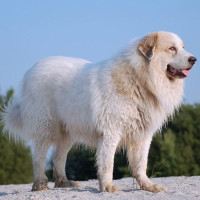
Pyrenean Mountain Dog

FCI standard Nº 137

Origin
France
Translation
Mrs Pamela Jeans-Brown, revised by Raymond Triquet and Alain Pécoult)
Group
Group 2 Pinscher and Schnauzer type dogs, Molossoids and mountain dogs and Swiss mountain dogs
Section
Section 2.2 Molossoids, mountain type.
Working
Without working trial
Acceptance on a definitive basis by the FCI
Tuesday 25 January 1955
Publication of the official valid standard
Tuesday 13 March 2001
Last update
Thursday 31 March 2005
En français, cette race se dit
Chien de montagne des Pyrénées
Diese Norm ist in deutscher Sprache sichtbar
Pyrenäen Berghund
En español, esta raza se dice
Perro de montaña de los Pirineos
In het Nederlands, wordt dit ras gezegd
Pyreneese Berghond

Usage

Pastoral guardian in the mountains.

Brief historical summary

Present in the Pyrenees from time immemorial, known in the Middle Ages and used as a guardian of castles, it is mentioned by Gaston Phoebus in the 14th century. Already appreciated as a companion dog in the 17th century, it reached glorious heights at the court of Louis XIV. The first detailed description of this breed dates from 1897 in the book by Count de Bylandt. Ten years later the first breed clubs were set up and in 1923 the Réunion of Pyrenean Dog Fanciers ( Réunion des Amateurs de Chiens Pyrénées – R.A.C.P.), at the instigation of Mr Bernard Sénac-Lagrange, registered the official standard with the SCC (Société Centrale Canine, French K.C.) the current standard is still very close to the standard worked out in 1923, only a few clarifying amendments having been made.

General appearance

Dog of great size, imposing and strongly built, but not without a certain elegance.

Important proportions

The widest part of the skull is equal to its length.
The muzzle is slightly Shorter than the skull.
The length of the body from the point of the shoulder to the point of the buttock is slightly greater than the height of the dog at the withers.
The depth of the chest is equal to, or slightly less than, half the height at the withers.

Behaviour / temperament

Used on its own to guarantee the protection of flocks from attacks by predators, its selection depended on its aptitude for guarding and dissuading as much as on its attachment to the flock. The resulting main qualities are strength and agility, allied to gentleness and attachment to those it is protecting. This protecting dog has a propensity for independence and a sense of initiative which demand a certain degree of authority from its owner.

Head

Cranial region

Head
Not too large in comparison with the size of the dog. Its sides are fairly flat.
Skull
The widest part of the skull is equal to its length. It is slightly rounded due to the sagittal crest being perceptible to the touch. Because the occipital protuberance is apparent, the back of the skull has on ogival shape. Superciliary ridges are not pronounced. The median furrow is scarcely perceptible to the touch between the eyes. 
Stop
Gentle slope.

Facial region

Nose
Totally black.
Muzzle
Broad, slightly shorter than the skull, narrowing progressively towards the tip. Seen from above it forms a blunt “V”. Well filled below the eyes.
Lips
Not very droopy, just enough to cover the lower jaw. Black or heavily marked with black, as is the palate.
Jaws and teeth
Complete dentition with healthy, white teeth. Scissors bite (upper incisors overlapping lower incisors without losing contact). Pincer bite tolerated as are the two lower pincers tipping forward.
Eyes
Rather small, almond-shaped, set slightly obliquely, with intelligent and contemplative expression, of amber-brown colour. Eyelids never loose. Gentle, dreamy look.
Ears
Set on level with the eye, fairly small, triangular in shape and rounded at the tip. They fall flat against the head and are carried slightly raised when the dog is alert.

Neck

Strong, relatively short, with very little dewlap.

Body

Body
The length of the body from the point of the shoulder to the point of the buttock is slightly greater than the height of the dog at the withers. The distance between the sternum and the ground is approximately half the height at the withers, never less.
Upper profile
Well-supported.
Withers
Broad.
Back
Of good length and strong.
Loin
Of moderate length.
Croup
Slightly oblique with fairly prominent haunches.
Chest
Not too low, but broad and long. Let down as far as the elbow but not lower. Its height is equal to or slightly less than half the height of the dog at the withers.
Ribs
The ribs are slightly rounded.
Side
Scarcely pronounced.

Tail

It reaches at least as far as the point of the hock. It is bushy and forms a plume. Carried low in repose with its tip forming a hook for preference. When the dog is alert, the tail rises towards the back, forming a strong circle with only the tip touching the loins (making the wheel “arroundera” to quote the expression used by the people of the Pyrenees).

Limbs

Forequarters

Generality
Upright, strong.
Shoulders
Moderately oblique.
Upper arm
Well muscled and moderately long.
Forearm
Straight, strong and well-fringed.
Carpal
The wrist is in line with the forearm.
Pastern
Slightly oglique.
Forefeet
Not long, compact, with slightly arched toes.
The front legs sometimes have single or double dewclaws.

Hindquarters

Generality
The hind legs have long, more abundant fringes than the forelegs. Seen from behind, they are perpendicular to the ground.
Upper thigh
Well muscled, not very long and moderately oblique, well-defined muscle.
Lower thigh
Of moderate length, strong.
Stifle
Moderately angulated and parallel to the body.
Hock
Broad, lean, moderately angulated.
Hind feet
Not long, compact, with slightly arched toes.
The hind legs cach have double well-formed dewclaws.

Gait and movement

The movement of the Pyrenean Mountain Dog is powerful and free, it is never ponderous, the movement is extended rather than fast, and not without a certain suppleness and elegance. The angulation of the dogs permits an unflagging gait.

Skin

Thick and supple, often showing patches of pigmentation over the whole body.

Coat

Hair
Well-furnished, flat, quite long and supple, rather crisp on the shoulders and back, longer on the tail and around the neck where it can be slightly wavy. The trouser hair, finer and woollier, is very thick. The undercoat is also thick.
Colour
White or white with patches appearing grey (badger or wolf) or pale yellow or orange (arrouye) on the head, ears, base of the tail and sometimes on the body. The most appreciated are badger grey patches.

Size and weight

Height at withers
Males from 70 cm to 80 cm, females from 65 cm to 75 cm. A tolerance of + 2 cm is allowed for perfectly typed specimens.
Weight
About 60 kg for males and 45 kg for females.

Faults

• Any departure from the foregoing points should be considered a fault and the seriousness with which the fault should be regarded should be in exact proportion to its degree and its effect upon the health and welfare of the dog and its ability to perform its traditional work.
• Faults listed should be in degree of seriousness.

General faults

 General appearance giving the impression of heaviness, without distinction.
 Flat, flabby, sluggish dog.
 Head too heavy, rectangular in shape.
 Skull too broad, bulging forehead.
 Stop too pronounced or non-existent.
 Lips too pendulous forming flews.
 Insufficient pigmentation on the nose; eye-rims and lips.
 Eyes round, light, deep-set or prominent, too large or too small, set too close together or too far apart.
 Third eyelid visible.
 Hard expression.
 Ears broad, long, curled, folded, carried too far back, set high.
 Neck slender, a little long or on the contrary, too short, giving the impression that the head is sunk into the shoulders.
 Too much dewlap.
 Body sway or roach-backed dipping, whippety or drooping belly.
 Chest too broad or too narrow, slab-sided or, on the contrary, barrel-chested.
 Tail not enough furnishing or carried badly, too short or too long, without a plume, not “making the wheel” in action, or making it continuously, even in repose.
 Forequarters turning out or turning in.
 Too open a scapulo-humeral angle.
 Hindquarters turning out or in.
 Hock too straight or too angulated.
 Feet long or splayed.
 Coat short or curly, silky, soft or lack of undercoat.

Disqualifying faults

 Aggressive or overly shy.
 Nose not completely black.
 Over or undershot, or any malformation of the jaws.
 Flesh colour on the eye-rims.
 Yellow eyes.
 No dewclaws or single dewclaw or atrophied double dewclaws on hind feet.
 Any colour not specified in the standard.
 Outside the limits.

NB :

• Any dog clearly showing physical or behavioural abnormalities shall be disqualified.
• The above mentioned faults when occurring to a highly marked degree or frequently are disqualifying.
• Male animals should have two apparently normal testicles fully descended into the scrotum.
• Only functionally and clinically healthy dogs, with breed typical conformation should be used for breeding.

Bibliography

https://www.fci.be/


Detailed history

The Mountain Dog of the Pyrenees is the most famous French dog in the world. He is also, like the little Pyrenean Shepherd with whom it is sometimes confused, the one who stayed closest to his regional roots.

As evidenced by the discovery of bones of such dogs in archaeological sites dating from 1800 to 1000 BC. -C., The Mountain of the Pyrenees would be present in the high valleys of the south-west of France since the Bronze Age, discovery which at the same time destroys the thesis of some authors that this dog was introduced in Spain by the Phoenicians, especially by their counter of Cadiz. The Mountain of the Pyrenees, implanted thus in this region of France, would have left it, except for some exceptional and noticed circumstances, that for a hundred years.

As for its origins proper, it is very likely that its ancestor comes from Central Asia and descends from the Tibetan Mastiff. If the road is long from the Tibetan highlands to the Pyrenees, it is nonetheless lined with mountain dogs whose relatives are more than obvious with the Patou (nickname affectionate but derogatory given to the race by the mountaineers Pyrenean), kinship that the famous dog specialist Senac-Lagrange had already noticed since 1908. Thus, from Afghanistan to Turkey, while passing by Iran and the Caucasus, then from Yugoslavia to the high reliefs Spanish and Portuguese, while passing by Czechoslovakia, the Alps and the Pyrenees, evolve various types of dogs similar in many points and which answer to the names of Leonberg, Shepherd of the Tatras, Shepherd of Abruzzes and Maremma, Kuvasz, Komondor, Saint-Bernard and Mountain Dog of Pyrenees.

Even more significantly, the map of distribution of mountain dogs in Europe faithfully reproduces that concerning the presence of the last great predators, such as bears, lynxes and wolves (which can not be found today, only in some parts of Central and Eastern Europe), which clearly shows that the primary role assigned to these dogs was the defense of herds. No doubt, mountain dogs have had a much wider spread, but their natural habitat is in the most inaccessible and wildest areas, where people have long lived on the basis of a traditional pastoral economy.

The case of the Mountain of the Pyrenees is in this respect exemplary, since the wolves coming from Spain have, until a recent period; the last wolf of the Pyrenees was killed in 1885; represented a real danger to the flocks. According to Hubbard, they "flooded" the valleys of the French side of the Pyrenees. But also, and above all, the Pyrenean chain has proved the last refuge of bears (whose too few specimens that we try to save no longer represent a danger). The "bear god", moreover, considered in ancient pagan traditions as a symbol of power and fertility, haunted for centuries the collective imagination of mountaineers. Thus, the Pyrenees were the setting of a true mountain civilization, which does not have its equivalent in any other French region: in very rigorous conditions, sometimes implying a real misery, the Pyrenean mountaineers clung, with as many obstinacy as pride, breeding herds very often ethical, to maintain their independence. In this difficult situation, which still marked the daily life of many Pyrenean villages in the eighteenth century, the large white dogs, watching over these meager herds and their obstinate pastors, were an essential element of survival for the mountain communities. The large size of the Pyrenean Dog (it was four times larger than the sheep which it ensured the safety) may seem paradoxical, given the indigence of its food based on milk and cheese crusts. In fact, perhaps we have not looked enough at this phenomenon: we tend to think that progress in canine breeding and nutrition has led to an increase in the size of dogs; but this does not seem to apply to the Pyrenees Mountain, which, as the oldest photographic documents indicate, was once as much impressive as it is today; some even say he was even stronger.

The earliest written testimonies on the Mountain Dog of the Pyrenees date from the end of the 14th century: it is mentioned that certain representatives of the race kept from 1350 the castles of Foix, Orthez and Carcassonne. In 1407, says the historian Bourdette, this dog was used in the castle of Lourdes; he even specifies that the sentry-boxes were specially furnished for the accommodation of the dog and the watchman, and that the jailers of the castle prison were always accompanied by one or more of these dogs. Argotte de Molina and Gaston Phoebus, who call him "bear dog", show the Pyrenean with the famous iron collar bristling with long spikes, which prevented him from being strangled during the fighting with his formidable opponent.

The Mountain of the Pyrenees knew an unexpected notoriety in 1675, on the occasion of the trip of Mme de Maintenon to Eaux de Barèges, where she accompanied the young duke of Maine, son of Louis XIV and Mme de Montespan, then eight years, whose education she directed. The young duke took a friendship for a Patou and wanted to take him back to Versailles.

Two years later, the Marquis de Louvois, who had also come to the cure in the region, bought Betpouey a year-old subject, magnificent according to the chronicle, and caused a sensation at court. The Dog of the Pyrenees then enjoyed a certain vogue, as evidenced by a painting by François Desportes (1661 - 1743), official painter of hunts and royal dogs, which represents two specimens facing a wolf. The Pyrenean having been decreed "royal dog", many courtiers considered it fashionable to have one, for the care of their Parisian homes and their provincial castles.

In 1824, La Fayette sent a couple of these dogs to his American friend Skinner and, in a missive, warmly recommended the breed as "invaluable to sheep breeders in all areas exposed to wolf attacks and to the slaughtering dogs of lambs ". Unfortunately, at that time, these dogs did not strain overseas. It was not until the nineteenth century that the evidence on the Pyrenean Dog increased. They emanate from French and foreign cynologists, such as Brehm, the Earl of Bylandt, Pierre Mégnin, Benedict Henri Revoil, Hugh Dalziel, but also travel stories, reports, journal articles (the passion of the Romantics for the " wild beauty "of the mountain puts it in fashion, and the popularization of thermal cures brings many townspeople to discover the Pyrenean countries). Prints and postcards reproduce the most characteristic aspects of mountain civilization: the Pyrenean Dog is in a good position. If, on occasion, his role as an avalanche dog is recalled, this is his essential function; herdsman; which is then most often featured.

Already, in 1600, Olivier de Serres, in his Theater of agriculture and mesnage of the fields, opposed the dogs of "dark color", intended for the guard of the houses, and the white dogs which, "by the conformity of their color, converse easily with sheep and sheep ". This was a way too literary, no doubt, to appreciate the work of the Pyrenean Dog. Among the mountaineers, we see things more realistically: raising such dogs is to ensure effective guardians; provided they are of good breed.

At the beginning of the nineteenth century, to be still empirical, the selection is none the less required of the connoisseurs, on the markets where, traditionally, the sales take place. The testimony of Commettant (quoted by Dr. Luquet) in 1808 is, in this respect, revealing: "Every Sunday, the shepherds went down to Cauterets where, on the market place, they were sure not to go back to their cabin. empty pockets if the dogs they brought were purebred. "

From about 1850, the fame of the Dog of the Pyrenees having definitely overflowed from its ancestral pastures, the cynophiles begin to be interested in the race. At the first French exhibition, organized by the Imperial Society of Acclimatization in 1863 at the Orangerie, several specimens are presented and two of them get a reward. Following the second exhibition, organized in Paris in 1865, the English cynologist Richardson notes: "The most remarkable among the guard dogs are the Dogs of the Pyrenees, which are large; their hair is hard, quite long and well furnished, their ears are drooping and their white coat with large orange, ocher or gray spots, especially on the head and neck; their tail is very bushy, they have blue eyes and double lugs. "

From then on, the breed is regularly presented in dog shows; well before then, the years 1906 - 1907, as it is sometimes claimed; even if the exposed specimens are often of very variable quality.

In 1874, in the newspaper L'Acclimatation, appears an article presumably written by de Kermadec, a cynophile warned, which has the merit of identifying the regions from which could be originated the most beautiful subjects and to signal the dangers of debasement and rarefaction that already weighed on the race. In contrast, it contrasts with the western Pyrenees dog, widespread in the region of Bagneres, white with black spots and rather squat, that of the eastern Pyrenees, which "is tall, has slender shapes, snout nose, ears pointed and drooping , the coat is soft, silky and abundant, a snow white with light gray spots or coffee-au-lait; usually, these spots exist only on the ears and on the face. In the latter case, it has a blackish band on each eye; often, too, it is entirely white. This type, perhaps the most beautiful of all French guard dogs, is, like all mountain dogs, remarkable for its vigor and vigilance. It was formerly widespread in the part of the Pyrenees which borders the department of Ariege and the Republic of Andorra, but it seems to be very rare today, if it is not completely destroyed. Fortunately, these remarks were somewhat pessimistic, since, at present, one still finds subjects typified not having as far of pedigree. The purest subjects were elsewhere in the sector Tarbes - Lourdes - Cauterets.

The merit of a first complete description of the "Patou" goes to the Count of Bylandt, the great Belgian cynologist; in 1897, he published in The Races of Dogs (a monumental work in two volumes) a draft standard, with illustrations in support. Overall, despite some errors (the "pointed" muzzle, or the back that can be "saddled"), the portrait corresponds to that of today's dogs, although two typical characteristics are not mentioned: the famous "Pyrenean expression" and the tail making the wheel ("arroundera", say the Pyrenees) when the dog is in action. Bylandt had the opportunity to check his appreciations on the ground, since he made, in 1907, a long trip in the Pyrenees, to accompany Théodore Dretzen, a powerful magnate of the press who had decided to devote his free time to the breeding of the Pyrenean Dog, on the advice of Dr. Pierre Mégnin. For two months, Dretzen and Bylandt traveled the Pyrenees in search of beautiful subjects, and they brought back several dogs in the Paris region. Passionate about his new breeder business, Dretzen did not spare his means: he built a model kennel in Bois-Colombes, including a kitchen, infirmary, bathrooms and drying rooms, and he surrounded his dogs attentions.

Original as it was, the action of this enlightened amateur, as fortunate as disinterested, contributed effectively to make known the race to the French cynophiles. Photos of the time show some of Dretzen's dogs, which are well typed, and his breeding (affix Zaïella) won the award of the President of the Republic. His enterprise gave rise to imitators; thus, following his trip to the Pyrenean country, a "Pyrenean Dog Club" was created in Argeles-Gazost, at the initiative of a breeder, M. Byasson, who published a pamphlet, the first of its kind, the history of the race.

At the same time, in 1907 Cauterets founded another club, the Pastour Club, around Baron A. de la Chevrelière, president, with the principal members Dr. Moulonguet and MM. Camajou and Sénac-Lagrange. This club also published a standard inspired by Bylandt's description. The efforts of these associations, too dispersed, could not stop a certain decline of the race, nor prevent the dissemination of topics more or less well typed, sold to tourists French and foreign, or even shipped to the north of France, Belgium and in Britain.

The First World War contributed to aggravate the situation of the race, because it decimated the ranks of dog breeders, as well as those of the mountaineers who maintained traditional breeding. After the turmoil, however, a very positive reaction occurred. In the early twenties, in fact, it was found that there was another Pyrenean race, that of the small Shepherd of the Pyrenees, and it was then that took shape the idea to jointly know these two pure products of the mountain, completely complementary in their traditional job, ensuring their selection; Especially since it was necessary to avoid scattering, as was the case before, the good wishes (a first club of the small Shepherd of the Pyrenees had been created in 1921). Hence the birth, in 1923, of the Meeting of Pyrenean dog lovers (RACP), under the leadership of Bernard Sénac-Lagrange, who took charge of the destiny of the two Pyrenean breeds: from the year of the creation of the Club, he published a newsletter, then had the association affiliated to the CCS; finally, after many studies, especially in the field, he wrote in 1927 a new standard, which is still current, with a few details (added, in 1970, a list of defects, endorsed by the International Cynological Federation in 1975, and some clarifications made in 1986, concerning the pigmentation of mucous membranes and truffles).

The Second World War was an opportunity to test the "warlike" qualities of the Pyrenees, since some units of alpine hunters, in France, were provided with dogs serving as liaison agents, for the transmission of messages (their whiteness made them virtually invisible in snowy landscapes). In the United States, the armed forces also mobilized Pyrenees. Nevertheless, the war greatly and durably contrasts the spread of the breed, especially in France.

Today, the Mountain has become rare in the Pyrenean chain; however, says Guy Mansencal, "he still lives there, certainly in limited numbers, since the last two wars, which, if they have altered some constants somewhat, have not however removed his biotype." It has also been the subject of renewed interest in France, thanks to the soap opera Belle et Sebastien, whose heroine was, we remember, a bitch of the Pyrenees (role played in France). made by two males). However, the promotional effect, temporary, is now exhausted, and the workforce is currently down. But the Pyrenees has made followers outside his homeland. The endearing nature of this dog and the outstanding services it can provide in mountain environments explain its worldwide distribution (which Sénac-Lagrange did not foresee). It is even, without doubt, the French race prevalent in the greatest number of countries.

In his native mountains, the Dog of the Pyrenees was called to tasks as numerous as varied: guardian of the castles of the South-West for more than six hundred years; he was also, when necessary, a pack dog, supplying even isolated villages, as reported by C. Douillard: "In Ariège, during a winter of the last war, a column of five or six Pyrenees crossed the valley covered with snow, loaded with small parcels. Information taken, these dogs were going to carry in an isolated village, cut of the world, supplies and objects of urgent necessity. "

These various and brilliant states of service must not, however, make us forget that, for centuries, the Mountain of the Pyrenees had for principal function to guarantee the safety of the herds; at the time when wolves, lynx and bears; not to mention the marauders; They were plentiful, he had to prevent these predators from taking an animal from the flock, and even to prevent one of them from approaching too closely, as the terrified animals might throw themselves into a cliff. Flock and shepherd having taken their nocturnal quarter, the Mountain, provided with its protective collar, stood guard; choosing a strategic location (a small nipple, for example, from where he watched the surrounding area), he performed regular rounds, continually launching his deep, powerful, sometimes deafened barking, always impressive and dissuasive even for the aggressors the more enterprising. He was above all a night-dog, discreet and calm during the day; and even sleepy, at least in appearance; but suddenly activating with twilight. Its effectiveness was proverbial: only one Mountain was enough to put to flight or to challenge the wolf or the lynx, but, specified Dralet in 1813, "it takes two or three to resist the attacks of the bears".

With the almost total disappearance of predators, the role of the Dog of the Pyrenees is so far become accessory, today, in its mountains? A sheep farmer exclaims: "The role of the Mountain is important in the prevention of all herd attacks by stray dogs or by foxes or even wild boars. "

This permanence of the ancestral qualities of the Pyrenean Dogs is confirmed in other mountainous regions, like those of Canada and the United States, where, put in competition with other races to watch over immense herds of sheep, has been shown to be very effective, even in the most delicate situations (in this respect, a subject named Ben, who has managed, alone, a 75 kg cougar) is mentioned.

The Mountain Guardian's abilities, which manifest themselves spectacularly when the herds are on pasture, also apply to the defense of buildings. Particularly valuable function in isolated farms; where, for centuries, one wondered if the stranger who approached was friend or foe. One of the least qualities of the Mountain is not to be able to distinguish, for sure, one and the other. "When, at night, a belated neighbor goes home, following the wall of the farm, the dog does not bark and does not even get up, because he knows what steps he hears every day," writes a connoisseur Patou, J. Dhers. "If the passer-by," he adds, "is a stranger, the dog goes to the entrance of the court and follows the man with his eyes; he lets him go away to a certain distance and does not worry about it anymore. But if the stranger enters the court, the dog escorts him by barking to warn his master, and he will not let him come near the house, the stables, or the locals, before the latter arrives. In the meantime, the unknown will do well to take care of his actions and to refrain from threats. "

Dhers further explains: "It is certain that delivered to itself, the good Dog of the Pyrenees attacks only at the last extremity, but then, nothing stops it. And he concludes: "I hold this dog for the best and safest guardian that exists because intelligent, observant, brave, cold and inaccessible to fear. "

Transposed in a more urban setting, the Mountain will do wonders if he is in charge of guarding a large property, in a park: sleeping peacefully in his corner during the day, he will be alert at dusk, and, all his senses awake, he will patrol in incessant rounds as long as the darkness reigns, answering with a dull bark, in the form of an ultimatum, at the least abnormal noise that will have alerted him.

The qualities of the Mountain still have their counterpart: it is necessary, given its temperament, to have it well in hand; for this dog, gentle but extremely mistrustful, knows how to be very cabochard on occasion. Also, "this born-born autonomist needs a hand-to-hand master whom he can respect and whose esteem will fill him", as correctly diagnosed by Dr. Millemann, veterinarian-counselor (and experienced breeder) of the RACP. Dog naturally domineering, and rather obedient, the Mountain must be educated very early and very firmly; it is particularly advisable to instil in him solid notions of recall, for he is willing to run away; which can be a source of trouble (for him, in particular) in an urbanized environment.

Towards his fellow creatures, Patou is generally not a model of tolerance. Some subjects even show a propensity to jump on any German Shepherd or related dog passing nearby; atavism, perhaps, of the old wolf hunter? On the other hand, the hostile demonstrations of the pugs leave it mostly indifferent.

His innate guardian qualities make the Mountain sufficiently aggressive; if the circumstances so require; and, in the opinion of all those who have a long practice of this dog, one should not try to increase his aggressiveness by a training. Building a Defense Mountain might even be dangerous, with heightened aggression and an immoderate taste for independence that can be an explosive mix. In fact, the manifestation of an authoritative firmness on the part of the teacher, and a balanced way of life, guarantee a satisfactory behavior of the Mountain, if the subject is of good quality.

If it is a little more bulky than many dogs called "companions", the Mountain can be very endearing. For who knows how to understand it; and it takes psychology, patience and common sense, for lack of "feeling", this dog, as brave as sweet, is not deprived in his hours of mischief, cheerfulness and a joyous indiscipline close to humor. These traits appear on reading A man and his dog, where Jean Nourry narrated with great verve his trouble with his Mountain during the last war. And, ideal companion of the man of action, the Dog of the Pyrenees also agrees with the contemplative, who knows how to appreciate the nonchalant elegance of his dog, to get lost in his unfathomable eyes and to dream with him deep nights where, in ancient times, the mountain rang the formidable bark of a Patou.

Comments

Latest page updates

  • Southern Hound

    Southern Hound He is not recognized by the F.C.I. Origin Great Britain Translation Francis Vandersteen En français, cette race se dit Chien du Sud Diese Norm ist in deutscher Sprache sichtbar Südlicher Laufhund En español, esta raza se dice Sabueso del sur In het Nederlands, wordt dit ras gezegd Zuidelijke Hond   The Southern Hound was a large...
  • St. John's Water Dog

    St. John's Water Dog He is not recognized by the F.C.I. Origin Canada Translation Francis Vandersteen En français, cette race se dit Chien d’eau de St. John's Diese Norm ist in deutscher Sprache sichtbar St. John's Wasserhund En español, esta raza se dice Perro de aguas de San Juan In het Nederlands, wordt dit ras gezegd St. John's Water Dog The St...
  • Rache Hound

    Rache Hound He is not recognized by the F.C.I. Origin Middle Ages Translation Francis Vandersteen En français, cette race se dit Chien courant Rache Diese Norm ist in deutscher Sprache sichtbar Rache-Laufhund En español, esta raza se dice Sabueso Rache In het Nederlands, wordt dit ras gezegd Rache-hond This breed is also known as RacchRachRatch   The term...
  • Welsh Grey Sheepdog

    Welsh Grey Sheepdog He is not recognized by the F.C.I. Origin Wales Translation Francis Vandersteen En français, cette race se dit Chien de berger gallois gris Diese Norm ist in deutscher Sprache sichtbar Waliser Grauer Schäferhund En español, esta raza se dice Pastor Gris Galés In het Nederlands, wordt dit ras gezegd Welsh Grey Herdershond This breed is...
  • Old Croatian Sighthound

    Old Croatian Sighthound He is not recognized by the F.C.I. Origin Croatia Translation Francis Vandersteen En français, cette race se dit Lévrier croate ancien Diese Norm ist in deutscher Sprache sichtbar Alter kroatischer Windhund En español, esta raza se dice Viejo lebrel croata In het Nederlands, wordt dit ras gezegd Oude Kroatische Windhond This...
  • Norman Hound

    Norman Hound He is not recognized by the F.C.I. Origin France Translation Francis Vandersteen En français, cette race se dit Chien normand Diese Norm ist in deutscher Sprache sichtbar Normannischer Laufhund En español, esta raza se dice Sabueso Normando In het Nederlands, wordt dit ras gezegd Normandische Brak   Little is known about the origins of...
  • Moscow Water Dog

    Moscow Water Dog He is not recognized by the F.C.I. Origin Russia Translation Francis Vandersteen En français, cette race se dit Chien d'eau de Moscou Diese Norm ist in deutscher Sprache sichtbar Moskauer Wasserhund En español, esta raza se dice Perro de agua de Moscú In het Nederlands, wordt dit ras gezegd Moskou-waterhond This breed is also...
  • Tracking Hound

    Tracking Hound He is not recognized by the F.C.I. Origin Middle Ages Translation Francis Vandersteen En français, cette race se dit Chien pisteur Diese Norm ist in deutscher Sprache sichtbar Spürhund En español, esta raza se dice Sabueso de rastro In het Nederlands, wordt dit ras gezegd Speurhond This breed is also known as LimerLymerLyam...
  • Laconian

    Laconian He is not recognized by the F.C.I. Origin Ancient Laconia, Greece Translation Francis Vandersteen En français, cette race se dit Laconien Diese Norm ist in deutscher Sprache sichtbar Lakonier En español, esta raza se dice Laconio In het Nederlands, wordt dit ras gezegd Laconisch This breed is also known as SpartanCastorian   The Laconian is an...
  • Halls Heeler

    Halls Heeler He is not recognized by the F.C.I. Origin Australia Translation Francis Vandersteen En français, cette race se dit Halls Heeler Diese Norm ist in deutscher Sprache sichtbar Halls Heeler En español, esta raza se dice Halls Heeler In het Nederlands, wordt dit ras gezegd Halls Heeler   The Halls Heeler is the presumed ancestor of two...
  • Dogo Cubano

    Dogo Cubano He is not recognized by the F.C.I. Origin Cuba Translation Francis Vandersteen The Dogo Cubano, also known as the Cuban Dogue, Cuban Bloodhound and Cuban Mastiff, is an extinct breed of dog from Cuba. It was of the Bullmastiff type and was used for bull and dog fighting. The breed was introduced to Cuba to capture runaway slaves...
  • Dalbo Dog

    Dalbo Dog He is not recognized by the F.C.I. Origin Sweden Translation Francis Vandersteen En français, cette race se dit Chien de Dalbo Diese Norm ist in deutscher Sprache sichtbar Dalbo-Hund En español, esta raza se dice Perro Dalbo In het Nederlands, wordt dit ras gezegd Dalbo-hond This breed is also known as DalbohundDalsland Mastiff   Icelandic...
  • Cordoba Fighting Dog

    Cordoba Fighting Dog He is not recognized by the F.C.I. Origin Argentina Translation Francis Vandersteen En français, cette race se dit Chien de combat de Cordoue Diese Norm ist in deutscher Sprache sichtbar Córdoba-Kampfhund En español, esta raza se dice Perro de pelea de Córdoba In het Nederlands, wordt dit ras gezegd Cordoba-vechthond This breed is...
  • Celtic Greyhound

    Celtic Greyhound He is not recognized by the F.C.I. Origin Celtic Mythology Translation Francis Vandersteen En français, cette race se dit Lévrier celte Diese Norm ist in deutscher Sprache sichtbar Keltische Windhund En español, esta raza se dice Lebrel celta In het Nederlands, wordt dit ras gezegd Keltische windhond   The Celtic Greyhound is an...
  • Belgian Mastiff

    Belgian Mastiff He is not recognized by the F.C.I. Origin Belgium Translation Francis VandersteenOrigin SRSH-KMSH - Belgian Royal Canine SocietyAuthentic language FR Group Group 2 : Pinscher and Schnauzer - Molossoid and Swiss Mountain and Cattle Dogs Section Section 2.1 : Molossoids, mastiff type Working Without working trial En français, cette...
  • Argentine polar dog

    Argentine polar dog He is not recognized by the F.C.I. Origin Argentina Translation Francis Vandersteen The Argentine polar dog (perro polar argentino) was a breed of Argentine dog that is now extinct. Argentine polar dogs were developed by the Argentine army to provide sled dogs for their Antarctic bases. The breed was the result of a cross...
  • Alaunt

    Alaunt He is not recognized by the F.C.I. Origin Central Asia Translation Francis Vandersteen This breed is also known as Kavkaz AlauntCaucasian AlauntAlan DoggePersian AlauntContinental AlauntEnglish AlauntFrench AlauntSpanish AlauntAlan DogArnaut Dogge The legendary Alaunt is one of the most important Molosse breeds in history, but also one of...
  • Small Dutch Hound

    Small Dutch Hound He is not recognized by the F.C.I. Origin The Netherlands Translation Francis Vandersteen En français, cette race se dit Petit Chien courant néerlandais Diese Norm ist in deutscher Sprache sichtbar Kleiner niederländischer Brackenhund En español, esta raza se dice Sabueso holandés pequeño In het Nederlands, wordt dit ras gezegd Kleine...
  • Sri Lankan Hound

    Sri Lankan Hound He is not recognized by the F.C.I. Origin Sri Lankan Translation Francis Vandersteen En français, cette race se dit Chien courant du Sri Lanka Diese Norm ist in deutscher Sprache sichtbar Sri-Lanka-Hund En español, esta raza se dice Sabueso de Sri Lanka In het Nederlands, wordt dit ras gezegd Sri Lankaanse Brak This breed is also...
  • Bulgarian Tricolour Hound

    Bulgarian Tricolour Hound He is not recognized by the F.C.I. Origin Bulgaria Translation Francis Vandersteen En français, cette race se dit Chien courant tricolore bulgare Diese Norm ist in deutscher Sprache sichtbar Bulgarischer Dreifarbiger Laufhund En español, esta raza se dice Sabueso tricolor búlgaro In het Nederlands, wordt dit ras gezegd Bulgaarse...
  • Međimurje Small Dog

    Međimurje Small Dog He is not recognized by the F.C.I. Origin Northwestern Croatia Translation Francis Vandersteen En français, cette race se dit Petit chien du Međimurje Diese Norm ist in deutscher Sprache sichtbar Međimurje-Kleinhund En español, esta raza se dice Perro pequeño de Međimurje In het Nederlands, wordt dit ras gezegd Međimurje-hondje This...
  • Serbian Yellow Hound

    Serbian Yellow Hound He is not recognized by the F.C.I. Origin Serbia (Balkans, Southeast Europe) Translation Francis Vandersteen En français, cette race se dit Chien jaune serbe Diese Norm ist in deutscher Sprache sichtbar Serbischer Gelber Laufhund En español, esta raza se dice Sabueso Amarillo Serbio In het Nederlands, wordt dit ras gezegd Servische...
  • Gotland Hound

    Gotland Hound He is not recognized by the F.C.I. Origin Sweden Translation Francis Vandersteen En français, cette race se dit Chien de chasse de Gotland Diese Norm ist in deutscher Sprache sichtbar Gotlandhund En español, esta raza se dice Sabueso de Gotland In het Nederlands, wordt dit ras gezegd Gotlandhond This breed is also known as Gotland...
  • Westerwald Mountain Dog

    Westerwald Mountain Dog He is not recognized by the F.C.I. Origin Germany Translation Francis Vandersteen En français, cette race se dit Bouvier du Westerwald Diese Norm ist in deutscher Sprache sichtbar Westerwalder Sennenhund En español, esta raza se dice Perro de Montaña de Westerwald In het Nederlands, wordt dit ras gezegd Westerwaldse...
  • Carnia Hound

    Carnia Hound He is not recognized by the F.C.I. Origin Italy Translation Francis Vandersteen En français, cette race se dit Chien courant de Carnia Diese Norm ist in deutscher Sprache sichtbar Carnia-Hund En español, esta raza se dice Sabueso de Carnia In het Nederlands, wordt dit ras gezegd Carnia-hond This breed is also known as Segugio Carnico   The...
  • Kemmer Feist

    Kemmer Feist He is not recognized by the F.C.I. Origin Southern United States Translation Francis Vandersteen En français, cette race se dit Kemmer Feist Diese Norm ist in deutscher Sprache sichtbar Kemmer Feist En español, esta raza se dice Kemmer Feist In het Nederlands, wordt dit ras gezegd Kemmer Feist   The Kemmer Feist originates from the...
  • Alpine Spaniel

    Alpine Spaniel He is not recognized by the F.C.I. Origin Switzerland Translation Francis Vandersteen En français, cette race se dit Epagneul Alpin Diese Norm ist in deutscher Sprache sichtbar Alpenspaniel En español, esta raza se dice Spaniel Alpino In het Nederlands, wordt dit ras gezegd Alpenspaniël   Alpine Spaniels were bred by canons in Alpine...
  • Alpine Mastiff

    Alpine Mastiff He is not recognized by the F.C.I. Origin Switzerland Translation Francis Vandersteen En français, cette race se dit Mâtin alpin Diese Norm ist in deutscher Sprache sichtbar Alpenmastiff En español, esta raza se dice Mastín Alpino In het Nederlands, wordt dit ras gezegd Alpenmastiff   The Alpine Mastiff was an ancient, giant working...
  • Hairless Chihuahua

    Hairless Chihuahua He is not recognized by the F.C.I. Origin Mexico Translation Francis Vandersteen En français, cette race se dit Chihuahua nu Diese Norm ist in deutscher Sprache sichtbar Nackter Chihuahua En español, esta raza se dice Chihuahua sin pelo In het Nederlands, wordt dit ras gezegd Haarloze Chihuahua   The Chihuahua is a small, lively,...
  • Argentine Pila

    Argentine Pila He is not recognized by the F.C.I. Origin Argentina Translation Francis Vandersteen En français, cette race se dit Pila Argentin Diese Norm ist in deutscher Sprache sichtbar Argentinischer Pila En español, esta raza se dice Pila Argentino In het Nederlands, wordt dit ras gezegd Argentijnse Pila This breed is also known as Perro...
  • Ecuadorian Hairless Dog

    Ecuadorian Hairless Dog He is not recognized by the F.C.I. Origin Ecuador Translation Francis Vandersteen En français, cette race se dit Chien nu équatorien Diese Norm ist in deutscher Sprache sichtbar Ecuadorianischer Nackthund En español, esta raza se dice Perro sin pelo ecuatoriano In het Nederlands, wordt dit ras gezegd Ecuadoriaanse...
  • Tesem

    Tesem He is not recognized by the F.C.I. Origin Egypt Translation Francis Vandersteen En français, cette race se dit Tesem Diese Norm ist in deutscher Sprache sichtbar Tesem En español, esta raza se dice Tesem In het Nederlands, wordt dit ras gezegd Tesem   The Tesem was a hunting dog from ancient Egypt. Now extinct, its ancestry is believed to...
  • Salish Woolly Dog

    Salish Woolly Dog He is not recognized by the F.C.I. Origin British Columbia, Canada Translation Francis Vandersteen En français, cette race se dit Chien laineux Salish Diese Norm ist in deutscher Sprache sichtbar Salish-Wollhund En español, esta raza se dice Perro Lanudo Salish In het Nederlands, wordt dit ras gezegd Salish wollige hond This...
  • Tierra del Fuego Dog

    Tierra del Fuego Dog He is not recognized by the F.C.I. Origin South America Translation Francis Vandersteen En français, cette race se dit Chien de Terre de Feu Diese Norm ist in deutscher Sprache sichtbar Feuerlandhund En español, esta raza se dice Perro de Tierra del Fuego In het Nederlands, wordt dit ras gezegd Tierra del Fuego-hond This...
  • Techichi

    Techichi He is not recognized by the F.C.I. Origin Mexico Translation Francis Vandersteen En français, cette race se dit Techichi Diese Norm ist in deutscher Sprache sichtbar Techichi En español, esta raza se dice Techichi In het Nederlands, wordt dit ras gezegd Techichi   The Techichi was an indigenous dog of Mesoamerica, specifically associated...
  • Hare Indian Dog

    Hare Indian Dog He is not recognized by the F.C.I. Origin Canada Translation Francis Vandersteen The Hare Indian Dog is an extinct domesticated dog; possibly a breed of domestic dog, hybrid coyote/dog or domestic coyote; previously found and originally bred in northern Canada by the Hare Indians for hunting. It had the speed and certain...
  • Tahitian Dog

    Tahitian Dog He is not recognized by the F.C.I. Origin Tahiti Translation Francis Vandersteen En français, cette race se dit Chien de Tahiti Diese Norm ist in deutscher Sprache sichtbar Tahiti-Hund En español, esta raza se dice Perro Tahitiano In het Nederlands, wordt dit ras gezegd Tahitiaanse hond   The Tahitian Dog is an extinct Polynesian breed,...
  • Polynesian Dog

    Polynesian Dog He is not recognized by the F.C.I. Origin Polynesia Translation Francis Vandersteen En français, cette race se dit Chien polynésien Diese Norm ist in deutscher Sprache sichtbar Polynesischer Hund En español, esta raza se dice Perro polinesio In het Nederlands, wordt dit ras gezegd Polynesische hond   The term "Polynesian dog" does...
  • Marquesan Dog

    Marquesan Dog He is not recognized by the F.C.I. Origin Marquesas Islands Translation Francis Vandersteen En français, cette race se dit Chien des Marquises Diese Norm ist in deutscher Sprache sichtbar Marquesas-Hund En español, esta raza se dice Perro Marquesano In het Nederlands, wordt dit ras gezegd De Marquesaanse hond This breed is also...
  • Kuri

    Kuri He is not recognized by the F.C.I. Origin New Zealand, between "Waikava" & Mataura plains, Catlins Translation Francis Vandersteen This breed is also known as Maori dog Kurī, or Pacific dog, were a unique breed, brought to Aotearoa New Zealand by ancestors of Māori. These animals were prized – not necessarily as friends, but as valuable...
  • Chiribaya Dog

    Chiribaya Dog He is not recognized by the F.C.I. Origin Peru Translation Francis Vandersteen The Chiribaya Dog (perro Chiribaya) or Peruvian Shepherd Dog (perro pastor Peruano) was a pre-Columbian breed of dog from southwestern Peru, identified by the 42 mummies discovered by anthropologist Sonia Guillén Oneglio in the Ilo district, Moquegua...
  • Philippine Forest Dog

    Philippine Forest Dog He is not recognized by the F.C.I. Origin Philippines Translation Francis Vandersteen En français, cette race se dit Chien des forêts des Philippines Diese Norm ist in deutscher Sprache sichtbar Philippinischer Waldhund En español, esta raza se dice Perro del Bosque Filipino In het Nederlands, wordt dit ras gezegd Filipijnse...
  • Lai Dog

    Lai Dog He is not recognized by the F.C.I. Origin Vietnam Translation Francis Vandersteen En français, cette race se dit Chien de Lai Diese Norm ist in deutscher Sprache sichtbar Lai-Hund En español, esta raza se dice Perro Lai In het Nederlands, wordt dit ras gezegd Lai-hond   With its unique appearance and hunting dog origins, the Lai Dog is...
  • Pampas Hound

    Pampas Hound He is not recognized by the F.C.I. Origin Brazil, Argentina, and Uruguay Translation Francis Vandersteen En français, cette race se dit Chien de chasse des Pampas Diese Norm ist in deutscher Sprache sichtbar Pampashund En español, esta raza se dice Sabueso de las Pampas In het Nederlands, wordt dit ras gezegd Pampashond   The Pampas Hound...
  • Zerdava

    Zerdava He is not recognized by the F.C.I. Origin Turkey and Georgia Translation Francis Vandersteen En français, cette race se dit Zerdava Diese Norm ist in deutscher Sprache sichtbar Zerdava En español, esta raza se dice Zerdava In het Nederlands, wordt dit ras gezegd Zerdava This breed is also known as Eastern Black Sea SpitzKapi Kopegi   The...
  • I-Twina

    I-Twina He is not recognized by the F.C.I. Origin Southern/Eastern Africa Translation Francis Vandersteen En français, cette race se dit I-Twina Diese Norm ist in deutscher Sprache sichtbar I-Twina En español, esta raza se dice I-Twina In het Nederlands, wordt dit ras gezegd I-Twina   The I-Twina is a specific variety of Africanis, an ancient dog breed...
  • Greek Greyhound

    Greek Greyhound He is not recognized by the F.C.I. Origin Greece Translation Francis Vandersteen En français, cette race se dit Lévrier grec Diese Norm ist in deutscher Sprache sichtbar Griechischer Windhund En español, esta raza se dice Galgo Griego In het Nederlands, wordt dit ras gezegd Griekse Windhond   The Greek Greyhound is medium-sized, and its...
  • Khoikhoi Hottentot Dog

      Khoikhoi Hottentot Dog He is not recognized by the F.C.I. Origin South Africa Translation Francis Vandersteen En français, cette race se dit Chien Khoïkhoï Hottentot Diese Norm ist in deutscher Sprache sichtbar Khoikhoi-Hottentottenhund En español, esta raza se dice Perro Hotentote Khoikhoi In het Nederlands, wordt dit ras gezegd Khoikhoi...
  • Santal Hound

    Santal Hound He is not recognized by the F.C.I. Origin India Translation Francis Vandersteen En français, cette race se dit Chien de chasse Santal Diese Norm ist in deutscher Sprache sichtbar Santal-Hund En español, esta raza se dice Sabueso Santal In het Nederlands, wordt dit ras gezegd Santal jachthond   The Santal Hound is an indigenous Indian...
  • Middle Eastern Village Dog

    Middle Eastern Village Dog He is not recognized by the F.C.I. Origin Middle East Translation Francis Vandersteen En français, cette race se dit Chien de village du Moyen-Orient Diese Norm ist in deutscher Sprache sichtbar Dorfhund aus dem Nahen Osten En español, esta raza se dice Perro de aldea de Oriente Medio In het Nederlands, wordt dit ras...
  • Avuvi

    Avuvi He is not recognized by the F.C.I. Origin Ghana and Togo Translation Francis Vandersteen En français, cette race se dit Avuvi Diese Norm ist in deutscher Sprache sichtbar Avuvi En español, esta raza se dice Avuvi In het Nederlands, wordt dit ras gezegd Avuvi This breed is also known as Ghana Stray Dog   Ghana stray dogs are free-roaming dogs that...
  • Old Spanish Pointer

    Old Spanish Pointer He is not recognized by the F.C.I. Origin Spain Translation Francis Vandersteen En français, cette race se dit Braque espagnol ancien Diese Norm ist in deutscher Sprache sichtbar Altspanischer Vorstehhund En español, esta raza se dice Pointer Español Antiguo In het Nederlands, wordt dit ras gezegd Oude Spaanse Pointer This breed...
  • Paisley Terrier

    Paisley Terrier He is not recognized by the F.C.I. Origin Scotland Translation Francis Vandersteen The Paisley Terrier is a descendant of its ancestor, the Skye Terrier, with a similar temperament and appearance.Records from 1440 use the word terrier, telling us that the Skye Terrier was not the first of this group, although we have little...
  • Blue Bay Shepherd

    Blue Bay Shepherd He is not recognized by the F.C.I. Origin U.S.A. Translation Francis Vandersteen En français, cette race se dit Berger de la Baie Bleue Diese Norm ist in deutscher Sprache sichtbar Blue Bay Schäferhund En español, esta raza se dice Pastor Azul de la Bahía In het Nederlands, wordt dit ras gezegd Blauwe Baai Herdershond   The Blue...
  • Tweed Water Spaniel

    Tweed Water Spaniel He is not recognized by the F.C.I. Origin Great Britain Translation Francis Vandersteen En français, cette race se dit Epagneul d'eau du Tweed Diese Norm ist in deutscher Sprache sichtbar Tweed Wasserspaniel En español, esta raza se dice Spaniel de Agua del Tweed In het Nederlands, wordt dit ras gezegd Tweed Waterspaniël   The...
  • Old English Terrier

    Old English Terrier He is not recognized by the F.C.I. Origin Great Britain Translation Francis Vandersteen En français, cette race se dit Terrier anglais ancien Diese Norm ist in deutscher Sprache sichtbar Alte Englische Terrier En español, esta raza se dice Terrier Inglés Antiguo In het Nederlands, wordt dit ras gezegd Oude Engelse Terriër   Also...
  • Old English Bulldog

    Old English Bulldog He is not recognized by the F.C.I. Origin Great Britain Translation Francis Vandersteen En français, cette race se dit Bouledogue anglais ancien Diese Norm ist in deutscher Sprache sichtbar Altenglische Bulldogge En español, esta raza se dice Bulldog Inglés Antiguo In het Nederlands, wordt dit ras gezegd Oude Engelse Bulldog   When...
  • North Country Beagle

    North Country Beagle He is not recognized by the F.C.I. Origin Great Britain Translation Francis Vandersteen Few records remain describing the appearance of the North Country Beagle, except that it resembled the Southern Hound, the English Foxhound and the modern Harrier. It has been said that the North Country Beagle was shorter than the...
  • Norfolk Spaniel

    Norfolk Spaniel He is not recognized by the F.C.I. Origin Great Britain Translation Francis Vandersteen The Norfolk Spaniel or Shropshire Spaniel is a dog breed that has been extinct since the early 20th century. It was originally thought to have originated from the work of one of the Dukes of Norfolk, but this theory was disproved after being...
  • English White Terrier

    English White Terrier He is not recognized by the F.C.I. Origin Great Britain Translation Francis Vandersteen This breed is also known as White TerrierOlde English White TerrierEnglish WhiteOld White Manchester TerrierBirmingham White Terrier A brief presentation of the English White Terrier The English White Terrier was one of the first, if not...
  • English Water Spaniel

    English Water Spaniel He is not recognized by the F.C.I. Origin Great Britain Translation Francis Vandersteen En français, cette race se dit Epagneul d'eau anglais Diese Norm ist in deutscher Sprache sichtbar Englischer Wasserspaniel En español, esta raza se dice Spaniel de Agua Inglés In het Nederlands, wordt dit ras gezegd Engelse Waterspaniël   The...
  • Cur Dog

    Cur Dog He is not recognized by the F.C.I. Origin U.S.A. Translation Francis Vandersteen En français, cette race se dit Chien Cur Diese Norm ist in deutscher Sprache sichtbar Cur-Hunde En español, esta raza se dice Perros Cur In het Nederlands, wordt dit ras gezegd Curhond   Cur dogs are a diverse group of intelligent, energetic, and loyal working breeds...
  • Cumberland Sheepdog

    Cumberland Sheepdog He is not recognized by the F.C.I. Origin Great Britain Translation Francis Vandersteen En français, cette race se dit Berger de Cumberland Diese Norm ist in deutscher Sprache sichtbar Cumberland Shepherd En español, esta raza se dice Pastor de Cumberland In het Nederlands, wordt dit ras gezegd Cumberland Shepherd   The...
  • Buckhound

    Buckhound He is not recognized by the F.C.I. Origin Great Britain Translation Francis Vandersteen En français, cette race se dit Buckhound Diese Norm ist in deutscher Sprache sichtbar Buckhound En español, esta raza se dice Buckhound In het Nederlands, wordt dit ras gezegd Buckhound   The Buckhound is an extinct breed of English hound, formerly...
  • Miniature Bulldog

    Miniature Bulldog He is not recognized by the F.C.I. Origin Great Britain Translation Francis Vandersteen En français, cette race se dit Bouledogue Miniature Diese Norm ist in deutscher Sprache sichtbar Zwergbulldogge En español, esta raza se dice Bulldog Miniatura In het Nederlands, wordt dit ras gezegd Miniatuur Bulldog   The Toy Bulldog was a...
  • Bullenbeisser

    Bullenbeisser He is not recognized by the F.C.I. Origin Germany and the Netherlands Translation Francis Vandersteen The Bullenbeisser was a Molosser-type dog native to Germany and the Netherlands. Bred for a variety of purposes, the Bullenbeisser specialized in bull-baiting and wild boar hunting. Also known as the Barenbeiszer, Bullenbijter,...
  • Panda German Shepherd

    Panda German Shepherd He is not recognized by the F.C.I. Origin Germany Translation Francis Vandersteen En français, cette race se dit Berger Allemand Panda Diese Norm ist in deutscher Sprache sichtbar Panda-Schäferhund En español, esta raza se dice Pastor Alemán Panda In het Nederlands, wordt dit ras gezegd Panda Duitse Herder   Panda German...
  • Russian Shepherd Dog

    Russian Shepherd Dog He is not recognized by the F.C.I. Origin Russia Translation Francis Vandersteen En français, cette race se dit Chien de berger russe Diese Norm ist in deutscher Sprache sichtbar Russischer Schäferhund En español, esta raza se dice Pastor Ruso In het Nederlands, wordt dit ras gezegd Russische Herdershond This breed is also known...
  • Sulimov Dog

    Sulimov Dog He is not recognized by the F.C.I. Origin Russia Translation Francis Vandersteen En français, cette race se dit Chien Sulimov Diese Norm ist in deutscher Sprache sichtbar Sulimov-Hund En español, esta raza se dice Perro Sulimov In het Nederlands, wordt dit ras gezegd Sulimov-hond This breed is also known as Shalaika   The Sulimov dog is a...
  • Kamchatka Sled Dog

    Kamchatka Sled Dog He is not recognized by the F.C.I. Origin Russia Translation Francis Vandersteen En français, cette race se dit Chien de traîneau du Kamtchatka Diese Norm ist in deutscher Sprache sichtbar Kamtschatka-Schlittenhund En español, esta raza se dice Perro de trineo de Kamchatka In het Nederlands, wordt dit ras gezegd Kamtsjatka-sledehond This...
  • Chukotka Sled Dog

    Chukotka Sled Dog He is not recognized by the F.C.I. Origin Russia Translation Francis Vandersteen En français, cette race se dit Chien de traîneau de Tchoukotka Diese Norm ist in deutscher Sprache sichtbar Tschukotkas Schlittenhund En español, esta raza se dice Perro de Trineo de Chukotka In het Nederlands, wordt dit ras gezegd Tsjoekotka-sledehond   The...
  • Dupuy Pointing Dog

    Dupuy Pointing Dog FCI standard Nº 178 Origin France Translation Mrs. Peggy Davis Group Group 7 Pointing Dogs Section Section 1.1 Continental Pointing Dogs « Braque » Type Working With working trial Acceptance on a definitive basis by the FCI Friday 21 June 1963 Publication of the official valid standard Friday 07 August 1998 En français, cette race...
  • Sanyo Dog

    Sanyo Dog He is not recognized by the F.C.I. Origin Japan Translation Francis Vandersteen En français, cette race se dit Chien de Sanyo Diese Norm ist in deutscher Sprache sichtbar Sanyo-Hund En español, esta raza se dice Perro de Sanyo In het Nederlands, wordt dit ras gezegd Sanyo-hond   The dogs of the Sanyo region more closely resemble those of...
  • Satsuma Dog

    Satsuma Dog He is not recognized by the F.C.I. Origin Japan Translation Francis Vandersteen En français, cette race se dit Chien de Satsuma Diese Norm ist in deutscher Sprache sichtbar Satsuma-Hund En español, esta raza se dice Perro Satsuma In het Nederlands, wordt dit ras gezegd Satsuma-hond   The Satsuma Dog was used as a hunting dog in the...
  • Neri Dog

    Neri Dog He is not recognized by the F.C.I. Origin Japan Translation Francis Vandersteen En français, cette race se dit Chien Neri Diese Norm ist in deutscher Sprache sichtbar Neri-Hund En español, esta raza se dice Perro Neri In het Nederlands, wordt dit ras gezegd Neri-hond   This dog breed originated in the village of Akagin, Tone district...
  • Kumano Dog

    Kumano Dog He is not recognized by the F.C.I. Origin Japan Translation Francis Vandersteen En français, cette race se dit Chien de Kumano Diese Norm ist in deutscher Sprache sichtbar Kumano-Hund En español, esta raza se dice Perro de Kumano In het Nederlands, wordt dit ras gezegd Kumano-hond   This is apparently a map of the estimated distribution...
  • Kurosakaishi Dog

    Kurosakaishi Dog He is not recognized by the F.C.I. Origin Japan Translation Francis Vandersteen En français, cette race se dit Chien de Kurosakaishi Diese Norm ist in deutscher Sprache sichtbar Kurosakaishi-Hund En español, esta raza se dice Perro Kurosakaishi In het Nederlands, wordt dit ras gezegd Kurosakaishi-hond   Three or four ri (12 to 16 km)...
  • Hane Dog

    Hane Dog He is not recognized by the F.C.I. Origin Japan Translation Francis Vandersteen En français, cette race se dit Chien de Hane Diese Norm ist in deutscher Sprache sichtbar Hane-Hund En español, esta raza se dice Perro de Hane In het Nederlands, wordt dit ras gezegd Hane-hond This breed is also known as Hane Inu   A local dog from the city of...
  • Amami Dog

    Amami Dog He is not recognized by the F.C.I. Origin Japan Translation Francis Vandersteen En français, cette race se dit Chien d'Amami Diese Norm ist in deutscher Sprache sichtbar Amami-Hund En español, esta raza se dice Perro de Amami In het Nederlands, wordt dit ras gezegd Amami-hond   Boar hunting is a common practice on the Amami Islands...
  • Iwate Dog

    Iwate Dog He is not recognized by the F.C.I. Origin Japan Translation Francis Vandersteen En français, cette race se dit Chien d'Iwate Diese Norm ist in deutscher Sprache sichtbar Iwate-Hund En español, esta raza se dice Perro de Iwate In het Nederlands, wordt dit ras gezegd Iwate-hond   Historically, the term "Iwate dog" refers to the medium-sized...
  • Yayoi Dog

    Yayoi Dog He is not recognized by the F.C.I. Origin Japan Translation Francis Vandersteen En français, cette race se dit Chien Yayoi Diese Norm ist in deutscher Sprache sichtbar Yayoi-Hund En español, esta raza se dice Perro Yayoi In het Nederlands, wordt dit ras gezegd Yayoi-hond   An ancient breed, the Yayoi is one of the two main ancestors of...
  • Yamakariya Dog

    Yamakariya Dog He is not recognized by the F.C.I. Origin Japan Translation Francis Vandersteen En français, cette race se dit Chien de Yamakariya Diese Norm ist in deutscher Sprache sichtbar Yamakariya-Hund En español, esta raza se dice Perro Yamakariya In het Nederlands, wordt dit ras gezegd Yamakariya-hond This breed is also known as Yamakariya...
  • Yakushima Hound

    Yakushima Hound He is not recognized by the F.C.I. Origin Japan Translation Francis Vandersteen En français, cette race se dit Chien de Yakushima Diese Norm ist in deutscher Sprache sichtbar Yakushima-Hund En español, esta raza se dice Sabueso de Yakushima In het Nederlands, wordt dit ras gezegd Yakushima-hond   Originating from Shimagai Island, where dogs...
  • Tsugaru Dog

    Tsugaru Dog He is not recognized by the F.C.I. Origin Japan Translation Francis Vandersteen En français, cette race se dit Chien de Tsugaru Diese Norm ist in deutscher Sprache sichtbar Tsugaru-Hund En español, esta raza se dice Perro Tsugaru In het Nederlands, wordt dit ras gezegd Tsugaru-hond This breed is also known as Aomori Dog   The Tsugaru...
  • Sendai Dog

    Sendai Dog He is not recognized by the F.C.I. Origin Japan Translation Francis Vandersteen En français, cette race se dit Chien de Sendai Diese Norm ist in deutscher Sprache sichtbar Sendai-Hund En español, esta raza se dice Perro de Sendai In het Nederlands, wordt dit ras gezegd Sendai-hond   The Sendai Dog (from Sendai Prefecture) is a land dog...
  • Sekishu Dog

    Sekishu Dog He is not recognized by the F.C.I. Origin Japan Translation Francis Vandersteen En français, cette race se dit Chien Sekishu Diese Norm ist in deutscher Sprache sichtbar Sekishu-Hund En español, esta raza se dice Perro Sekishu In het Nederlands, wordt dit ras gezegd Sekishu-hond   Originally, the Shiba Inu Sanin consisted of two lines. The...
  • Sanin-Tora

    Sanin-Tora He is not recognized by the F.C.I. Origin Japan Translation Francis Vandersteen En français, cette race se dit Sanin-Tora Diese Norm ist in deutscher Sprache sichtbar Sanin-Tora En español, esta raza se dice Sanin-Tora In het Nederlands, wordt dit ras gezegd Sanin-Tora   The term "Sanin-Tora" refers to the Kai Ken (also called Tora Inu...
  • Mikawa Land Dog

    Mikawa Land Dog He is not recognized by the F.C.I. Origin Japan Translation Francis Vandersteen En français, cette race se dit Chien terrestre de Mikawa Diese Norm ist in deutscher Sprache sichtbar Mikawa-Erdhund En español, esta raza se dice Perro de Tierra de Mikawa In het Nederlands, wordt dit ras gezegd Mikawa Aardhond This breed is also known...
  • Mikawa Dog

    Mikawa Dog He is not recognized by the F.C.I. Origin Japan Translation Francis Vandersteen En français, cette race se dit Chien Mikawa Diese Norm ist in deutscher Sprache sichtbar Mikawa-Hund En español, esta raza se dice Perro Mikawa In het Nederlands, wordt dit ras gezegd Mikawa-hond This breed is also known as Mikawa InuMikawa KenAichi Dog   The...
  • Maeda Dog

    Maeda Dog He is not recognized by the F.C.I. Origin Japan Translation Francis Vandersteen En français, cette race se dit Chien Maeda Diese Norm ist in deutscher Sprache sichtbar Maeda-Hund En español, esta raza se dice Perro Maeda In het Nederlands, wordt dit ras gezegd Maeda-hond This breed is also known as Maeda KenKaga Dog   The Maeda dog is a...
  • Koyasu Dog

    Koyasu Dog He is not recognized by the F.C.I. Origin Japan Translation Francis Vandersteen En français, cette race se dit Chien de Koyasu Diese Norm ist in deutscher Sprache sichtbar Koyasu-Hund En español, esta raza se dice Perro Koyasu In het Nederlands, wordt dit ras gezegd Koyasu-hond This breed is also known as Koyasu InuTakayasu Inu   The...
  • Koshino Dog

    Koshino Dog He is not recognized by the F.C.I. Origin Japan Translation Francis Vandersteen En français, cette race se dit Chien Koshino Diese Norm ist in deutscher Sprache sichtbar Koshino-Hund En español, esta raza se dice Perro Koshino In het Nederlands, wordt dit ras gezegd Koshino-hond This breed is also known as Koshino InuTateyama...
  • Koshikiyama Dog

    Koshikiyama Dog He is not recognized by the F.C.I. Origin Japan Translation Francis Vandersteen En français, cette race se dit Chien de Koshikiyama Diese Norm ist in deutscher Sprache sichtbar Koshikiyama-Hund En español, esta raza se dice Perro Koshikiyama In het Nederlands, wordt dit ras gezegd Koshikiyama-hond   Koshikiyama dogs originated on the...
  • Karafuto Dog

    Karafuto Dog He is not recognized by the F.C.I. Origin Japan Translation Francis Vandersteen En français, cette race se dit Chien de Karafuto Diese Norm ist in deutscher Sprache sichtbar Karafuto-Hund En español, esta raza se dice Perro Karafuto In het Nederlands, wordt dit ras gezegd Karafuto-hond   This breed is a spitz-type dog related to other...
  • Jōmon Dog

    Jōmon Dog He is not recognized by the F.C.I. Origin Japan Translation Francis Vandersteen En français, cette race se dit Chien Jōmon Diese Norm ist in deutscher Sprache sichtbar Jōmon-Hund En español, esta raza se dice Perro Jōmon In het Nederlands, wordt dit ras gezegd Jōmon-hond   The term "Jōmon dog" refers to the ancestral canine ancestor of...
  • Iki Dog

    Iki Dog He is not recognized by the F.C.I. Origin Japan Translation Francis Vandersteen En français, cette race se dit Chien d'Iki Diese Norm ist in deutscher Sprache sichtbar Iki-Hund En español, esta raza se dice Perro Iki In het Nederlands, wordt dit ras gezegd Iki-hond This breed is also known as Iki Inu   An ancient Japanese dog breed. The Iki...
  • Hyuga Dog Okufru Nitta

    Hyuga Dog Okufru Nitta He is not recognized by the F.C.I. Origin Japan Translation Francis Vandersteen En français, cette race se dit Chien Hyuga Okufuru Nitta Diese Norm ist in deutscher Sprache sichtbar Hyuga-Hund Okufru Nitta En español, esta raza se dice Perro Hyuga Okufru Nitta In het Nederlands, wordt dit ras gezegd Hyuga-hond Okufru Nitta   Its...
  • Hinata Dog of Hyuga

    Hinata Dog of Hyuga He is not recognized by the F.C.I. Origin Japan Translation Francis Vandersteen En français, cette race se dit Chien Hinata de Hyuga Diese Norm ist in deutscher Sprache sichtbar Hinata-Hund der Hyuga En español, esta raza se dice Perro Hinata de Hyuga In het Nederlands, wordt dit ras gezegd Hinata-hond van de Hyuga-clan   Probably not...
  • Azusayama Dog

    Azusayama Dog He is not recognized by the F.C.I. Origin Japan Translation Francis Vandersteen En français, cette race se dit Chien d'Azusayama Diese Norm ist in deutscher Sprache sichtbar Azusayama-Hund En español, esta raza se dice Perro Azusayama In het Nederlands, wordt dit ras gezegd Azusayama-hond This breed is also known as Azusayama InuJikkoku...
  • Higo Wolfdog

    Higo Wolfdog He is not recognized by the F.C.I. Origin Japan Translation Francis Vandersteen En français, cette race se dit Chien-loup de Higo Diese Norm ist in deutscher Sprache sichtbar Higo-Wolfshund En español, esta raza se dice Perro lobo de Higo In het Nederlands, wordt dit ras gezegd De Higo-wolfhond This breed is also known as Higo Rou...
  • Ichigo-Shiba

    Ichigo-Shiba He is not recognized by the F.C.I. Origin Japan Translation Francis Vandersteen En français, cette race se dit Ichigo-Shiba Diese Norm ist in deutscher Sprache sichtbar Ichigo-Shiba En español, esta raza se dice Ichigo-Shiba In het Nederlands, wordt dit ras gezegd Ichigo-Shiba   "Ichigo-Shiba" does not refer to a specific dog breed, but...
  • Daito Dog

    Daito Dog He is not recognized by the F.C.I. Origin Japan Translation Francis Vandersteen En français, cette race se dit Chien Daito Diese Norm ist in deutscher Sprache sichtbar Daito-Hund En español, esta raza se dice Perro Daito In het Nederlands, wordt dit ras gezegd Daito-hond This breed is also known as Daito InuDaito Ken   The Daito dog is a...
  • Chichibu Dog

    Chichibu Dog He is not recognized by the F.C.I. Origin Japan Translation Francis Vandersteen En français, cette race se dit Chien de Chichibu Diese Norm ist in deutscher Sprache sichtbar Chichibu-Hund En español, esta raza se dice Perro de Chichibu In het Nederlands, wordt dit ras gezegd Chichibu-hond   Originating from Chichibu, this dog is said to be closely related to the...
  • Ayachi Dog

    Ayachi Dog He is not recognized by the F.C.I. Origin Japan Translation Francis Vandersteen En français, cette race se dit Chien Ayachi Diese Norm ist in deutscher Sprache sichtbar Ayachi-Hund En español, esta raza se dice Perro Ayachi In het Nederlands, wordt dit ras gezegd Ayachi-hond This breed is also known as Ayachi InuAyachi Ken   The "Ayachi Dog"...
  • Awa Dog

    Awa Dog He is not recognized by the F.C.I. Origin Japan Translation Francis Vandersteen En français, cette race se dit Chien Awa Diese Norm ist in deutscher Sprache sichtbar Awa-Hund En español, esta raza se dice Perro Awa In het Nederlands, wordt dit ras gezegd Awa-hond This breed is also known as Awa KenAwa Inu   The Awa dog is a breed...
  • Atsuma Dog

    Atsuma Dog He is not recognized by the F.C.I. Origin Japan Translation Francis Vandersteen En français, cette race se dit Chien Atsuma Diese Norm ist in deutscher Sprache sichtbar Atsuma-Hund En español, esta raza se dice Perro Atsuma In het Nederlands, wordt dit ras gezegd Atsuma-hond   The term « Atsuma dog » most likely refers to the historical Atsuma...
  • Amagi Dog

    Amagi Dog He is not recognized by the F.C.I. Origin Japan Translation Francis Vandersteen En français, cette race se dit Chien Amagi Diese Norm ist in deutscher Sprache sichtbar Amagi-Hund En español, esta raza se dice Perro Amagi In het Nederlands, wordt dit ras gezegd Amagi-hond   The Amagi dog is a rare local breed of dog, originating from the...
  • Akagi dog

    Akagi dog He is not recognized by the F.C.I. Origin Japan Translation Francis Vandersteen En français, cette race se dit Chien Akagi Diese Norm ist in deutscher Sprache sichtbar Akagi-Hund En español, esta raza se dice Perro Akagi In het Nederlands, wordt dit ras gezegd Akagi-hond   Its characteristics were probably similar to those of the Shiba Inu.
  • Aizu Dog

    Aizu Dog He is not recognized by the F.C.I. Origin Japan Translation Francis Vandersteen En français, cette race se dit Chien Aizu Diese Norm ist in deutscher Sprache sichtbar Aizu-Hund En español, esta raza se dice Perro Aizu In het Nederlands, wordt dit ras gezegd Aizu hond This breed is also known as Ainu DogHokkaido Dog   The Aizu is an ancient...
  • Talbot Hound

    Talbot Hound He is not recognized by the F.C.I. Origin France Translation Francis Vandersteen This breed is also known as Talbot BloodhoundFrench Talbot HoundEnglish Talbot Hound The Talbot was a type of white hunting dog. It is now extinct and has been credited with being an ancestor of the modern beagle and bloodhound. The term Talbot is used...
  • The King's White Hound

    The King's White Hound He is not recognized by the F.C.I. Origin France Translation Francis Vandersteen En français, cette race se dit Chien Blanc du Roi Diese Norm ist in deutscher Sprache sichtbar Der Königliche Weiße Hund En español, esta raza se dice El Sabueso Blanco del Rey In het Nederlands, wordt dit ras gezegd De Koningswitte Hond   The...
  • Grey-Hound

      Grey-Hound He is not recognized by the F.C.I.     Origin   France Translation   Francis Vandersteen En français, cette race se dit Chien-gris Diese Norm ist in deutscher Sprache sichtbar Grau-Hund En español, esta raza se dice Perro-Gris In het Nederlands, wordt dit ras gezegd Grijs-hound This breed is also known as   Grey Saint-Louis Hound   The Grey-Hound was...
  • Odate Inu

    Odate Inu He is not recognized by the F.C.I. Origin Japan Translation Francis Vandersteen En français, cette race se dit Odate Inu Diese Norm ist in deutscher Sprache sichtbar Odate Inu En español, esta raza se dice Odate Inu In het Nederlands, wordt dit ras gezegd Odate Inu   The « Odate Inu » refers to a breed of Akita dog, named after the city...
  • Satsuma Inu

    Satsuma Inu He is not recognized by the F.C.I. Origin Japan Translation Francis Vandersteen En français, cette race se dit Satsuma Inu Diese Norm ist in deutscher Sprache sichtbar Satsuma Inu En español, esta raza se dice Satsuma Inu In het Nederlands, wordt dit ras gezegd Satsuma Inu This breed is also known as Satsuma Ken   The Satsuma Inu is a...
  • Sakhalin Husky

    Sakhalin Husky He is not recognized by the F.C.I. Origin Japan Translation Francis Vandersteen En français, cette race se dit Husky de Sakhaline Diese Norm ist in deutscher Sprache sichtbar Sachalin-Husky En español, esta raza se dice Husky de Sajalín In het Nederlands, wordt dit ras gezegd Sachalin Husky This breed is also known as Karafuto Ken   The...
  • Shiba Mino

    Shiba Mino He is not recognized by the F.C.I. Origin Japan Translation Francis Vandersteen En français, cette race se dit Shiba Mino Diese Norm ist in deutscher Sprache sichtbar Shiba Mino En español, esta raza se dice Shiba Mino In het Nederlands, wordt dit ras gezegd Shiba Mino   The Shiba Mino refers to a historical and regional variety of Shiba Inu...
  • Ryukyu Dog

    Ryukyu Dog He is not recognized by the F.C.I. Origin Japan Translation Francis Vandersteen En français, cette race se dit Chien Ryukyu Diese Norm ist in deutscher Sprache sichtbar Ryukyu-Hund En español, esta raza se dice Perro Ryukyu In het Nederlands, wordt dit ras gezegd Ryukyu-hond This breed is also known as Ryukyu KenRyukyu Inu   The Ryukyu...
  • Kawakami Dog

    Kawakami Dog He is not recognized by the F.C.I. Origin Japan Translation Francis Vandersteen En français, cette race se dit Chien Kawakami Diese Norm ist in deutscher Sprache sichtbar Kawakami-Hund En español, esta raza se dice Perro Kawakami In het Nederlands, wordt dit ras gezegd Kawakami-hond This breed is also known as Kawakami KenKawakami...
  • Tugou

    Tugou He is not recognized by the F.C.I. Origin China Translation Francis Vandersteen En français, cette race se dit Tugou Diese Norm ist in deutscher Sprache sichtbar Tugou En español, esta raza se dice Tugou In het Nederlands, wordt dit ras gezegd Tugou   Tugou literally means "earth dog" in Chinese. It is a diverse group of dogs originating in...
  • Fu Quan

    Fu Quan He is not recognized by the F.C.I. Origin China Translation Francis Vandersteen En français, cette race se dit Fu Quan Diese Norm ist in deutscher Sprache sichtbar Fu Quan En español, esta raza se dice Fu Quan In het Nederlands, wordt dit ras gezegd Fu Quan This breed is also known as Xiong QuanLong QuanTian QuanChinese Foo DogChinese Temple...
  • Bone-Mouth

    Bone-Mouth He is not recognized by the F.C.I. Origin China Translation Francis Vandersteen En français, cette race se dit Shar Pei à gueule osseuse Diese Norm ist in deutscher Sprache sichtbar Knochenmaul En español, esta raza se dice Shar Pei de hocico óseo In het Nederlands, wordt dit ras gezegd Botbek This breed is also known as Guzui   Both the Bone-Mouth...
  • Chuandong Hound

    Chuandong Hound He is not recognized by the F.C.I. Origin China Translation Francis Vandersteen En français, cette race se dit Chien courant de Chuandong Diese Norm ist in deutscher Sprache sichtbar Chuandong-Hund En español, esta raza se dice Sabueso Chuandong In het Nederlands, wordt dit ras gezegd Chuandong Hound   The Chuandong Hound is an...
  • Pungsan dog

    Pungsan dog He is not recognized by the F.C.I. Origin North Korea Translation Francis Vandersteen En français, cette race se dit Pungsan dog Diese Norm ist in deutscher Sprache sichtbar Pungsan dog En español, esta raza se dice Pungsan dog In het Nederlands, wordt dit ras gezegd Pungsan dog This breed is also known as PhungsanKorean PhungsanPoongsan...
  • Sanshu

    Sanshu He is not recognized by the F.C.I. Origin Japan Translation Francis Vandersteen En français, cette race se dit Sanshu Diese Norm ist in deutscher Sprache sichtbar Sanshu En español, esta raza se dice Sanshu In het Nederlands, wordt dit ras gezegd Sanshu   The Sanshu was developed in 1912 in Japan and is not recognized by the AKC/FCI. It is...
  • Alaskan Noble Companion Dog

    Alaskan Noble Companion Dog He is not recognized by the F.C.I. Origin Alaska Translation Francis Vandersteen En français, cette race se dit Chien de compagnie noble d'Alaska Diese Norm ist in deutscher Sprache sichtbar Edler Begleithund Alaskas En español, esta raza se dice Perro de Compañía Noble de Alaska In het Nederlands, wordt dit ras gezegd Edele...
  • Smithfield

    Smithfield He is not recognized by the F.C.I. Origin Great Britain, now Australia Translation Francis Vandersteen En français, cette race se dit Smithfield Diese Norm ist in deutscher Sprache sichtbar Smithfield En español, esta raza se dice Smithfield In het Nederlands, wordt dit ras gezegd Smithfield This breed is also known as Smithfield...
  • Perro Leonés de Pastor

    Perro Leonés de Pastor He is not recognized by the F.C.I. Origin Spain Translation Francis Vandersteen En français, cette race se dit Perro Leonés de Pastor Diese Norm ist in deutscher Sprache sichtbar Perro Leonés de Pastor En español, esta raza se dice Perro Leonés de Pastor In het Nederlands, wordt dit ras gezegd Perro Leonés de Pastor This breed...
  • Pencil-tailed Feist

    Pencil-tailed Feist He is not recognized by the F.C.I. Origin U.S.A., Spain Translation Francis Vandersteen En français, cette race se dit Feist à queue de crayon Diese Norm ist in deutscher Sprache sichtbar Bleistiftschwanz-Feist En español, esta raza se dice Lucha de cola de lápiz In het Nederlands, wordt dit ras gezegd Potloodstaart Feist   The...
  • Moscow Dragon

    Moscow Dragon He is not recognized by the F.C.I. Origin Russia Translation Francis Vandersteen En français, cette race se dit Dragon de Moscou Diese Norm ist in deutscher Sprache sichtbar Moskauer Drache En español, esta raza se dice Dragón de Moscú In het Nederlands, wordt dit ras gezegd Moskou Draak   Preambule The breed was created in the...
  • Hameerpura Sikar Sighthound

    Hameerpura Sikar Sighthound He is not recognized by the F.C.I. Origin India Translation Francis Vandersteen En français, cette race se dit Lévrier de Sikar d'Hameerpura Diese Norm ist in deutscher Sprache sichtbar Hameerpura Sikar Windhund En español, esta raza se dice Lebrel Hameerpura Sikar In het Nederlands, wordt dit ras gezegd Hameerpura...
  • Dhangari Kutta

    Dhangari Kutta He is not recognized by the F.C.I. Origin India Translation Francis Vandersteen En français, cette race se dit Dhangari Kutta Diese Norm ist in deutscher Sprache sichtbar Dhangari Kutta En español, esta raza se dice Dhangari Kutta In het Nederlands, wordt dit ras gezegd Dhangari Kutta This breed is also known as Maharashtra Shepherd...
  • Sarail Dog

    Sarail Dog He is not recognized by the F.C.I. Origin Bangladesh Translation Francis Vandersteen En français, cette race se dit Chien de Sarail Diese Norm ist in deutscher Sprache sichtbar Sarail-Hund En español, esta raza se dice Perro Sarail In het Nederlands, wordt dit ras gezegd Sarail Hond This breed is also known as Bengal GreyhoundSoriala...
  • Soneri Kutta

    Soneri Kutta He is not recognized by the F.C.I. Origin India Translation Francis Vandersteen En français, cette race se dit Soneri Kutta Diese Norm ist in deutscher Sprache sichtbar Soneri Kutta En español, esta raza se dice Soneri Kutta In het Nederlands, wordt dit ras gezegd Soneri Kutta   The Soneri Kutta is a rare and endangered Indian breed of...
  • Marwari Shepherd

    Marwari Shepherd He is not recognized by the F.C.I. Origin India Translation Francis Vandersteen En français, cette race se dit Berger Marwari Diese Norm ist in deutscher Sprache sichtbar Marwari-Schäferhund En español, esta raza se dice Pastor Marwari In het Nederlands, wordt dit ras gezegd Marwari Herder This breed is also known as Rajasthan...
  • Vikhan Sheepdog

    Vikhan Sheepdog He is not recognized by the F.C.I. Origin India and Pakistan Translation Francis Vandersteen En français, cette race se dit Chien de berger Vikhan Diese Norm ist in deutscher Sprache sichtbar Vikhan-Schäferhund En español, esta raza se dice Pastor Vikhan In het Nederlands, wordt dit ras gezegd Vikhan Herdershond   The Vikhan...
  • Ramanathapuram Mandai

    Ramanathapuram Mandai He is not recognized by the F.C.I. Origin India Translation Francis Vandersteen En français, cette race se dit Ramanathapuram Mandai Diese Norm ist in deutscher Sprache sichtbar Ramanathapuram Mandai En español, esta raza se dice Ramanathapuram Mandai In het Nederlands, wordt dit ras gezegd Ramanathapuram Mandai   The...
  • Haofa Tangkhul Hui

    Haofa Tangkhul Hui He is not recognized by the F.C.I. Origin India Translation Francis Vandersteen En français, cette race se dit Haofa Tangkhul Hui Diese Norm ist in deutscher Sprache sichtbar Haofa Tangkhul Hui En español, esta raza se dice Haofa Tangkhul Hui In het Nederlands, wordt dit ras gezegd Haofa Tangkhul Hui   The Haofa Tangkhul Hui is a...
  • Miniature Bullmastiff

    Miniature Bullmastiff He is not recognized by the F.C.I. Origin Great Britain Translation Francis Vandersteen En français, cette race se dit Bullmastiff miniature Diese Norm ist in deutscher Sprache sichtbar Miniatur-Bullmastiff En español, esta raza se dice Bullmastiff Miniatura In het Nederlands, wordt dit ras gezegd Miniatuur Bullmastiff   This...
  • Durmitor Shepherd

    Durmitor Shepherd He is not recognized by the F.C.I. Origin Montenegro Translation Francis Vandersteen En français, cette race se dit Berger du Durmitor Diese Norm ist in deutscher Sprache sichtbar Durmitor-Schäferhund En español, esta raza se dice Pastor Durmitor In het Nederlands, wordt dit ras gezegd Durmitor Herdershond This breed is also...
  • Kopaonik Guard Dog

    Kopaonik Guard Dog He is not recognized by the F.C.I. Origin Serbia Translation Francis Vandersteen En français, cette race se dit Chien de garde Kopaonik Diese Norm ist in deutscher Sprache sichtbar Kopaonik-Wachhund En español, esta raza se dice Perro Guardián Kopaonik In het Nederlands, wordt dit ras gezegd Kopaonik waakhond This breed is also...
  • Kurdish Shepherd Dog

    Kurdish Shepherd Dog He is not recognized by the F.C.I. Origin Kurdistan Translation Francis Vandersteen En français, cette race se dit Berger kurde Diese Norm ist in deutscher Sprache sichtbar Kurdischer Schäferhund En español, esta raza se dice Pastor Kurdo In het Nederlands, wordt dit ras gezegd Koerdische Herdershond This breed is also known...
  • Mojee

    Mojee He is not recognized by the F.C.I. Origin China Translation Francis Vandersteen En français, cette race se dit Mojee Diese Norm ist in deutscher Sprache sichtbar Mojee En español, esta raza se dice Mojee In het Nederlands, wordt dit ras gezegd Mojee This breed is also known as Mojee QuanHeilang QuanMojie QuanChinese black wolfdog   The Mojee (or...
  • Mongolian Xigou

    Mongolian Xigou He is not recognized by the F.C.I. Origin China Translation Francis Vandersteen En français, cette race se dit Xigou de Mongolie Diese Norm ist in deutscher Sprache sichtbar Mongolischer Xigou En español, esta raza se dice Xigou mongol In het Nederlands, wordt dit ras gezegd Mongoolse Xigou This breed is also known as Menggu...
  • Hebei Xigou

    Hebei Xigou He is not recognized by the F.C.I. Origin China Translation Francis Vandersteen En français, cette race se dit Xigou du Hebei Diese Norm ist in deutscher Sprache sichtbar Hebei Xigou En español, esta raza se dice Hebei Xigou In het Nederlands, wordt dit ras gezegd Hebei Xigou This breed is also known as Kangxi Imperial Dog   The Hebei...
  • Shaanxi Hound

    Shaanxi Hound He is not recognized by the F.C.I. Origin China Translation Francis Vandersteen En français, cette race se dit Lévrier du Shaanxi Diese Norm ist in deutscher Sprache sichtbar Shaanxi-Hund En español, esta raza se dice Sabueso de Shaanxi In het Nederlands, wordt dit ras gezegd Shaanxi-Hond This breed is also known as Shaanxi Xian...
  • Laizhou Hong Dog

    Laizhou Hong Dog He is not recognized by the F.C.I. Origin China Translation Francis Vandersteen En français, cette race se dit Chien rouge de Laizhou Diese Norm ist in deutscher Sprache sichtbar Laizhou-Hund En español, esta raza se dice Perro de Laizhou In het Nederlands, wordt dit ras gezegd Laizhou-Hond This breed is also known as Zhuqiao...
  • Tang Dog

    Tang Dog He is not recognized by the F.C.I. Origin China Translation Francis Vandersteen En français, cette race se dit Chien Tang Diese Norm ist in deutscher Sprache sichtbar Tang-Hund En español, esta raza se dice Perro Tang In het Nederlands, wordt dit ras gezegd Tang-Hond This breed is also known as Tong GauTugou   The Tang dog is an ancient,...

© 2026 Groupe Milouchouchou ASBL. Tous droits réservés. En savoir plus

Protected by Copyright01

