Irish Red Setter

FCI standard Nº 120

Origin
Ireland
Group
Group 7 Pointing Dogs
Section
Section 2 British and Irish Pointers and Setters
Working
With working trial
Acceptance on a definitive basis by the FCI
Wednesday 22 December 1954
Publication of the official valid standard
Tuesday 13 March 2001
Last update
Monday 02 April 2001
En français, cette race se dit
Setter irlandais rouge
Diese Norm ist in deutscher Sprache sichtbar
Irischer Roter Setter
En español, esta raza se dice
Setter irlandés rojo
In het Nederlands, wordt dit ras gezegd
Ierse Setter

Usage

Gun dog and family dog.

Brief historical summary

The Irish Red Setter was developed in Ireland as a working dog for hunting game. The breed is derived from the Irish Red and White Setter and an unknown solid red coloured dog. It was a clearly identifiable type in the 18 th century. The Irish Red Setter Club was established in 1882 to promote the Breed. The club issued the Breed Standard in 1886, and has organised field trials and shows to set the Standard for the Breed since that time. In 1998 the club published the working style for the breed. The standard and working style together describes the physical form and working ability of the breed.
The Irish Red Setter has evolved down the years into a hardy, healthy, intelligent dog, possessed of excellent working ability and great stamina.

General appearance

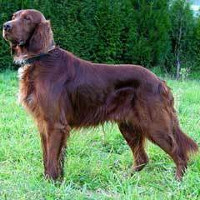
Racy and athletic full of quality, kindly in expression. Balanced and in proportion.

Behaviour / temperament

Keen, intelligent, energetic, affectionate and loyal.

Head

Cranial region

Head
Long and lean, and not coarse at the ears. Muzzle and skull of equal length and on parallel lines.
Skull
Oval (from ear to ear), having plenty of brain room, and with well defined occipital protuberance. Brows raised. 
Stop
Well defined.

Facial region

Nose
The colour of the nose is dark mahogany, or dark walnut or black, the nostrils wide.
Muzzle
Moderately deep and fairly square at the end. From the stop to point of nose, long, flews not pendulous.
Jaws and teeth
Jaws of nearly equal length. Scissors bite.
Eyes
Dark hazel or dark brown ought not to be too large.
Ears
Of moderate size, fine in texture, set low and well back, hanging in a neat fold close to head.

Neck

Moderately long, very muscular, not too thick, slightly arched, no tendency to throatiness.

Body

Body
Proportionate to size of dog.
Loin
Muscular and slightly arched.
Chest
Deep chest, rather narrow in front, ribs well sprung, leaving plenty of lung room.

Tail

Moderate length, proportionate to size of body, set on rather low, strong at root, tapering to fine point. Carried level with or below back.

Limbs

Forequarters

Shoulders
Fine at the point, deep and sloping well back.
Elbows
Free and well let down, not turned in or out.
Forearm
Straight and sinewy, well boned.

Hindquarters

Generality
Wide and powerful.
Lower thigh
Long and muscular from hip to hock; from hock to heel short and strong.
Stifle
Well bent
Hock
Turned neither in or out.

Feet

Small, very firm, toes strong, arched and close together.

Gait and movement

Free flowing, driving movement; head held high. Forelegs reaching well ahead but carried low. Hindquarters drive smoothly with great power. Crossing or weaving of legs unacceptable.

Coat

Hair
On head, front of legs, and tips of ears, short and fine; on other parts of body and legs moderate length, flat and as free as possible from curl or wave. Feather on upper portion of ears long and silky; on back of fore and hind legs long and fine; fair amount of hair on belly, forming fringe which may extend onto chest and throat. Feet well feathered between toes. Tail having fringe of moderately long hair, decreasing in length as it approaches the point. All feathering straight and flat.
Colour
Rich chestnut with no trace of black; white on chest, throat, and toes; or small star on forehead or narrow streak or blaze on nose or face not to disqualify.

Size and weight

Height at withers
Males 23 ins (58 cm) to 26.5 ins (67 cm). Female 21.5 ins (55 cm) to 24.5 ins (62 cm).

Faults

• Any departure from the foregoing points should be considered a fault and the seriousness with which the fault should be regarded should be in exact proportion to its degree and its effect upon the health and welfare of the dog and its ability to perform its traditional work.
• Faults listed should be in degree of seriousness.

Disqualifying faults

 Aggressive or overly shy dogs.

NB :

• Any dog clearly showing physical or behavioural abnormalities shall be disqualified.
• The above mentioned faults when occurring to a highly marked degree or frequently are disqualifying.
• Male animals should have two apparently normal testicles fully descended into the scrotum.
• Only functionally and clinically healthy dogs, with breed typical conformation should be used for breeding.

Bibliography

https://www.fci.be/


Detailed history

Certain races have the undeniable advantage of presenting to their amateurs clear and almost clear origins and history. Any self-respecting cynophile attributes the German Shepherd to von Stephanitz, the Malinois to Huyghebaert, the Leonberg to Heissig and the Dobermann to the German municipal employee of the same name. On the other hand, when one comes to talk about the Setters, the long-haired British sting dogs, the wisest ones prefer to keep quiet. Indeed, the past of these dogs today so listed, we know nothing, or not much. In fact, opinions diverge on this subject.

The Setters, the Spaniels and the Spaniels (non-continental Spaniels), this is commonly admitted, would all have for grandfather the Quail Braque, or Dog of Oysel, who was a dog lying, that is to say a dog of stop, itself descended from the ancient Canis familiaris intermedius. One school, among the cynologists, argues that the dog in question is from Spain, which would explain nicely the still used name of Spaniel (or Spaniel). One of the few testimonies in favor of this thesis is that which Gaston de Foix would have brought, says Phoebus, in his Treatise on the hunt, where he would have spoken of the dogs of birds as being Spanish.

According to another school, the name of the Spaniels and Spaniels would have a very different etymology (from the old French "to be spared", to lie down). Moreover, these dogs do not come originally from Spain. This is the opinion of Strebel, for example: this specialist quotes a jewel that belonged to Philip II of Macedonia, the father of Alexander the Great, on which would be represented an ancestor of the famous Braque aux Quails, who would have lived at 4th century BC.

Be that as it may, since the Middle Ages and up to a relatively little time in relation to the duration of history, these dogs would have spread in the Netherlands, France, Germany, England. In each of these countries, crosses with local dogs would have taken place, eventually creating different national Spaniels.

The Comte de Foix, to come back to him, also quotes the hunting technique used with this type of dog. They were taught to lie down in front of the game, which made it possible to cover the dog and the birds with a net, hence their name of Oyster Dogs. This very particular form of arrest was also worth to their descendants, on the other side of the Channel, to be called soon "Setters", of the English verb to set, which can mean to be put in place, in the occurrence to lie down.

It is not known when and by what route the Setters were imported into the British Isles. In any case, it is probably in Ireland that the use of sodding dogs began to spread, making our Irish Setter the elder of his family. We know that the Setters met with great success with the first fighter jets, whose very long stop allowed to support their arquebus.

To find precise traces of the Irish Setter, one must then place around 1810, at which time fans of this beautiful race imagined nothing better than to quarrel for stories of dress. Indeed, there was not one, but two Irish Setters, the one-colored (red) and the two-colored (white and red). This second variety was the most common, and was said to be better than the first. Breeders began to discuss the visibility of the different dresses, then the hunting qualities inherent to each "model". Some claimed the training of "all red" easier. The first dog shows arrived (1859), and the public decided: the Irish Setter would be red, say red, like his compatriots.

This controversy about colors may seem trivial, but it did determine the future of this dog. Who knows what the Setter would be today if we had selected it with two-color breeders? Better, less good? Nobody can tell. One thing is certain, white is an integral part of the characters of this race, as evidenced by the white marks sometimes appearing on the chest, legs or heads of the current "red devils" and that amateurs call " the Irish star ". While dog show enthusiasts seek to eliminate them, hunters are proud to own dogs that have them.

Whether or not he wears Erin's star, the Irish Setter is one of the most beautiful dogs ever. Let's listen to an excerpt from Cajelli's praise: "Guided by his powerful flair, he gallops quickly, head outstretched. In the undergrowth, he slows down his pace and never loses sight of the one he accompanies. He works both in the mountains and in the water, deploying everywhere the same ardor. He does not suffer from cold or heat, he ignores fatigue. There is no other dog whose sense of smell is so fine, and we are sometimes astonished by the results he gets thanks to his extraordinary flair. When he is in the presence of the game, he slows down his pace, redoubles precautions to not lose the odor trail left behind him by the fugitive. Instinctively, his body falls to the ground; at the same time, he raises his head and his chamfer remains perfectly horizontal while his hind end flexes and his stretched tail comes to rest a little below the line of the kidneys. As if petrified, he remains stuck in front of the hiding place of the game he has just spotted. And the author adds: "Unfortunately, in the past as nowadays, many breeders have been and still are attracted by the aesthetic qualities of this dog. The great beauty of the Irish Setter makes one forget what he is able to do on the ground. "

Indeed, this dog is so beautiful that it ended up harming him. To convince oneself of this, it is enough to mention those big doggy dogs that scoured the dog shows not too long ago, scooping up all the prizes, and who would not have known how to make a hare or a woodcock. These "clappers", as the fans of the real Irish Setter called them, narrow waders, were nothing more than the ghosts of what they should have been. And that because of the fashion that stubbornly promoted this Setter as a companion dog while he asked only to remain the faithful auxiliary of the hunter.

Fortunately, the Red Club, founded in 1905 by the Marquis de Gantes and since taken over by conscientious successors, has understood that the abyss that had widened between the giants, very beautiful indeed, dog shows and smaller dogs but infinitely better, the good hunter could only harm the race. The trend has therefore reversed, and current job champions are gaining top prizes in the exhibitions.

The Irish Setter, a magnificent dog, but also a genius of the hunt, now accumulates the two jobs for which he has the most passion: those of his master hunter and companion of the whole family. It is in these two roles that he blossoms the most. To deprive him of one or the other is to take away a part of himself. A very old breed that has lost none of its nobility, the Irish Setter is a king dog. And having him by his side is a prince's pleasure.

Some said crazy, others hypernervous. It has been accused of sensitivity to the skin. Is the Irish Setter really that much distressed that rumors are pleased to paint us? Let's share things. First, nothing is more ambiguous than stating generalities, especially in terms of dog behavior. No, not all the Labradors are bulimic, nor the ferocious Malinois, nor the stupid Greyhounds, nor the irresistible Irish Setters. Each case is unique: why would not some of these "red devils" spend most of their time sleeping on a cushion? Without falling into excess, we can try to find an intelligent average and give some indications concerning the temperament of this dog.

At first sight, we discover a tall, slender, well-made animal with a long, thin, very dry head: nothing in the morphology of the Irish Setter leads to placidity. We can therefore deduce that this is a dog that is usually quite awake. In addition, it is a hunting dog, which many tend to forget: if he fell asleep in full swing, it would be to say the least embarrassing, all things that his detractors did not take into account before treat him a little fast hysterical. However, we must be objective: the Irish Setter has a natural tendency to nervousness, appreciation that will nuance however by specifying "balanced" nervousness, if it is possible, paradoxical quality but no less essential in the good hunting dog. Moreover, in the field, no one would think of criticizing the Irish Setter. He runs too well, his gallop beautiful and light, he looks too well, not losing a square centimeter of land, it stops too well, the whole body strained towards the motionless animal. Finally, it flows too well, bringing out the game under the rifle of the master. No, definitely, there are only those who know him badly to criticize the Irish Setter.

And is the report naturally carried? In truth, what races are it? Frankly, it will be said that learning the report is long for the Irishman. His head is too hot to pay much attention to the trainer, and he needs a lot of patience, gentleness and firmness for the red devil to end up accepting the game. More delicate than the others, this phase Dressage may be longer with this passionate Irishman. For it must be known that this Setter is not lacking in stubbornness. This is also what makes his value on the ground, because, if he turns his master into jail because of his obstinacy, he puts the same perseverance to hunt down his game mercilessly. The defects of the Irish Setter are his qualities.

What about the Irish Setter pet dog? The same as the Irish Setter hunting dog. He is sometimes independent, deaf to orders, but on the other hand full of loyalty and affection. This Irishman is a permanent contrast. Living with him is not necessarily relaxing, but one is sure to never be bored. If you want to have a companion, not a cannonball, one solution to it: tenacity. Since this dog closes in front of coercion like a snail returning to its shell, his master will do well to leave the whip in the locker room and appeal to his intelligence (he is very cunning) and his love for him (because, deep down, he has a heart of gold). So he will have to play on the complicity, the long walks with two, the small hugs, the games and the caresses, to ask in return for his dog a minimum of savoir-vivre. Attention, to be loved does not mean to sell, and some demonstrations of firmness and will will only bring up the master in the esteem of the Irish Setter.

Make him participate in your activities as often as possible, and then he will take the trouble to please you. In this respect, he lives badly in an apartment and, in this case, demands from his master incessant and very long walks in exchange for his respect for the furniture. With such a dog, living in the countryside or in the suburbs is certainly easier, provided that the place abounds with large green spaces where he will be able to frolic all his drunk. For this, it is important to have previously prepared for the recall, otherwise he was quick to take the wheel. One can start when he is any puppy, by calling him frequently, fondling him for support. If it does not come back, the use of the light loin is recommended. Small shakes will return the young rebel, who will quickly realize that he can not avoid orders (a caress will welcome course on each return, even after forcefully jerks on the loin). Once trained to return to you in all circumstances, the Irish Setter will make the best of the companions of walk, because he is never tired and is always very friendly during the outings (normal, they make him so much pleasure). Unless you are particularly dominant, it will behave well with dogs and people you can meet on the way, because it is quite sociable, which is good for a hunting dog, often brought to rub shoulders with many congeners.

With the children, no problem, provided that they are up to the task and know not to bother him, in which case His Majesty the Irishman is likely to show his disapproval with a significant groan. At the limit, he will always flee rather than bite children, of which he is the friend by nature. He willingly participates in all their games, not missing such a good opportunity to spend. Other animals; of the cat, rabbit, hen or hamster type; In order to live harmoniously with the Irish Setter, he must remember that he is above all a hunting dog with the corresponding instincts. So beware of imprudences, and place an early education of all parties. Thus, the puppy must learn at a very young age to respect pets, and they must know how to be discreet at times. In these conditions, the Setter can very well become the cat's friend of the house and know placidly look at the turtles. On the other hand, game-like animals, such as rabbits and birds, should rather avoid the Irish Setter in general, and if he is a keen hunter in particular.

So that's a dog that is often wrongly faked. It is true that some individuals selected solely on physical criteria sometimes lacked balance. This situation, however, belongs to the past, and with the return of character as a factor of selection, the Irish Setter is once again the balanced dog he should never have ceased to be. It is true that he is not one of those who stand up in a jiffy, but does not the skill of the educator also measure up to the will of the trained animal? Whoever gets good results with an Irish Setter can boast of having a soft, firm hand that is ideal for any training. The temper of the Irish Setter does not belie his origins. Proud and rebellious, but also good and loyal, such is this Setter, and such he must remain.

An incomparable hunting dog, a genius nose, a feline appearance, a statue stop, but also an inseparable friend of his master, watching over his children, accompanying him everywhere, the Irish Setter has not finished talking about him. A probable ancestor of the English Setter, certain of Setter Gordon, the Irishman is the very soul of these dogs. These Setters, so admirable by the lines of their body and the kindness of their temperament, have become auxiliaries to hunters all over the world. And, more than any other of them, the Irish Setter represents the Dog. Hard and strong, but pure and faithful. Like a real Irishman. And a real friend of the man.

Comments

Latest page updates

  • Yorkshire Terrier

    Yorkshire Terrier FCI Standard No. 86 Origin Great Britain Group Group 3 Terriers Section Section 4 Toy Terriers Working Without working trial Date of acceptance on a definitive basis by the FCI Saturday 30 October 1954 Date of publication of the official valid standard Tuesday 08 September 2026 Date of the last update Tuesday 06 October 2026 En...
  • West Highland White Terrier

    West Highland White Terrier FCI Standard No. 85 Origin Great Britain Group Group 3 Terriers Section Section 2 Small-sized Terriers Working Without working trial Date of acceptance on a definitive basis by the FCI Friday 29 October 1954 Date of publication of the official valid standard Tuesday 08 September 2026 Date of the last update Tuesday 06...
  • Welsh Terrier

    Welsh Terrier FCI Standard No. 78 Origin Great Britain Group Group 3 Terriers Section Section 1 Large- and medium sized Terriers Working Without working trial Date of acceptance on a definitive basis by the FCI Saturday 23 October 1954 Date of publication of the official valid standard Tuesday 08 September 2026 Date of the last update Tuesday 06...
  • Welsh Springer Spaniel

    Welsh Springer Spaniel FCI Standard No. 126 Origin Great Britain Group Group 8 Retrievers-Flushing Dogs-Water Dogs Section Section 2 Flushing Dogs Working With working trial Date of acceptance on a definitive basis by the FCI Thursday 30 December 1954 Date of publication of the official valid standard Tuesday 08 September 2026 Date of the last...
  • Welsh Corgi Pembroke

    Welsh Corgi Pembroke FCI Standard No. 39 Origin Great Britain Group Group 1 Sheepdogs and Cattle Dogs (except Swiss Cattle Dogs) Section Section 2 Cattledogs (except Swiss Cattledogs) Working Without working trial Date of acceptance on a definitive basis by the FCI Wednesday 13 November 1963 Date of publication of the official valid standard Tuesday 08...
  • Welsh Corgi Cardigan

    Welsh Corgi Cardigan FCI Standard No. 38 Origin Great Britain Group Group 1 Sheepdogs and Cattle Dogs (except Swiss Cattle Dogs) Section Section 2 Cattledogs (except Swiss Cattledogs) Working Without working trial Date of acceptance on a definitive basis by the FCI Tuesday 12 November 1963 Date of publication of the official valid standard Tuesday 08...
  • Sussex Spaniel

    Sussex Spaniel FCI Standard No. 127 Origin Great Britain Group Group 8 Retrievers, Flushing dogs, Water dogs. Section Section 2 Flushing dogs Working With working trial Date of acceptance on a definitive basis by the FCI Friday 31 December 1954 Date of publication of the official valid standard Tuesday 08 September 2026 Date of the last update Tuesday 06...
  • Staffordshire Bull Terrier

    Staffordshire Bull Terrier FCI Standard No. 76 Origin Great Britain Group Group 3 Terriers Section Section 3 Bull type Terriers Working Without working trial Date of acceptance on a definitive basis by the FCI Thursday 21 October 1954 Date of publication of the official valid standard Tuesday 08 September 2026 Date of the last update Tuesday 06...
  • Skye Terrier

    Skye Terrier FCI Standard No. 75 Origin Great Britain Group Group 3 Terriers Section Section 2 Small-sized Terriers Working Without working trial Date of acceptance on a definitive basis by the FCI Wednesday 20 October 1954 Date of publication of the official valid standard Tuesday 08 September 2026 Date of the last update Tuesday 06 October 2026 En...
  • Shetland Sheepdog

    Shetland Sheepdog FCI Standard No. 88 Origin Great Britain Group Group 1 Sheepdogs and Cattle Dogs Section Section 1 Sheepdogs Working Without working trial Date of acceptance on a definitive basis by the FCI Tuesday 09 November 1954 Date of publication of the official valid standard Tuesday 08 September 2026 Date of the last update Tuesday 06...
  • Sealyham Terrier

    Sealyham Terrier FCI Standard No. 74 Origin Great Britain Group Group 3 Terriers Section Section 2 Small sized Terriers Working Without working trial Date of acceptance on a definitive basis by the FCI Tuesday 19 October 1954 Date of publication of the official valid standard Tuesday 08 September 2026 Date of the last update Tuesday 06 October...
  • Scottish Terrier

    Scottish Terrier FCI Standard No. 73 Origin Great Britain Group Group 3 Terriers Section Section 2 Small-sized Terriers Working Without working trial Date of acceptance on a definitive basis by the FCI Monday 18 October 1954 Date of publication of the official valid standard Tuesday 08 September 2026 Date of the last update Tuesday 06 October...
  • Old English Sheepdog (Bobtail)

      Old English Sheepdog (Bobtail) FCI Standard No. 16     Origin   Great Britain Group   Group 1 Sheepdogs and Cattle Dogs (except Swiss Cattle Dogs) Section   Section 1 Sheepdogs Working   Without working trial Date of acceptance on a definitive basis by the FCI   Monday 25 November 1963 Date of publication of the official valid standard   Tuesday 08 September...
  • Norwich Terrier

    Norwich Terrier FCI Standard No. 72 Origin Great Britain Group Group 3 Terriers Section Section 2 Small-sized Terriers Working Without working trial Date of acceptance on a definitive basis by the FCI Saturday 16 October 1954 Date of publication of the official valid standard Tuesday 08 September 2026 Date of the last update Tuesday 06 October...
  • Norfolk Terrier

    Norfolk Terrier FCI Standard No. 272 Origin Great Britain Group Group 3 Terriers Section Section 2 Small-sized Terriers Working Without working trial Date of acceptance on a definitive basis by the FCI Saturday 01 October 1966 Date of publication of the official valid standard Tuesday 08 September 2026 Date of the last update Tuesday 06 October...
  • Manchester Terrier

    Manchester Terrier FCI Standard No. 71 Origin Great Britain Group Group 3 Terriers Section Section 1 Large and medium sized Terriers Working Without working trial Date of acceptance on a definitive basis by the FCI Friday 15 October 1954 Date of publication of the official valid standard Tuesday 08 September 2026 Date of the last update Tuesday 06 October...
  • Lakeland Terrier

    Lakeland Terrier FCI Standard No. 70 Origin Great Britain Group Group 3 Terriers Section Section 1 Large and medium-sized Terriers Working Without working trial Date of acceptance on a definitive basis by the FCI Thursday 14 October 1954 Date of publication of the official valid standard Tuesday 08 September 2026 Date of the last update Tuesday 06 October...
  • Labrador Retriever

      Labrador Retriever FCI Standard No. 122     Origin   Canada Group   Group 8 Retrievers, Flushing dogs, Water dogs Section   Section 1 Retrievers Working   With working trial Date of acceptance on a definitive basis by the FCI   Friday 24 December 1954 Date of publication of the official valid standard   Tuesday 08 September 2026 Date of the last update   Tuesday 06...
  • King Charles Spaniel

    King Charles Spaniel FCI Standard No. 128 Origin Great Britain Group Group 9 Companion and Toy Dogs Section Section 7 English Toy Spaniels Working Without working trial Date of acceptance on a definitive basis by the FCI Monday 03 January 1955 Date of publication of the official valid standard Tuesday 08 September 2026 Date of the last update Tuesday 06...
  • Harrier

      Harrier FCI Standard No. 295     Origin   Great Britain Translation   Mrs. Peggy Davis, brought up to day by Dr. Paschoud Group   Group 6 Scenthounds and related breeds Section   Section 1.2 Medium-sized Hounds Working   With working trial Date of acceptance on a definitive basis by the FCI   Wednesday 27 November 1974 Date of publication of the official valid...
  • Greyhound

    Greyhound FCI Standard No. 158 Origin Great Britain Group Group 10 Sighthounds Section Section 3 Short-haired sighthounds Working Without working trial Date of acceptance on a definitive basis by the FCI Saturday 23 April 1955 Date of publication of the official valid standard Tuesday 08 September 2026 Date of the last update Tuesday 06 October...
  • Gordon Setter

    Gordon Setter FCI Standard No. 6 Origin Great Britain Group Group 7 Pointing Dogs Section Section 2.2 British and Irish Pointers and Setters; Setters Working With working trial Date of acceptance on a definitive basis by the FCI Tuesday 28 May 1963 Date of publication of the official valid standard Tuesday 08 September 2026 Date of the last...
  • Golden Retriever

    Golden Retriever FCI Standard No. 111 Origin Great Britain Group Group 8 Retrievers, Flushing Dogs, Water Dogs Section Section 1 Retrievers Working With working trial Date of acceptance on a definitive basis by the FCI Thursday 02 December 1954 Date of publication of the official valid standard Tuesday 28 July 2009 Date of the last update Wednesday...
  • Fox Terrier Wire

    Fox Terrier Wire FCI Standard No. 169 Origin Great Britain Group Group 3 Terriers Section Section 1 Large and medium-sized Terriers Working Working trial optional Date of acceptance on a definitive basis by the FCI Friday 13 May 1955 Date of publication of the official valid standard Tuesday 08 September 2026 Date of the last update Tuesday 06...
  • Fox Terrier Smooth

    Fox Terrier Smooth FCI Standard No. 12 Origin Great Britain Group Group Terriers Section Section 1 Large and medium sized Terriers Working Working trial optional Date of acceptance on a definitive basis by the FCI Wednesday 26 June 1963 Date of publication of the official valid standard Tuesday 08 September 2026 Date of the last update Tuesday 06...
  • Flat Coated Retriever

    Flat Coated Retriever FCI Standard No. 121 Origin Great Britain Group Group 8 Retrievers-Flushing Dogs-Water Dogs Section Section 1 Retrievers Working With working trial Date of acceptance on a definitive basis by the FCI Thursday 23 December 1954 Date of publication of the official valid standard Tuesday 08 September 2026 Date of the last update Tuesday...
  • Field Spaniel

    Field Spaniel FCI Standard No. 123 Origin Great-Britain Group Group 8 Retrievers, Flushing Dogs, Water Dogs Section Section 2 Flushing Dogs Working With working trial Date of acceptance on a definitive basis by the FCI Monday 27 December 1954 Date of publication of the official valid standard Tuesday 08 September 2026 Date of the last update Tuesday...
  • English Toy Terrier

    English Toy Terrier FCI Standard No. 13 Origin Great Britain Group Group 3 Terriers Section Section 4 Toy Terriers Working Without working trial Date of acceptance on a definitive basis by the FCI Tuesday 17 September 1963 Date of publication of the official valid standard Tuesday 08 September 2026 Date of the last update Tuesday 06 October 2026 En...
  • English Springer Spaniel

    English Springer Spaniel FCI Standard No. 125 Origin Great Britain Group Group 8 Retrievers-Flushing Dogs-Water Dogs Section Section 2 Flushing Dogs Working With working trial Date of acceptance on a definitive basis by the FCI Wednesday 29 December 1954 Date of publication of the official valid standard Tuesday 08 September 2026 Date of the last...
  • English Setter

    English Setter FCI Standard No. 2 Origin Great Britain Group Group 7 Pointing Dogs Section Section 2.2 British and Irish Pointers and Setters, Setter Working With working trial Date of acceptance on a definitive basis by the FCI Wednesday 06 March 1963 Date of publication of the official valid standard Tuesday 08 September 2026 Date of the last...
  • English Pointer

    English Pointer FCI Standard No. 1 Origin Great Britain Group Group 7 Pointing Dogs Section Section 2.1 British and Irish Pointers and Setters, Pointer Working With working trial Date of acceptance on a definitive basis by the FCI Tuesday 05 March 1963 Date of publication of the official valid standard Tuesday 08 September 2026 Date of the last...
  • English Foxhound

    English Foxhound FCI Standard No. 159 Origin Great Britain Group Group 6 Scenthounds and related breeds Section Section 1.1 Large-sized Scent hounds Working With working trial Date of acceptance on a definitive basis by the FCI Monday 25 April 1955 Date of publication of the official valid standard Thursday 26 March 2009 Date of the last update Wednesday...
  • English Cocker Spaniel

    English Cocker Spaniel FCI Standard No. 5 Origin Great Britain Group Group 8 Retrievers, Flushing Dogs, Water Dogs Section Section 2 Flushing dogs Working With working trial Date of acceptance on a definitive basis by the FCI Wednesday 10 April 1963 Date of publication of the official valid standard Tuesday 08 September 2026 Date of the last...
  • Tibetan Mastiff

    Tibetan Mastiff FCI Standard No. 230 Origin Tibet (China)Patronage FCI Group Group 2 Pinscher and Schnauzer- Molossoid breeds- Swiss Mountain and Cattle Dogs Section Section 2.2 Molossoid breeds, Mountain type Working Without working trial Date of acceptance on a definitive basis by the FCI Tuesday 22 August 1961 Date of publication of the...
  • Deerhound

    Deerhound FCI Standard No. 164 Origin Great Britain Group Group 10 Sighthounds Section Section 2 Rough-haired Sighthounds Working Without working trial Date of acceptance on a definitive basis by the FCI Friday 29 April 1955 Date of publication of the official valid standard Tuesday 08 September 2026 Date of the last update Tuesday 06 October...
  • Dandie Dinmont Terrier

    Dandie Dinmont Terrier FCI Standard No. 168 Origin Great Britain Group Group 3 Terriers Section Section 2 Small-sized Terriers Working Without working trial Date of acceptance on a definitive basis by the FCI Thursday 12 May 1955 Date of publication of the official valid standard Tuesday 08 September 2026 Date of the last update Tuesday 06...
  • Curly Coated Retriever

    Curly Coated Retriever FCI Standard No. 110 Origin Great Britain Group Group 8 Retrievers, Flushing Dogs, Water Dogs Section Section 1 Retrievers Working With working trial Date of acceptance on a definitive basis by the FCI Friday 10 December 1954 Date of publication of the official valid standard Tuesday 08 September 2026 Date of the last...
  • Collie Smooth

    Collie Smooth FCI Standard No. 296 Origin Great Britain Group Group 1 Sheepdogs and Cattle Dogs (except Swiss Cattle Dogs) Section Section 1 Sheepdogs Working Without working trial Date of acceptance on a definitive basis by the FCI Wednesday 18 December 1974 Date of publication of the official valid standard Tuesday 08 September 2026 Date of the...
  • Collie Rough

    Collie Rough FCI Standard No. 156 Origin Great Britain Group Group 1 Sheepdogs and Cattle Dogs (except Swiss Cattle Dogs) Section Section 1 Sheepdogs Working Without working trial Date of acceptance on a definitive basis by the FCI Wednesday 13 April 1955 Date of publication of the official valid standard Tuesday 08 September 2026 Date of the...
  • Clumber Spaniel

    Clumber Spaniel FCI Standard No. 109 Origin Great Britain Group Group 8 Retrievers, Flushing dogs, Water dogs Section Section 2 Flushing dogs Working With working trial Date of acceptance on a definitive basis by the FCI Thursday 09 December 1954 Date of publication of the official valid standard Tuesday 08 September 2026 Date of the last update Tuesday...
  • Chow Chow

    Chow Chow FCI Standard No. 205 Origin China, patronage : Great Britain Group Group 5 Spitz and primitive type Section Section 5 Asian Spitz and related breeds Working Without working trial Date of acceptance on a definitive basis by the FCI Tuesday 10 December 1957 Date of publication of the official valid standard Tuesday 08 September 2026 Date...
  • Chinese Crested Dog

    Chinese Crested Dog FCI Standard No. 288 Origin China, patronage Great Britain Group Group 9 Companion and Toy Dogs Section Section 4 Hairless breeds Working Without working trial Date of acceptance on a definitive basis by the FCI Monday 17 July 1972 Date of publication of the official valid standard Tuesday 08 September 2026 Date of the last...
  • Cairn Terrier

    Cairn Terrier FCI Standard No. 4 Origin Great Britain Group Group 3 Terriers Section Section 2 Small-sized Terriers Working Without working trial Date of acceptance on a definitive basis by the FCI Saturday 06 April 1963 Date of publication of the official valid standard Tuesday 08 September 2026 Date of the last update Tuesday 06 October 2026 En...
  • Bullmastiff

    Bullmastiff FCI Standard No. 157 Origin Great Britain Group Group 2 Pinscher and Schnauzer Molossoid breeds - Swiss Mountain and Cattle Dogs Section Section 2.1 Molossoid breeds, Mastiff Type Working Without working trial Date of acceptance on a definitive basis by the FCI Saturday 23 April 1955 Date of publication of the official valid standard Tuesday...
  • English Bulldog

    English Bulldog FCI Standard No. 149 Origin Great Britain Group Group 2 Pinscher and Schnauzer Molossoid breeds-Swiss Mountain and Cattle Dogs Section Section 2.1 Molossoid breeds, Mastiff Type Working Without working trial Date of acceptance on a definitive basis by the FCI Monday 14 March 1955 Date of publication of the official valid standard Tuesday...
  • Bull Terrier

    Bull Terrier FCI Standard No. 11 Origin Grande-Bretagne Group Group 3 Terriers Section Section 3 Bull type Terriers Working Working trial optional Date of acceptance on a definitive basis by the FCI Saturday 26 June 1993 Date of publication of the official valid standard Tuesday 08 September 2026 Date of the last update Tuesday 06 October 2026 En...
  • Border Terrier

    Border Terrier FCI Standard No. 10 Origin Great Britain Group Group 3 Terriers Section Section 1 Large and medium-sized terriers Working Without working trial Date of acceptance on a definitive basis by the FCI Wednesday 26 June 1963 Date of publication of the official valid standard Tuesday 08 September 2026 Date of the last update Tuesday 06...
  • Bedlington Terrier

    Bedlington Terrier FCI Standard No. 9 Origin Great Britain Group Group 3 Terriers Section Section 1 Large and medium sized Terriers Working Without working trial Date of acceptance on a definitive basis by the FCI Thursday 20 June 1963 Date of publication of the official valid standard Tuesday 08 September 2026 Date of the last update Tuesday 06...
  • Bearded Collie

    Bearded Collie FCI Standard No. 271 Origin Great-Britain Group Group 1 Sheepdogs and Cattle Dogs (except Swiss Cattle Dogs) Section Section 1 Sheepdogs Working Without working trial Date of acceptance on a definitive basis by the FCI Wednesday 30 August 1967 Date of publication of the official valid standard Tuesday 08 September 2026 Date of the...
  • Beagle

    Beagle FCI Standard No. 161 Origin Great Britain Translation Prof. R. Triquet Group Group 6 Scent hounds and related breeds Section Section 1.3 Small-sized hounds Date of acceptance on a definitive basis by the FCI Tuesday 26 April 1955 Date of publication of the official valid standard Tuesday 08 September 2026 Date of the last update Tuesday 06...
  • Basset Hound

    Basset Hound FCI Standard No. 163 Origin Great Britain Group Group 6 Scent hounds and related breeds Section Section 1.3 Small-sized hounds Working With working trial Date of acceptance on a definitive basis by the FCI Thursday 28 April 1955 Date of publication of the official valid standard Tuesday 08 September 2026 Date of the last update Tuesday...
  • Basenji

    Basenji FCI Standard No. 43 Origin Democratic Republic of Congo, under the patronage of Great Britain Group Group 5 Spitz and primitive types Section Section 6 Primitive type Working Without working trial Date of acceptance on a definitive basis by the FCI Thursday 26 March 1964 Date of publication of the official valid standard Tuesday 08...
  • Airedale Terrier

    Airedale Terrier FCI Standard No. 7 Origin Great Britain Group Group 3 Terriers Section Section 1 Large and medium sized Terriers Working Working trial optional Date of acceptance on a definitive basis by the FCI Tuesday 28 May 1963 Date of publication of the official valid standard Tuesday 08 September 2026 Date of the last update Tuesday 06...
  • Afghan Hound

    Afghan Hound FCI Standard No. 228 Origin AfghanistanPatronage Great Britain Group Group 10 Sighthounds Section Section 1 Long-haired or fringed sighthounds Working Without working trial Date of acceptance on a definitive basis by the FCI Tuesday 12 December 1961 Date of publication of the official valid standard Tuesday 08 September 2026 Date of the...
  • Romagna Water Dog

    Romagna Water Dog FCI Standard No. 298 Origin Italy Translation Antonio Morsiani, Renée Sporre-Willes and Prof. R. TriquetRevised by ENCI and Renée Sporre-WillesRevised by the FCI Head OfficeOfficial language (EN). Group Group 8 Retrievers –Flushing Dogs –Water Dogs Section Section 3 Water Dogs Working Working trial optional Date of acceptance on a...
  • Whippet

    Whippet FCI Standard No. 162 Origin Great Britain Group Group 10 Sighthounds Section Section 3 Short-haired Sighthounds Working Without working trial Date of acceptance on a definitive basis by the FCI Wednesday 27 April 1955 Date of publication of the official valid standard Tuesday 08 September 2026 Date of the last update Tuesday 06 October...
  • Tibetan Terrier

    Tibetan Terrier FCI Standard No. 209 Origin Tibet, patronage Great Britain Group Group 9 Companion and Toy Dogs Section Section 5 Tibetan breeds Working Without working trial Date of acceptance on a definitive basis by the FCI Wednesday 18 December 1957 Date of publication of the official valid standard Tuesday 08 September 2026 Date of the last...
  • Tibetan Spaniel

    Tibetan Spaniel FCI Standard No. 231 Origin Tibet (China)Patronage Great Britain Group Group 9 Companion and Toy Dogs Section Section 5 Tibetan breeds Working Without working trial Date of acceptance on a definitive basis by the FCI Tuesday 22 August 1961 Date of publication of the official valid standard Tuesday 08 September 2026 Date of the...
  • Shih Tzu

    Shih Tzu FCI Standard No. 208 Origin Tibet, patronage Great Britain Group Group 9 Companion and Toy Dogs Section Section 5 Tibetan breeds Working Without working trial Date of acceptance on a definitive basis by the FCI Monday 16 December 1957 Date of publication of the official valid standard Tuesday 08 September 2026 Date of the last update Tuesday 06...
  • Pug

    Pug FCI Standard No. 253 Origin China, patronage Great Britain Group Group 9 Companion and Toy Dogs Section Section 11 Small Molossian type dogs Working Without working trial Date of acceptance on a definitive basis by the FCI Friday 04 November 1966 Date of publication of the official valid standard Tuesday 08 September 2026 Date of the last...
  • Pharaoh Hound

    Pharaoh Hound FCI Standard No. 248 Origin Malta, patronage Great Britain Group Group 5 Spitz and primitive types Section Section 6 Primitive type Working Without working trial Date of acceptance on a definitive basis by the FCI Friday 09 August 1963 Date of publication of the official valid standard Tuesday 08 September 2026 Date of the last...
  • Pekingese

    Pekingese FCI Standard No. 207 Origin China, patronage Great Britain Group Group 9 Companion and Toy Dogs Section Section 8 Japan Chin and Pekingese Working Without working trial Date of acceptance on a definitive basis by the FCI Thursday 03 November 1966 Date of publication of the official valid standard Tuesday 08 September 2026 Date of the last...
  • Parson Russell Terrier

    Parson Russell Terrier FCI Standard No. 339 Origin Great Britain Group Group 3 Terriers Section Section 1 Large and medium sized Terriers Working Working trial optional Date of acceptance on a definitive basis by the FCI Monday 04 June 2001 Date of acceptance on a provisional basis by the FCI Monday 02 July 1990 Date of publication of the...
  • Otterhound

    Otterhound FCI Standard No. 294 Origin Great Britain Group Group 6 Scenthounds and related breeds Section Section 1.1 Large-sized hounds Working Without working trial Date of acceptance on a definitive basis by the FCI Thursday 12 September 1974 Date of publication of the official valid standard Tuesday 08 September 2026 Date of the last update Tuesday 06...
  • Miniature Bull Terrier

    Miniature Bull Terrier FCI Standard No. 359 Origin Grande-Bretagne Group Group 3 Terriers Section Section 3 Bull type Terriers Working Working trial optional Date of acceptance on a definitive basis by the FCI Tuesday 05 July 2011 Date of acceptance on a provisional basis by the FCI Tuesday 05 July 2011 Date of publication of the official valid...
  • Mastiff

    Mastiff FCI Standard No. 264 Origin Great Britain Group Group 2 Pinscher and Schnauzer – Molossoid breeds - Swiss Mountain and Cattle Dogs Section Section 2.1 Molossoid breeds, Mastiff Type Working Without working trial Date of acceptance on a definitive basis by the FCI Thursday 05 November 1964 Date of publication of the official valid standard Tuesday 08...
  • Lhassa Apso

    Lhassa Apso FCI Standard No. 227 Origin Tibet (China)Patronage Great Britain Group Group 9 Companion and Toy Dogs Section Section 5 Tibetan breeds Working Without working trial Date of acceptance on a definitive basis by the FCI Saturday 19 November 1960 Date of publication of the official valid standard Tuesday 08 September 2026 Date of the last...
  • Lancashire-Heeler

    Lancashire-Heeler FCI Standard No. 360 Origin England, patronage : FCI Group Group 1 Sheepdogs and Cattle Dogs (except Swiss Cattle Dogs) Section Section 1 Sheepdogs Working Without working trial Date of acceptance on a provisional basis by the FCI Sunday 01 May 2016 Date of publication of the official valid standard Tuesday 08 September 2026 Date...

© 2026 Groupe Milouchouchou ASBL. Tous droits réservés. En savoir plus

Protected by Copyright01
