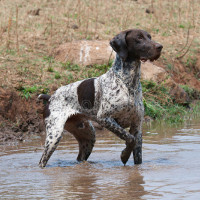
German Shorthaired Pointing Dog

FCI standard Nº 119

Origin
Germany
Translation
Walter Schicker
Group
Group 7 Pointing Dogs
Section
Section 1.1 Continental Pointing Dogs « Braque » Type
Working
With working trial
Acceptance on a definitive basis by the FCI
Friday 01 January 1954
Publication of the official valid standard
Wednesday 25 October 2000
Last update
Wednesday 25 April 2001
En français, cette race se dit
Braque allemand à poil court
Diese Norm ist in deutscher Sprache sichtbar
Deutsch Kurzhaar
En español, esta raza se dice
Braco Alemán de pelo corto
In het Nederlands, wordt dit ras gezegd
Duitse Staande Korthaar

Usage

Versatile hunting dog.

Brief historical summary

The history of the German Shorthaired Pointing Dog starts with the dogs which were used for the hunt with nets on feathered game, especially in the Mediterranean countries, and in combination with falconry. Via France, Spain and Flanders the Pointers came to the German courts. The most important distinctive feature of these dogs was their pointing performance. After the first double-barreled gun was made (1750), a pointing dog was even more required. In full sight of the dog « game birds in flight » were shot. That was the beginning of the transition from a mere pointer to a versatile gundog. As a fundamental basis for the structure and development of the breed the « Zuchtbuch Deutsch-Kurzhaar » (Studbook) has been published since 1897. It was Prince Albrecht zu Solms-Braunfeld who compiled breed characteristics, judging rules for conformation and finally also simple trial regulations for hunting dogs. Today the German Shorthaired Pointing Dog still passes through the filter of elaborated breeding- and trial regulations. The standard stipulates the consitution of the German Shorthaired Pointing Dog, as a versatile hunting dog, which enables him to perform all requirements in connection with hunting activities, even when advanced in age.

General appearance

A dog of noble and balanced appearance, the conformation of which ensures strength, endurance and speed. Proud attitude, smooth outlines, lean head, well carried tail, firm shiny coat and well reaching, harmonious strides emphasize its nobility.

Important proportions

Length of body should slightly exceed height at withers.

Behaviour / temperament

Firm, balanced, reliable, restrained temperament, neither nervous nor shy or aggressive.

Head

Cranial region

Head
Lean, well defined, neither too light nor too heavy; as to strength and length it matches the substance and the sex of the dog.
Skull
Moderately wide, flatly rounded, scarcely pronounced occipital bone, frontal furrow not too deep, noticeably developed superciliary ridges. 
Stop
Moderately defined.

Facial region

Nose
Somewhat protruding. Nostrils sufficiently wide, broad and mobile. Basically brown, however black in black or black roan dogs. A flesh-coloured or spotted nose is only permissible in dogs with white as basic colour.
Muzzle
Long, broad, deep and strong in order to enable the dog’s correct carrying of game. Viewed from the side the nasal bridge shows a slight curvature in all transitions from a nobly constructed ram’s nose to a slight rise above the straight line - more prominent in males.
Lips
Tight fitting, not too pendulous, good pigmentation. The naso-labial line slopes almost vertically and then continues in a flat arch to the moderately pronounced corner of the lips.
Nasal bridge
A totally straight nasal bridge, although still acceptable, is less attractive; a concave bridge (dish-face) is a serious fault.
Jaws and teeth
Strong jaws with a perfect, regular and complete scissor bite. The upper inscisors should reach over the lower incisors without gap and the teeth should be positioned vertically in the jaws. 42 sound teeth, in accordance with the teeth formula.
Cheeks
Strong, well muscled.
Eyes
Of medium size, neither protruding nor deep set. The ideal colour is dark brown. Eyelids tight fitting.
Ears
Moderately long, set on high and broad, flat and without twisting hanging down close to the head, bluntly rounded at the tip. Neither too fleshy nor too thin. When brought forward they are supposed to reach more or less the corner of the lips.

Neck

Length in harmony with general appearance of the dog, progressively thickening towards the body. Very muscular and slightly crested nape. Tight fitting skin of throat.

Body

Topline
Straight and slightly sloping.
Withers
Well defined.
Back
Firm and muscular. Vertebral processes should be covered by muscles.
Loin
Short, broad, muscular, straight or slightly arched. Transition from back to loin tight and well knit.
Croup
Broad and long enough, not abruptly slanting, but slightly slanting towards the tail, well muscled.
Chest
Somewhat deeper than broad with well defined forechest, with the sternum reaching back as far as possible. Sternum and elbow joint ont the same level.
Ribs
Ribs well sprung, neither flat nor barrel-shaped. False ribs well reaching down.
Underline and belly
With elegant arch, slightly tucked up towards rear, dry.

Tail

Set high, strong at the root and then tapering, of medium length. About halfway docked for hunting purposes. At rest hanging down; in movement horizontal, neither carried too high above the backline nor extremely bent. (In countries where tail docking is prohibited by law, the tail can remain in its natural shape. It should reach down as far as the hocks and be carried straight or slightly sabre tail fashion).

Limbs

Forequarters

Generality
Viewed from the front, straight and parallel; viewed from the side, the legs are well placed under the body.
Shoulders
Shoulder blades well laid back, well attached to chest, and strongly muscled. Shoulder blade and upperarm well angulated.
Upper arm
As long as possible, well muscled and dry.
Elbows
Close but not too tight to body, neither turned in nor out, well set back.
Forearm
Straight and sufficiently muscled. Strong bone, not too coarse.
Carpal
Strong.
Pastern
Minimal angulation of pastern and forearm, never standing upright.
Forefeet
Round to spoon shaped, with well tight and adequately arched toes. Strong toenails. Tough, resistant pads. Feet set parallel, neither turned in nor out, in stance as well as in movement.

Hindquarters

Generality
Viewed from behind straight and parallel. Good angulations in stifles and hocks, strong bone.
Upper thigh
Long, broad and muscular, with good angulation between pelvis and femur.
Lower thigh
Long, muscular with clearly visible tendons. Good angulation between lower thigh and hocks.
Stifle
Strong, with good angulation of upper- and lower thigh.
Metatarsus
Strong, vertical.
Hock
Strong.
Hind feet
Round to spoon shaped, with well tight and adequately arched toes. Strong toenails. Tough, resistant pads. Foot set parallel, neither turned in nor out, in stance as well as in movement.

Gait and movement

Well extended strides, with forceful propulsion from the hindquarters and adequate reach of the forelimbs. Front and hind legs moving straight and parallel. The dog is carrying himself in a proud attitude. Pacing gait is not desirable.

Skin

Close and tight, not wrinkly.

Coat

Hair
Short and dense, rough and hard to the touch. Somewhat thinner and shorter on the head and ears, not remarkably longer at the underside of the tail. Should cover the whole body.
Colour
• Solid brown, without markings.
• Brown with small white or flecked markings at chest and legs.
• Dark brown roan, with brown head, brown patches or specks. The basic colour of such a dog is not brown mixed with whit or white with brown, but the coat shows such an even intensive mixture of brown and white which results in that kind of inconspicuous exterior of the dog ever so valuable for the practical hunt. At the inner sides of the hindlegs as well as at the tip of the tail the colour is often lighter.
• Light brown roan with brown head, brown patches, specks or without patches. In this colouring the brown hairs are fewer, the white hairs are predominant.
• White with brown head markings, brown patches or specks.
• Black colour in the same nuances as the brown, respectively the brown roan colours.
• Yellow tan markings are permissible.
• Blaze, fleck and speckled flews are permissible.

Size and weight

Height at withers
Dogs 62 to 66 cm, bitches 58 to 63 cm.

Faults

• Any departure from the foregoing points should be considered a fault and the seriousness with which the fault should be regarded should be in exact proportion to its degree and its effect upon the health and welfare of the dog and its ability to perform its traditional work.
• Faults listed should be in degree of seriousness.

General faults

 Faults in attitude, not according or typical to gender.
 Muzzle too short.
 Flews too heavy or too thin.
 From the total of 4 PM 1 and 2 M3 only two teeth may be missing.
 Eyes too light.
 Yellowish « bird of prey » eyes.
 Ears too long, too short, too heavy, set on too narrow or twisted.
 Loose skin at throat.
 Slight roach back.
 Rump too short.
 Chest too deep.
 Tail strongly bent or carried too high above the topline.
 Elbows turned in or out.
 Feet turned in or out.
 Forelegs standing close or wide.
 Hindquarters too straight.
 Slightly bow-legged, slightly cow-hocked or close hocks.

Serious faults

 Clumsy, lymphatic, coarse conformation.
 Marked stop.
 Flesh-coloured or flecked nose (except when basic colour of coat is white).
 Snipy muzzle, concave bridge of the nose (dish-face).
 Pincer bite or partial pincer bite (For dogs older than 4 years a so-called pincer bite due to age shall not affect evaluation as long as a « Deutsch-Kurzhaar-Club » has certified that at a previous show a correct bite was confirmed).
 Distinct roach back, slight swayback.
 Considerable lack in depth of chest.
 Poorly developed forechest.
 Ribs too flat or barrel shaped.
 Distinctly turned in or turned out elbows.
 Weak and down on pasterns.
 Pastern totally vertical.
 Distinctly cow-hocked or bow-legged, in stance as well as in movement.
 Overbuilt hindquarters.
 Flat feet.
 Spread toes.
 Clumsy gait.
 Deviation of more than 2 cm from the given height at the withers.

Disqualifying faults

 Aggresive or overly shy.
 Distinctly non-typical gender characteristics.
 Absence of more than 2 teeth from the total of 4 PM 1 and 2 M3.
 Absence of 1 tooth or more teeth other than PM 1 and M3.
 Non visible teeth have to be considered as missing except when certified by a « Deutsch-Kurzhaar-Club » that at a previous show or trial their existence was confirmed.
 Overshot and undershot bite, wry mouth as well as all intergrades.
 Any surplus teeth arranged outside the dental arch.
 Cleft palate and hare lip.
 Excessively loose eyelids, ectropion, entropion, distichiasis (double row of eyelashes).
 Excessive swayback, malformation of the spine.
 Any malformation of the chest, eg « clipped sternum » (short sternum blending abruptly into the abdominal line).
 Dewclaws with or without bony skeleton.
 Weak character.

NB :

• Any dog clearly showing physical or behavioural abnormalities shall be disqualified.
• The above mentioned faults when occurring to a highly marked degree or frequently are disqualifying.
• Male animals should have two apparently normal testicles fully descended into the scrotum.
• Only functionally and clinically healthy dogs, with breed typical conformation should be used for breeding.

Bibliography

https://www.fci.be/


Detailed history

Deutscher Kurzhaariger Vorstehhund; in French, his official name is German Shorthaired Pointer; is the most famous and most popular German hunting dog in the world, and his skills are far beyond what is usually expected of this kind of dog. It should be known, in fact, that German hunters, having no tradition of hunting, have always hunted hare, deer or deer with firearms (since the sixteenth century). They therefore needed, along with a hunting dog for game birds, a dog tracker and tracker who is also dog of red, that is to say able to follow the game losing its blood.

Initially reserved for an elite, the hunt became somewhat more democratic in the 19th century, and small landowners were able to gain access to it. However, they did not have the means to maintain large kennels, so they had to resort to a versatile dog, able to adapt to all sorts of game and different hunting styles. It is this dog at once tracker and tracker, robust and powerful; although a little "meaty" and lymphatic; and that one could name the "Old German Braque", which is undoubtedly the ancestor of the current Deutscher Kurzhaariger Vorstehhund.

For many specialists, this original Braque is not born from the German soil. It is rather derived from southern breeds which, like him, are characterized by a short hair adapted to warmer climatic conditions and by a great delicacy of nose. Defenders of this thesis evoke two possible sources: the Iberian Peninsula; where still today, there are two close cousins of the German Pointer, the Perdiguero de Burgos and the Portuguese Perdigueiro, breeds considered very old; the north of Italy, and more precisely Lombardy and Piedmont, from which is probably another close relative of the German Pointer, the Italian Pointer, which is mentioned in ancient manuscripts. All these dogs, thick, with loose but recognized qualities, were first used as bloodhounds and as auxiliaries of falconry, then, thanks to an appropriate training, as dogs of rets (the nets being nets used to catch the birds). ) and finally as stop dogs and stationary dogs.

There is, however, another hypothesis explaining Braque's presence in Germany. Some authors think, indeed, that this dog would have for ancestors the famous Molosses called Alans (in reference doubtless to the people of the Alans) who had accompanied the barbarian hordes coming from the east shortly before the fall of the Roman Empire. Hunters of aurochs, bears and wild boars, some of these dogs, finer than others, were gradually used as bloodhounds and spread throughout the Europe of the Middle Ages, under the influence of Merovingian then Carolingian lords, all passionate about hunting.

Be that as it may, it is only from the second half of the nineteenth century that the story of the German Pointer is better known to cynologists. At that time, hunters from across the Rhine, especially the lowland hunters, were looking for a more active, more enterprising and adaptable type of dog, like the Setters and Pointers selected by British breeders , who then dominated European cynophilia.

The German aristocracy, under the leadership of Prince Albrecht zu Solms-Bauenfels, of the Hanover House, endeavored to meet this need by creating a dog that could compete with the English races. From 1860, therefore, it was applied to improve the Old German Watchman; to whom one had already injected a little Bloodhound blood to give him more nose (at the expense however of his speed of action); crossing it with Fox-Hounds and especially Pointers.

In 1880; some specialists even put forward an older date; this modern German pointer had become a very effective hunting and sporting dog, to the point of supplanting the original strain in many parts of Germany. A subject by the name of Nero and owned by Julius Mehlich of Berlin was even held up to the Pointers and Setters during a field trial held in Buckow. This same Nero had to reoffend in 1883, along with another subject named Trief, during a large dog show. Nero and Trief are also considered as the first archetypes of the new race (Flora, the daughter of Nero, having given birth the following year to Waldin, Waldo and Hertha, whose influence proved to be determining on the Braques Germans, and Era Hoppenrade, herself a granddaughter of Nera, having won numerous field trial victories between 1890 and 1900).

Shortly before the First World War, the German Pointer received a supply of Dobermann's blood, which made it possible to lighten his morphology, and perhaps to give him a greater aptitude for the guard and the defense. At the beginning of the 1920s, the breed had reached full maturity in Germany, with remarkable stallions such as Edelmann Gif tif. And, if some dog poochs report an infusion Pointer in the thirties, it had little influence on a type already well fixed.

The hunters from the other side of the Rhine, however, remained reluctant with regard to the "new German Braque", and for a very long time some irreducible ones preferred the old type, very fine nose and obstinate, even if he was judged a slow. It was not until the excellent results of the modern race in practical trials that it was finally adopted unanimously. From then on, as the distinguished cynologist A.-L. Blatt, the German Pointer could easily bear comparison with "a Pointer, a Bloodhound, a Labrador, an Airedale, a Springer, a Defense Dog and a Lighter".

With the exception of Austria, Yugoslavia and Czechoslovakia, where he was established fairly quickly, the German Shorthair took a long time to be recognized outside his country of origin, because of the stranglehold still exercised at the time. by Britain all over Europe. France ranked soon after among the supporters of the "New German Braque". A club of the breed founded in Strasbourg in 1891 became French after the Great War, and, although this dog was especially widespread in the east of France, the SCC recognized from 1924 the association which had succeeded the Alsatian club. Since 1958, the very dynamic French Club Braque Allemand has allowed this beautiful animal to conquer all of France, thanks in particular to the very good results obtained in the field-trials organized on the continent, during which many subjects are, revealed very dangerous competitors for the Brittany Spaniels, yet accustomed to the first places on the podium.

The German Pointer is primarily a hunting dog that has been converted as a pet. Indeed, hunters usually sacrifice only twenty days a year to St. Hubert, they need, the rest of the time, an animal that can integrate into family life. And Kurzhaar has no shortage of assets to become the darling of the family. Wise and obedient, he loves to play with children, for whom he will always be gentle and patient. Of a cheerful nature, endowed with a good memory, a faculty of observation and a spirit of initiative very developed, he knows how to astonish his entourage by guessing and anticipating the least desires of his masters. He also has an instinctive sense of his territory and is a good guardian. He has courage and even biting skills and, after an appropriate training, can turn into a very useful defense dog. This quick portrait of the German Pointer can surprise, being a dog often considered difficult, and requiring an iron fist. This reputation is unfounded if we believe many cynologists, such as Father Godard, author of an excellent book called The Dressage of the Pointer, who describes it as "an easy dog to train, but who has character ", or A.-L. Blatt, who adds: "The ediles of the race have advocated the ability to adapt to training that today gives balanced subjects, intelligent, with character, certainly, but whose training does not pose any particular problem, and n ' does not require the trainer to behave as a canine psychiatrist, as is unfortunately all too often the case with many other breeds. "A. de Monbrisson, author of Tel chien, such master, says:" They are sometimes criticized for their character, they have the reputation of being tough and stubborn. In fact, they are gentle and very affectionate by nature: they are just as flexible as others and just as willing to learn. "

The German pointer is therefore an adaptable dog, malleable and manageable. A "must" for this versatile dog who must not shine on a single field; and in a single hunting mode; but to give satisfaction in very varied genera, at rest as in report, on game-birds as on game birds, on land as in water, with hare as with deer. The German Braque will accomplish all these tasks brilliantly if he has received a thorough and judicious training, more based on his intelligence and sense of initiative than on the tedious repetition of restrictive automatisms. The German Watchman stands up very easily, provided his master shows authority without having his heavy hand. And the breed has enough subjects and lines of high quality to fill any dog, whether specialist or simple amateur. The lowland hunter will prefer a dog to ascending trialers to have a galloping questing subject, which will be measured without difficulty to Setters and Pointers; If you want a quieter helper with a slightly more restricted quest, you will choose a subject from winners in autumn fields on drawn game (these are the contests that come closest to the practical hunt); the waterfowl, finally, will instead use a puppy from lines specializing in hunting woodcock or snipe.

The German Pointer is a beautiful athlete, tall, with a dense skeleton and without heaviness, with dry musculature but strong. Powerful and very enduring, he knows how to gallop, with his head held up, in search of the direct emanation, frequently taking stops of length. As a true sportsman, he will pass with the same go of long days of hunting in difficult ground, which precise K.-G. the Moing: "This very reliable dog is a precious auxiliary on all game, this perfect athlete, despite his short hair and thin skin, not afraid of deep water or bramble. He is a complete dog who knows how to team up perfectly with his master ". Moreover, has not it been said that the German Braque is "one of the greatest achievements of the century, because it brings together a set of moral and physical qualities that make his formula approach perfection? "

Beaten, he becomes a retriever, which does not prevent him from giving full satisfaction to the hunt before you. He brings great joys to the waterfowler: "In the marsh, I experimented with great success, hunting snipe. He was tracking the deaf, in the reeds, with dexterity! And of course stopped them in cleared places, "remembers P. Baux, and A.-L. Blatt added: "The same dog will beat the beetroots of the Plaine de Beauce, at the opening, with a large, quick and well-arranged quest, fanning the partridges with great security and blocking them with authority. In November, he will dislodge the rabbits of the worst villains and you will pull the most vicious cock. I know a hunter from Normandy who uses two German Braques to pull wild boars out of the big squares of a national forest, leading them like Lighters, and holding them at the farm with great courage. These same two dogs stop indefinitely a gorse that holds! "

The French Braques fan may be surprised when he first gets in touch with this less placid dog, a little less supple than his French cousins; but he will have for companion a smart and balanced dog, not having the nerves "on edge of skin" like other very sporting races which satisfy only certain experts. But, as pointed out by Father Godard, this does not prevent the German Braque to be very successful in the field-trials: "One day when I judged a field on partridges, I followed the course of the most famous champion in France. Suddenly, his quest became weird, a stop unmaintained, he took the quest, then stop unmaintained, he left, and that for perhaps a kilometer. His driver did not understand anything. As there was a farm nearby, he thought that a pheasant mixed with hens had dragged there. Finally, stop. Curious, we arrive, and we see a meter from his nose a beautiful hare at the cottage. It should not be surprising that this dog is a champion of work. "

Very nice show, the field allows above all to select the lines of animals of utility, from which will be able to leave as well champions of beauty as working dogs. However, this event is not within the reach of all hunters, and the French Club Braque German, for ease of access, regularly organizes initiation days, which serve at the same time support for the passage of the test natural abilities. The young German Pointer must show that he is passionate about hunting, that he stops in the presence of game and that he does not fear the shot.

The German Watchman, finally, has class, "branch": elegant silhouette, firm construction with straight back, oblique shoulder, croup almost horizontal; obvious signs of speed; a neckline with no dewlap and a long, chiseled, slightly severe head with a slightly hooked chamfer, many work subjects win awards on show. The German Pointer has everything of the "good and good dog", in which the dogs see the ideal to reach.

Comments

Latest page updates

  • Yorkshire Terrier

    Yorkshire Terrier FCI Standard No. 86 Origin Great Britain Group Group 3 Terriers Section Section 4 Toy Terriers Working Without working trial Date of acceptance on a definitive basis by the FCI Saturday 30 October 1954 Date of publication of the official valid standard Tuesday 08 September 2026 Date of the last update Tuesday 06 October 2026 En...
  • West Highland White Terrier

    West Highland White Terrier FCI Standard No. 85 Origin Great Britain Group Group 3 Terriers Section Section 2 Small-sized Terriers Working Without working trial Date of acceptance on a definitive basis by the FCI Friday 29 October 1954 Date of publication of the official valid standard Tuesday 08 September 2026 Date of the last update Tuesday 06...
  • Welsh Terrier

    Welsh Terrier FCI Standard No. 78 Origin Great Britain Group Group 3 Terriers Section Section 1 Large- and medium sized Terriers Working Without working trial Date of acceptance on a definitive basis by the FCI Saturday 23 October 1954 Date of publication of the official valid standard Tuesday 08 September 2026 Date of the last update Tuesday 06...
  • Welsh Springer Spaniel

    Welsh Springer Spaniel FCI Standard No. 126 Origin Great Britain Group Group 8 Retrievers-Flushing Dogs-Water Dogs Section Section 2 Flushing Dogs Working With working trial Date of acceptance on a definitive basis by the FCI Thursday 30 December 1954 Date of publication of the official valid standard Tuesday 08 September 2026 Date of the last...
  • Welsh Corgi Pembroke

    Welsh Corgi Pembroke FCI Standard No. 39 Origin Great Britain Group Group 1 Sheepdogs and Cattle Dogs (except Swiss Cattle Dogs) Section Section 2 Cattledogs (except Swiss Cattledogs) Working Without working trial Date of acceptance on a definitive basis by the FCI Wednesday 13 November 1963 Date of publication of the official valid standard Tuesday 08...
  • Welsh Corgi Cardigan

    Welsh Corgi Cardigan FCI Standard No. 38 Origin Great Britain Group Group 1 Sheepdogs and Cattle Dogs (except Swiss Cattle Dogs) Section Section 2 Cattledogs (except Swiss Cattledogs) Working Without working trial Date of acceptance on a definitive basis by the FCI Tuesday 12 November 1963 Date of publication of the official valid standard Tuesday 08...
  • Sussex Spaniel

    Sussex Spaniel FCI Standard No. 127 Origin Great Britain Group Group 8 Retrievers, Flushing dogs, Water dogs. Section Section 2 Flushing dogs Working With working trial Date of acceptance on a definitive basis by the FCI Friday 31 December 1954 Date of publication of the official valid standard Tuesday 08 September 2026 Date of the last update Tuesday 06...
  • Staffordshire Bull Terrier

    Staffordshire Bull Terrier FCI Standard No. 76 Origin Great Britain Group Group 3 Terriers Section Section 3 Bull type Terriers Working Without working trial Date of acceptance on a definitive basis by the FCI Thursday 21 October 1954 Date of publication of the official valid standard Tuesday 08 September 2026 Date of the last update Tuesday 06...
  • Skye Terrier

    Skye Terrier FCI Standard No. 75 Origin Great Britain Group Group 3 Terriers Section Section 2 Small-sized Terriers Working Without working trial Date of acceptance on a definitive basis by the FCI Wednesday 20 October 1954 Date of publication of the official valid standard Tuesday 08 September 2026 Date of the last update Tuesday 06 October 2026 En...
  • Shetland Sheepdog

    Shetland Sheepdog FCI Standard No. 88 Origin Great Britain Group Group 1 Sheepdogs and Cattle Dogs Section Section 1 Sheepdogs Working Without working trial Date of acceptance on a definitive basis by the FCI Tuesday 09 November 1954 Date of publication of the official valid standard Tuesday 08 September 2026 Date of the last update Tuesday 06...
  • Sealyham Terrier

    Sealyham Terrier FCI Standard No. 74 Origin Great Britain Group Group 3 Terriers Section Section 2 Small sized Terriers Working Without working trial Date of acceptance on a definitive basis by the FCI Tuesday 19 October 1954 Date of publication of the official valid standard Tuesday 08 September 2026 Date of the last update Tuesday 06 October...
  • Scottish Terrier

    Scottish Terrier FCI Standard No. 73 Origin Great Britain Group Group 3 Terriers Section Section 2 Small-sized Terriers Working Without working trial Date of acceptance on a definitive basis by the FCI Monday 18 October 1954 Date of publication of the official valid standard Tuesday 08 September 2026 Date of the last update Tuesday 06 October...
  • Old English Sheepdog (Bobtail)

      Old English Sheepdog (Bobtail) FCI Standard No. 16     Origin   Great Britain Group   Group 1 Sheepdogs and Cattle Dogs (except Swiss Cattle Dogs) Section   Section 1 Sheepdogs Working   Without working trial Date of acceptance on a definitive basis by the FCI   Monday 25 November 1963 Date of publication of the official valid standard   Tuesday 08 September...
  • Norwich Terrier

    Norwich Terrier FCI Standard No. 72 Origin Great Britain Group Group 3 Terriers Section Section 2 Small-sized Terriers Working Without working trial Date of acceptance on a definitive basis by the FCI Saturday 16 October 1954 Date of publication of the official valid standard Tuesday 08 September 2026 Date of the last update Tuesday 06 October...
  • Norfolk Terrier

    Norfolk Terrier FCI Standard No. 272 Origin Great Britain Group Group 3 Terriers Section Section 2 Small-sized Terriers Working Without working trial Date of acceptance on a definitive basis by the FCI Saturday 01 October 1966 Date of publication of the official valid standard Tuesday 08 September 2026 Date of the last update Tuesday 06 October...
  • Manchester Terrier

    Manchester Terrier FCI Standard No. 71 Origin Great Britain Group Group 3 Terriers Section Section 1 Large and medium sized Terriers Working Without working trial Date of acceptance on a definitive basis by the FCI Friday 15 October 1954 Date of publication of the official valid standard Tuesday 08 September 2026 Date of the last update Tuesday 06 October...
  • Lakeland Terrier

    Lakeland Terrier FCI Standard No. 70 Origin Great Britain Group Group 3 Terriers Section Section 1 Large and medium-sized Terriers Working Without working trial Date of acceptance on a definitive basis by the FCI Thursday 14 October 1954 Date of publication of the official valid standard Tuesday 08 September 2026 Date of the last update Tuesday 06 October...
  • Labrador Retriever

      Labrador Retriever FCI Standard No. 122     Origin   Canada Group   Group 8 Retrievers, Flushing dogs, Water dogs Section   Section 1 Retrievers Working   With working trial Date of acceptance on a definitive basis by the FCI   Friday 24 December 1954 Date of publication of the official valid standard   Tuesday 08 September 2026 Date of the last update   Tuesday 06...
  • King Charles Spaniel

    King Charles Spaniel FCI Standard No. 128 Origin Great Britain Group Group 9 Companion and Toy Dogs Section Section 7 English Toy Spaniels Working Without working trial Date of acceptance on a definitive basis by the FCI Monday 03 January 1955 Date of publication of the official valid standard Tuesday 08 September 2026 Date of the last update Tuesday 06...
  • Harrier

      Harrier FCI Standard No. 295     Origin   Great Britain Translation   Mrs. Peggy Davis, brought up to day by Dr. Paschoud Group   Group 6 Scenthounds and related breeds Section   Section 1.2 Medium-sized Hounds Working   With working trial Date of acceptance on a definitive basis by the FCI   Wednesday 27 November 1974 Date of publication of the official valid...
  • Greyhound

    Greyhound FCI Standard No. 158 Origin Great Britain Group Group 10 Sighthounds Section Section 3 Short-haired sighthounds Working Without working trial Date of acceptance on a definitive basis by the FCI Saturday 23 April 1955 Date of publication of the official valid standard Tuesday 08 September 2026 Date of the last update Tuesday 06 October...
  • Gordon Setter

    Gordon Setter FCI Standard No. 6 Origin Great Britain Group Group 7 Pointing Dogs Section Section 2.2 British and Irish Pointers and Setters; Setters Working With working trial Date of acceptance on a definitive basis by the FCI Tuesday 28 May 1963 Date of publication of the official valid standard Tuesday 08 September 2026 Date of the last...
  • Golden Retriever

    Golden Retriever FCI Standard No. 111 Origin Great Britain Group Group 8 Retrievers, Flushing Dogs, Water Dogs Section Section 1 Retrievers Working With working trial Date of acceptance on a definitive basis by the FCI Thursday 02 December 1954 Date of publication of the official valid standard Tuesday 28 July 2009 Date of the last update Wednesday...
  • Fox Terrier Wire

    Fox Terrier Wire FCI Standard No. 169 Origin Great Britain Group Group 3 Terriers Section Section 1 Large and medium-sized Terriers Working Working trial optional Date of acceptance on a definitive basis by the FCI Friday 13 May 1955 Date of publication of the official valid standard Tuesday 08 September 2026 Date of the last update Tuesday 06...
  • Fox Terrier Smooth

    Fox Terrier Smooth FCI Standard No. 12 Origin Great Britain Group Group Terriers Section Section 1 Large and medium sized Terriers Working Working trial optional Date of acceptance on a definitive basis by the FCI Wednesday 26 June 1963 Date of publication of the official valid standard Tuesday 08 September 2026 Date of the last update Tuesday 06...
  • Flat Coated Retriever

    Flat Coated Retriever FCI Standard No. 121 Origin Great Britain Group Group 8 Retrievers-Flushing Dogs-Water Dogs Section Section 1 Retrievers Working With working trial Date of acceptance on a definitive basis by the FCI Thursday 23 December 1954 Date of publication of the official valid standard Tuesday 08 September 2026 Date of the last update Tuesday...
  • Field Spaniel

    Field Spaniel FCI Standard No. 123 Origin Great-Britain Group Group 8 Retrievers, Flushing Dogs, Water Dogs Section Section 2 Flushing Dogs Working With working trial Date of acceptance on a definitive basis by the FCI Monday 27 December 1954 Date of publication of the official valid standard Tuesday 08 September 2026 Date of the last update Tuesday...
  • English Toy Terrier

    English Toy Terrier FCI Standard No. 13 Origin Great Britain Group Group 3 Terriers Section Section 4 Toy Terriers Working Without working trial Date of acceptance on a definitive basis by the FCI Tuesday 17 September 1963 Date of publication of the official valid standard Tuesday 08 September 2026 Date of the last update Tuesday 06 October 2026 En...
  • English Springer Spaniel

    English Springer Spaniel FCI Standard No. 125 Origin Great Britain Group Group 8 Retrievers-Flushing Dogs-Water Dogs Section Section 2 Flushing Dogs Working With working trial Date of acceptance on a definitive basis by the FCI Wednesday 29 December 1954 Date of publication of the official valid standard Tuesday 08 September 2026 Date of the last...
  • English Setter

    English Setter FCI Standard No. 2 Origin Great Britain Group Group 7 Pointing Dogs Section Section 2.2 British and Irish Pointers and Setters, Setter Working With working trial Date of acceptance on a definitive basis by the FCI Wednesday 06 March 1963 Date of publication of the official valid standard Tuesday 08 September 2026 Date of the last...
  • English Pointer

    English Pointer FCI Standard No. 1 Origin Great Britain Group Group 7 Pointing Dogs Section Section 2.1 British and Irish Pointers and Setters, Pointer Working With working trial Date of acceptance on a definitive basis by the FCI Tuesday 05 March 1963 Date of publication of the official valid standard Tuesday 08 September 2026 Date of the last...
  • English Foxhound

    English Foxhound FCI Standard No. 159 Origin Great Britain Group Group 6 Scenthounds and related breeds Section Section 1.1 Large-sized Scent hounds Working With working trial Date of acceptance on a definitive basis by the FCI Monday 25 April 1955 Date of publication of the official valid standard Thursday 26 March 2009 Date of the last update Wednesday...
  • English Cocker Spaniel

    English Cocker Spaniel FCI Standard No. 5 Origin Great Britain Group Group 8 Retrievers, Flushing Dogs, Water Dogs Section Section 2 Flushing dogs Working With working trial Date of acceptance on a definitive basis by the FCI Wednesday 10 April 1963 Date of publication of the official valid standard Tuesday 08 September 2026 Date of the last...
  • Tibetan Mastiff

    Tibetan Mastiff FCI Standard No. 230 Origin Tibet (China)Patronage FCI Group Group 2 Pinscher and Schnauzer- Molossoid breeds- Swiss Mountain and Cattle Dogs Section Section 2.2 Molossoid breeds, Mountain type Working Without working trial Date of acceptance on a definitive basis by the FCI Tuesday 22 August 1961 Date of publication of the...
  • Deerhound

    Deerhound FCI Standard No. 164 Origin Great Britain Group Group 10 Sighthounds Section Section 2 Rough-haired Sighthounds Working Without working trial Date of acceptance on a definitive basis by the FCI Friday 29 April 1955 Date of publication of the official valid standard Tuesday 08 September 2026 Date of the last update Tuesday 06 October...
  • Dandie Dinmont Terrier

    Dandie Dinmont Terrier FCI Standard No. 168 Origin Great Britain Group Group 3 Terriers Section Section 2 Small-sized Terriers Working Without working trial Date of acceptance on a definitive basis by the FCI Thursday 12 May 1955 Date of publication of the official valid standard Tuesday 08 September 2026 Date of the last update Tuesday 06...
  • Curly Coated Retriever

    Curly Coated Retriever FCI Standard No. 110 Origin Great Britain Group Group 8 Retrievers, Flushing Dogs, Water Dogs Section Section 1 Retrievers Working With working trial Date of acceptance on a definitive basis by the FCI Friday 10 December 1954 Date of publication of the official valid standard Tuesday 08 September 2026 Date of the last...
  • Collie Smooth

    Collie Smooth FCI Standard No. 296 Origin Great Britain Group Group 1 Sheepdogs and Cattle Dogs (except Swiss Cattle Dogs) Section Section 1 Sheepdogs Working Without working trial Date of acceptance on a definitive basis by the FCI Wednesday 18 December 1974 Date of publication of the official valid standard Tuesday 08 September 2026 Date of the...
  • Collie Rough

    Collie Rough FCI Standard No. 156 Origin Great Britain Group Group 1 Sheepdogs and Cattle Dogs (except Swiss Cattle Dogs) Section Section 1 Sheepdogs Working Without working trial Date of acceptance on a definitive basis by the FCI Wednesday 13 April 1955 Date of publication of the official valid standard Tuesday 08 September 2026 Date of the...
  • Clumber Spaniel

    Clumber Spaniel FCI Standard No. 109 Origin Great Britain Group Group 8 Retrievers, Flushing dogs, Water dogs Section Section 2 Flushing dogs Working With working trial Date of acceptance on a definitive basis by the FCI Thursday 09 December 1954 Date of publication of the official valid standard Tuesday 08 September 2026 Date of the last update Tuesday...
  • Chow Chow

    Chow Chow FCI Standard No. 205 Origin China, patronage : Great Britain Group Group 5 Spitz and primitive type Section Section 5 Asian Spitz and related breeds Working Without working trial Date of acceptance on a definitive basis by the FCI Tuesday 10 December 1957 Date of publication of the official valid standard Tuesday 08 September 2026 Date...
  • Chinese Crested Dog

    Chinese Crested Dog FCI Standard No. 288 Origin China, patronage Great Britain Group Group 9 Companion and Toy Dogs Section Section 4 Hairless breeds Working Without working trial Date of acceptance on a definitive basis by the FCI Monday 17 July 1972 Date of publication of the official valid standard Tuesday 08 September 2026 Date of the last...
  • Cairn Terrier

    Cairn Terrier FCI Standard No. 4 Origin Great Britain Group Group 3 Terriers Section Section 2 Small-sized Terriers Working Without working trial Date of acceptance on a definitive basis by the FCI Saturday 06 April 1963 Date of publication of the official valid standard Tuesday 08 September 2026 Date of the last update Tuesday 06 October 2026 En...
  • Bullmastiff

    Bullmastiff FCI Standard No. 157 Origin Great Britain Group Group 2 Pinscher and Schnauzer Molossoid breeds - Swiss Mountain and Cattle Dogs Section Section 2.1 Molossoid breeds, Mastiff Type Working Without working trial Date of acceptance on a definitive basis by the FCI Saturday 23 April 1955 Date of publication of the official valid standard Tuesday...
  • English Bulldog

    English Bulldog FCI Standard No. 149 Origin Great Britain Group Group 2 Pinscher and Schnauzer Molossoid breeds-Swiss Mountain and Cattle Dogs Section Section 2.1 Molossoid breeds, Mastiff Type Working Without working trial Date of acceptance on a definitive basis by the FCI Monday 14 March 1955 Date of publication of the official valid standard Tuesday...
  • Bull Terrier

    Bull Terrier FCI Standard No. 11 Origin Grande-Bretagne Group Group 3 Terriers Section Section 3 Bull type Terriers Working Working trial optional Date of acceptance on a definitive basis by the FCI Saturday 26 June 1993 Date of publication of the official valid standard Tuesday 08 September 2026 Date of the last update Tuesday 06 October 2026 En...
  • Border Terrier

    Border Terrier FCI Standard No. 10 Origin Great Britain Group Group 3 Terriers Section Section 1 Large and medium-sized terriers Working Without working trial Date of acceptance on a definitive basis by the FCI Wednesday 26 June 1963 Date of publication of the official valid standard Tuesday 08 September 2026 Date of the last update Tuesday 06...
  • Bedlington Terrier

    Bedlington Terrier FCI Standard No. 9 Origin Great Britain Group Group 3 Terriers Section Section 1 Large and medium sized Terriers Working Without working trial Date of acceptance on a definitive basis by the FCI Thursday 20 June 1963 Date of publication of the official valid standard Tuesday 08 September 2026 Date of the last update Tuesday 06...
  • Bearded Collie

    Bearded Collie FCI Standard No. 271 Origin Great-Britain Group Group 1 Sheepdogs and Cattle Dogs (except Swiss Cattle Dogs) Section Section 1 Sheepdogs Working Without working trial Date of acceptance on a definitive basis by the FCI Wednesday 30 August 1967 Date of publication of the official valid standard Tuesday 08 September 2026 Date of the...
  • Beagle

    Beagle FCI Standard No. 161 Origin Great Britain Translation Prof. R. Triquet Group Group 6 Scent hounds and related breeds Section Section 1.3 Small-sized hounds Date of acceptance on a definitive basis by the FCI Tuesday 26 April 1955 Date of publication of the official valid standard Tuesday 08 September 2026 Date of the last update Tuesday 06...
  • Basset Hound

    Basset Hound FCI Standard No. 163 Origin Great Britain Group Group 6 Scent hounds and related breeds Section Section 1.3 Small-sized hounds Working With working trial Date of acceptance on a definitive basis by the FCI Thursday 28 April 1955 Date of publication of the official valid standard Tuesday 08 September 2026 Date of the last update Tuesday...
  • Basenji

    Basenji FCI Standard No. 43 Origin Democratic Republic of Congo, under the patronage of Great Britain Group Group 5 Spitz and primitive types Section Section 6 Primitive type Working Without working trial Date of acceptance on a definitive basis by the FCI Thursday 26 March 1964 Date of publication of the official valid standard Tuesday 08...
  • Airedale Terrier

    Airedale Terrier FCI Standard No. 7 Origin Great Britain Group Group 3 Terriers Section Section 1 Large and medium sized Terriers Working Working trial optional Date of acceptance on a definitive basis by the FCI Tuesday 28 May 1963 Date of publication of the official valid standard Tuesday 08 September 2026 Date of the last update Tuesday 06...
  • Afghan Hound

    Afghan Hound FCI Standard No. 228 Origin AfghanistanPatronage Great Britain Group Group 10 Sighthounds Section Section 1 Long-haired or fringed sighthounds Working Without working trial Date of acceptance on a definitive basis by the FCI Tuesday 12 December 1961 Date of publication of the official valid standard Tuesday 08 September 2026 Date of the...
  • Romagna Water Dog

    Romagna Water Dog FCI Standard No. 298 Origin Italy Translation Antonio Morsiani, Renée Sporre-Willes and Prof. R. TriquetRevised by ENCI and Renée Sporre-WillesRevised by the FCI Head OfficeOfficial language (EN). Group Group 8 Retrievers –Flushing Dogs –Water Dogs Section Section 3 Water Dogs Working Working trial optional Date of acceptance on a...
  • Whippet

    Whippet FCI Standard No. 162 Origin Great Britain Group Group 10 Sighthounds Section Section 3 Short-haired Sighthounds Working Without working trial Date of acceptance on a definitive basis by the FCI Wednesday 27 April 1955 Date of publication of the official valid standard Tuesday 08 September 2026 Date of the last update Tuesday 06 October...
  • Tibetan Terrier

    Tibetan Terrier FCI Standard No. 209 Origin Tibet, patronage Great Britain Group Group 9 Companion and Toy Dogs Section Section 5 Tibetan breeds Working Without working trial Date of acceptance on a definitive basis by the FCI Wednesday 18 December 1957 Date of publication of the official valid standard Tuesday 08 September 2026 Date of the last...
  • Tibetan Spaniel

    Tibetan Spaniel FCI Standard No. 231 Origin Tibet (China)Patronage Great Britain Group Group 9 Companion and Toy Dogs Section Section 5 Tibetan breeds Working Without working trial Date of acceptance on a definitive basis by the FCI Tuesday 22 August 1961 Date of publication of the official valid standard Tuesday 08 September 2026 Date of the...
  • Shih Tzu

    Shih Tzu FCI Standard No. 208 Origin Tibet, patronage Great Britain Group Group 9 Companion and Toy Dogs Section Section 5 Tibetan breeds Working Without working trial Date of acceptance on a definitive basis by the FCI Monday 16 December 1957 Date of publication of the official valid standard Tuesday 08 September 2026 Date of the last update Tuesday 06...
  • Pug

    Pug FCI Standard No. 253 Origin China, patronage Great Britain Group Group 9 Companion and Toy Dogs Section Section 11 Small Molossian type dogs Working Without working trial Date of acceptance on a definitive basis by the FCI Friday 04 November 1966 Date of publication of the official valid standard Tuesday 08 September 2026 Date of the last...
  • Pharaoh Hound

    Pharaoh Hound FCI Standard No. 248 Origin Malta, patronage Great Britain Group Group 5 Spitz and primitive types Section Section 6 Primitive type Working Without working trial Date of acceptance on a definitive basis by the FCI Friday 09 August 1963 Date of publication of the official valid standard Tuesday 08 September 2026 Date of the last...
  • Pekingese

    Pekingese FCI Standard No. 207 Origin China, patronage Great Britain Group Group 9 Companion and Toy Dogs Section Section 8 Japan Chin and Pekingese Working Without working trial Date of acceptance on a definitive basis by the FCI Thursday 03 November 1966 Date of publication of the official valid standard Tuesday 08 September 2026 Date of the last...
  • Parson Russell Terrier

    Parson Russell Terrier FCI Standard No. 339 Origin Great Britain Group Group 3 Terriers Section Section 1 Large and medium sized Terriers Working Working trial optional Date of acceptance on a definitive basis by the FCI Monday 04 June 2001 Date of acceptance on a provisional basis by the FCI Monday 02 July 1990 Date of publication of the...
  • Otterhound

    Otterhound FCI Standard No. 294 Origin Great Britain Group Group 6 Scenthounds and related breeds Section Section 1.1 Large-sized hounds Working Without working trial Date of acceptance on a definitive basis by the FCI Thursday 12 September 1974 Date of publication of the official valid standard Tuesday 08 September 2026 Date of the last update Tuesday 06...
  • Miniature Bull Terrier

    Miniature Bull Terrier FCI Standard No. 359 Origin Grande-Bretagne Group Group 3 Terriers Section Section 3 Bull type Terriers Working Working trial optional Date of acceptance on a definitive basis by the FCI Tuesday 05 July 2011 Date of acceptance on a provisional basis by the FCI Tuesday 05 July 2011 Date of publication of the official valid...
  • Mastiff

    Mastiff FCI Standard No. 264 Origin Great Britain Group Group 2 Pinscher and Schnauzer – Molossoid breeds - Swiss Mountain and Cattle Dogs Section Section 2.1 Molossoid breeds, Mastiff Type Working Without working trial Date of acceptance on a definitive basis by the FCI Thursday 05 November 1964 Date of publication of the official valid standard Tuesday 08...
  • Lhassa Apso

    Lhassa Apso FCI Standard No. 227 Origin Tibet (China)Patronage Great Britain Group Group 9 Companion and Toy Dogs Section Section 5 Tibetan breeds Working Without working trial Date of acceptance on a definitive basis by the FCI Saturday 19 November 1960 Date of publication of the official valid standard Tuesday 08 September 2026 Date of the last...
  • Lancashire-Heeler

    Lancashire-Heeler FCI Standard No. 360 Origin England, patronage : FCI Group Group 1 Sheepdogs and Cattle Dogs (except Swiss Cattle Dogs) Section Section 1 Sheepdogs Working Without working trial Date of acceptance on a provisional basis by the FCI Sunday 01 May 2016 Date of publication of the official valid standard Tuesday 08 September 2026 Date...

© 2026 Groupe Milouchouchou ASBL. Tous droits réservés. En savoir plus

Protected by Copyright01
