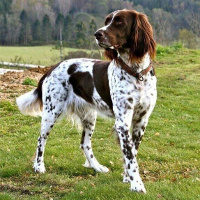
German Long Haired Pointing Dog

FCI standard Nº 117

Origin
Germany
Translation
Mrs C. Seidler
Group
Group 7 Pointing Dogs
Section
Section 1.2 Continental pointing dogs, Spaniel Type
Working
With working trial
Acceptance on a definitive basis by the FCI
Saturday 18 December 1954
Publication of the official valid standard
Thursday 10 November 2011
Last update
Wednesday 17 September 2014
En français, cette race se dit
Chien d'arrêt allemand à poil long
Diese Norm ist in deutscher Sprache sichtbar
Deutsch Langhaar
En español, esta raza se dice
Perro de muestra alemán de pelo largo
In het Nederlands, wordt dit ras gezegd
Duitse Staande Langhaar

Usage

Versatile working Gundog.

Brief historical summary

The German long-haired Pointing Dog combines the bloodlines of a bird-, hawk- and water dog as well as of Bracken (Scenthounds). He therefore has scope for great versatility. Pure breeding has been carried out since the year 1879 and main characteristics of the breed laid down. In the year 1897, Baron von Schorlemer set down the first standard for the German Long-haired and thus laid the foundation stone for today’s pure breeding.

General appearance

Strong; muscular; low set; flowing lines. Small dogs must have plenty of substance. Too massive and thereby clumsy dogs are not desired.

Important proportions

Muzzle and skull of equal length. Dog should not be overbuilt. Slightly higher at shoulder than rump.

Behaviour / temperament

Balanced, calm, controlled temperament, good natured, easily trained.

Head

Cranial region

Head
Special value must be attached to the beautiful Long-haired head. Noble appearance, elongated.
Skull
Slightly rounded. 
Stop
Gently rising, not deep and sharp.

Facial region

Nose
Brown, slightly lighter spots permitted.
Lips
Not overlapping too much.
Nasal bridge
Lightly arched, not too slender.
Jaws and teeth
Jaws not too fine. Well developed and complete (42 teeth) scissor bite i.e. upper incisors closely overlapping the lower incisors.
Cheeks
Cheekbones not too strong.
Eyes
Colour brown, as dark as possible. Lids fitting close to eyeballs, without visible haw. Set neither too deep, nor protruding.
Ears
Not set on too low, turned slightly forward.

Neck

Strong and noble. No dewlap. Getting harmoniously stronger towards the chest. Not too short.

Body

Back
Straight, firm, not too long.
Loin
Specially muscular.
Croup
Long, with moderate slope.
Chest
Forechest well developed, ribcage broad and deep, reaching at least to elbows.

Tail

Carried not too steep. It should be carried horizontally, the last third being slightly turned up.

Limbs

Forequarters

Generality
In normal stance, bones of upper arm, forearm and of foot, seen from the front, should form an almost vertical line.
Shoulders
Close fitting. Seen from side, in repose, shoulder-blade and upper arm should form approximately a right angle.
Elbows
Close fitting.
Carpal
Slightly angulated.
Pastern
Not quite straight.

Hindquarters

Generality
Seen from behind, the hip bone, upper thigh, bones of lower thigh and of foot should form a vertical line.
Hock
Special value is attached to good angulation. Dewclaws are to be removed at birth.

Feet

Pads coarse and strong.

Gait and movement

Ground covering movement with good drive from hindquarters.

Skin

Close fitting to body, no wrinkles.

Coat

Hair
The greatest importance is attached to correct coat, neither excessive growth nor too short hair. On back and sides of body : Hair 3 - 5 cm, close fitting. On underside of neck, on chest and belly, coat may be longer.
• Belly : Well coated.
• Leathers : Hair wavy and feathered.
• Tail : With good plume, coated to tip.
• Back of front legs : Feathered.
• Back of hind legs : Feathered, forming breeches.
• Below hock : Hair significantly shorter. Too much feathering is not desired. Dense short hair between toes.
• Head : Hair much shorter, but all the same, longer than on a short-haired German Pointing Dog. Topknot not desired.
• On body : Hair is sleek, firm, smooth or slightly wavy, close fitting. Dense with good undercoat.
Colour
• Self coloured brown.
• Brown with white or speckled markings (specially on chest and feet).
• Dark roan (with large or smaller dark brown patches; brown head, possibly with white blaze, snip or star).
• Pale roan (with large or smaller pale brown patches; brown head with possibly white blaze, snip or star).
• Mottled (many small brown spots on white background; head brown, possibly with white blaze, snip or star).
• Brown and white, either pure brown and white or with very few small spots (large brown patches with saddle or blanket. Head brown, possibly with white blaze, snip or star).
• Occasionally fawn markings may occur as a very old throw-back to the Hounds.

Size and weight

Height at withers
Dogs 60-70 cm, ideal height 63-66 cm, bitches 58-66 cm, ideal height 60-63 cm.
Weight
Average 30 kg.

Faults

• Any departure from the foregoing points should be considered a fault and the seriousness with which the fault should be regarded should be in exact proportion to its degree and its effect upon the health and welfare of the dog and its ability to perform its traditional work.
• Faults listed should be in degree of seriousness.

General faults

 Pale hawk-eye, slanting position of eyes.
 Ears not carried against the cheeks, leathery tips.
 Hollow back, roach back.
 Chest barrel shaped or too narrow.
 Curled or hooked tail.
 Scapulo-humeral angle too open, pastern too straight.
 Cowhocked, bow legged.
 Splayed feet, cat or hare feet.
 Longer hair on beard; bushy eyebrows; curly coat.

Disqualifying faults

 Aggresive or overly shy.
 Dogs with insufficient bone and muscle.
 Dogs with heads diverging from breed type.
 Ectropion (lids turned outwards).
 Entropion (lids turned inwards).
 Also eyelids which have been corrected.

NB :

• Any dog clearly showing physical or behavioural abnormalities shall be disqualified.
• The above mentioned faults when occurring to a highly marked degree or frequently are disqualifying.
• Male animals should have two apparently normal testicles fully descended into the scrotum.
• Only functionally and clinically healthy dogs, with breed typical conformation should be used for breeding.

Bibliography

https://www.fci.be/


Detailed history

Rightly, the German Braques and the Drahthaar acquired an excellent reputation, but their success was not without prejudice to their compatriots of the seventh group: it made forget that the Germanic pointers could also take a hair long spaniel.

Thus, the Langhaar (or, according to its official name, the Deutscher Langhaariger Vorstehhund, which can be translated into a German Stop Dog in Poil Long, is just emerging from a long eclipse, yet this dog, native to the northern regions from Germany, is known since at least the sixteenth century in this country.There is still a "Spaniel" (the word does not exist in German) for which the thesis of the Spanish origin is taken in default! of Europe have indeed for a long time this type of dog, moreover one can not more adapted to their climate and to the more or less marshy grounds which they were abundantly provided the Spagneuls are, obviously, also to at ease in these countries, as are the Braques in the southern garrigues.

On the subject of Langhaar, we can also observe the abundance of Spaniel breeds in Northern Europe, whereas they are nonexistent in the South. In addition to the German Langhaar, it is worth mentioning Drentsche Patrijshond (Dutch Epagneul de Drente) in the Netherlands, the French Epagneuls (French, Picard, Bleu de Picardie, Breton) spread throughout the north-west of the country. The Staby Hound of the Netherlands and the Münsterlanders (Grand and Petit) can still be linked to the Spaniel-type stop dogs. As for the Wachtelhund of Germany, it is not a sting dog but a game hunter and a bushman, and the Wetterhoun is a Dutch water dog. Finally, there are the British Setters and Spaniels.

In all these countries, where, in particular, many migratory birds pass, these dogs were formerly used for hunting with nets; they were also indispensable complements in hunts with falcons and with greyhounds, and also the auxiliaries of hunters with bow, crossbow, arquebus and finally rifle. It should be noted that in Germany, where hunting with hounds was almost unknown, the shooting of the game could quickly take a predominant place. It is impossible not to notice the striking resemblance between French Spaniel, Dutch Spaniel of Drente and Langhaar. For all that, a scholar would be one who could determine with certainty which is truly the oldest, and still more establish that one of these races is the ancestor of others. At most we can suppose that these three dogs appear as the national varieties of a European type present everywhere.

Like the French Spaniel, the Langhaar had to bow before the arrival of English dogs on the Continent (in the nineteenth century). Then, his fate even became darker because of the ascendency taken in Germany by the Shorthaired Pointer (Kurzhaar), then, at the beginning of the twentieth century, by the Stop Dog in Poil Dur (Drahthaar). The harsher and harder characters of the latter were, it is true, better adapted to all the tasks assigned to the dogs in this country, the hunt for stink and guard, among others. Since that time, therefore, it seems that Langhaar has mainly served to create or improve the other long-haired German races, which, moreover, have benefited from infusion of foreign blood. Thus, the Wachtelhund is derived in particular from Langhaar and British Spaniels. Similarly, the two Münsterlanders are from Langhaar with, it is said, a contribution of Breton Spaniel.

And then, all of a sudden, and very recently, the Langhaar has become established in the eyes of European specialists as a race capable of competing with the best continental dogs. In the fall of 1982, a Langhaar dog (driven by a Dutchman) won the world championship shooting field championship held that year in Spain. The following year, as if to prove that this feat was not the result of happy circumstances, another subject of the same race, still led by a member of the Dutch team, was second.

It was then claimed that his racy silhouette, his unicoloured brown dress, made one think of the Irish Setter, with the morphology of a continental dog; that his qualities of hunter, as brilliant as homogeneous, were not without evoking those of the German Pointer. It would be daring, to say the least, to think that modern Langhaar comes from these two races or that it owes them something of its renewal. Between the time when Langhaar was considered "endangered" and its recent successes in international championships, it can be said that nothing has happened that would allow such an assumption. No significant changes occurred in the characteristics of Langhaar, which was selected according to the criteria of purity of breed and performance breeding, which consists of maintaining and improving the dog's hunting qualities.

Currently, demand for Langhaar is increasing significantly in Germany and the Netherlands. In France, hunters are becoming interested in Langhaar, especially since Dutch amateurs have introduced it in competitions and dog shows. There is no doubt that the former German spaniel, tenacious, docile and enduring, has not lost any of these traits, but has won an incomparably larger, faster quest without showing 'impatience. The delicacy of his nose is perfectly adapted to the vivacity of his paces. If his flexible and active search does not predispose him to the hunt of the rabbits, his services allow to say that plain and wood are also suitable for him, with the partridges (or pheasants) as game, as well as the work with the water on ducks, in good Spaniel that it is.

It should be noted that the Langhaar bred in Germany is mainly used to find big game wounded, while that which is bred in the Netherlands is lighter and better adapted to the French needs for practical hunting in plain and water . It can be successfully presented in pulled game contests, at the International Practical Hunting Certificate, and also in Spring Fields. In keeping with the balance of his physical constitution, which joins an undeniable power with a noble hold, the Langhaar shows a stable and gentle temperament, typical of the Spaniel type. It is also a very flexible dog with dressage and particularly pleasant to live at home, where his kindness and his good humor are unanimous.

Today, the Langhaar has become the most successful Spaniel. Hopefully a wider spread will allow this beautiful and good dog to confirm this flattering reputation.

Comments

Latest page updates

  • Yorkshire Terrier

    Yorkshire Terrier FCI Standard No. 86 Origin Great Britain Group Group 3 Terriers Section Section 4 Toy Terriers Working Without working trial Date of acceptance on a definitive basis by the FCI Saturday 30 October 1954 Date of publication of the official valid standard Tuesday 08 September 2026 Date of the last update Tuesday 06 October 2026 En...
  • West Highland White Terrier

    West Highland White Terrier FCI Standard No. 85 Origin Great Britain Group Group 3 Terriers Section Section 2 Small-sized Terriers Working Without working trial Date of acceptance on a definitive basis by the FCI Friday 29 October 1954 Date of publication of the official valid standard Tuesday 08 September 2026 Date of the last update Tuesday 06...
  • Welsh Terrier

    Welsh Terrier FCI Standard No. 78 Origin Great Britain Group Group 3 Terriers Section Section 1 Large- and medium sized Terriers Working Without working trial Date of acceptance on a definitive basis by the FCI Saturday 23 October 1954 Date of publication of the official valid standard Tuesday 08 September 2026 Date of the last update Tuesday 06...
  • Welsh Springer Spaniel

    Welsh Springer Spaniel FCI Standard No. 126 Origin Great Britain Group Group 8 Retrievers-Flushing Dogs-Water Dogs Section Section 2 Flushing Dogs Working With working trial Date of acceptance on a definitive basis by the FCI Thursday 30 December 1954 Date of publication of the official valid standard Tuesday 08 September 2026 Date of the last...
  • Welsh Corgi Pembroke

    Welsh Corgi Pembroke FCI Standard No. 39 Origin Great Britain Group Group 1 Sheepdogs and Cattle Dogs (except Swiss Cattle Dogs) Section Section 2 Cattledogs (except Swiss Cattledogs) Working Without working trial Date of acceptance on a definitive basis by the FCI Wednesday 13 November 1963 Date of publication of the official valid standard Tuesday 08...
  • Welsh Corgi Cardigan

    Welsh Corgi Cardigan FCI Standard No. 38 Origin Great Britain Group Group 1 Sheepdogs and Cattle Dogs (except Swiss Cattle Dogs) Section Section 2 Cattledogs (except Swiss Cattledogs) Working Without working trial Date of acceptance on a definitive basis by the FCI Tuesday 12 November 1963 Date of publication of the official valid standard Tuesday 08...
  • Sussex Spaniel

    Sussex Spaniel FCI Standard No. 127 Origin Great Britain Group Group 8 Retrievers, Flushing dogs, Water dogs. Section Section 2 Flushing dogs Working With working trial Date of acceptance on a definitive basis by the FCI Friday 31 December 1954 Date of publication of the official valid standard Tuesday 08 September 2026 Date of the last update Tuesday 06...
  • Staffordshire Bull Terrier

    Staffordshire Bull Terrier FCI Standard No. 76 Origin Great Britain Group Group 3 Terriers Section Section 3 Bull type Terriers Working Without working trial Date of acceptance on a definitive basis by the FCI Thursday 21 October 1954 Date of publication of the official valid standard Tuesday 08 September 2026 Date of the last update Tuesday 06...
  • Skye Terrier

    Skye Terrier FCI Standard No. 75 Origin Great Britain Group Group 3 Terriers Section Section 2 Small-sized Terriers Working Without working trial Date of acceptance on a definitive basis by the FCI Wednesday 20 October 1954 Date of publication of the official valid standard Tuesday 08 September 2026 Date of the last update Tuesday 06 October 2026 En...
  • Shetland Sheepdog

    Shetland Sheepdog FCI Standard No. 88 Origin Great Britain Group Group 1 Sheepdogs and Cattle Dogs Section Section 1 Sheepdogs Working Without working trial Date of acceptance on a definitive basis by the FCI Tuesday 09 November 1954 Date of publication of the official valid standard Tuesday 08 September 2026 Date of the last update Tuesday 06...
  • Sealyham Terrier

    Sealyham Terrier FCI Standard No. 74 Origin Great Britain Group Group 3 Terriers Section Section 2 Small sized Terriers Working Without working trial Date of acceptance on a definitive basis by the FCI Tuesday 19 October 1954 Date of publication of the official valid standard Tuesday 08 September 2026 Date of the last update Tuesday 06 October...
  • Scottish Terrier

    Scottish Terrier FCI Standard No. 73 Origin Great Britain Group Group 3 Terriers Section Section 2 Small-sized Terriers Working Without working trial Date of acceptance on a definitive basis by the FCI Monday 18 October 1954 Date of publication of the official valid standard Tuesday 08 September 2026 Date of the last update Tuesday 06 October...
  • Old English Sheepdog (Bobtail)

      Old English Sheepdog (Bobtail) FCI Standard No. 16     Origin   Great Britain Group   Group 1 Sheepdogs and Cattle Dogs (except Swiss Cattle Dogs) Section   Section 1 Sheepdogs Working   Without working trial Date of acceptance on a definitive basis by the FCI   Monday 25 November 1963 Date of publication of the official valid standard   Tuesday 08 September...
  • Norwich Terrier

    Norwich Terrier FCI Standard No. 72 Origin Great Britain Group Group 3 Terriers Section Section 2 Small-sized Terriers Working Without working trial Date of acceptance on a definitive basis by the FCI Saturday 16 October 1954 Date of publication of the official valid standard Tuesday 08 September 2026 Date of the last update Tuesday 06 October...
  • Norfolk Terrier

    Norfolk Terrier FCI Standard No. 272 Origin Great Britain Group Group 3 Terriers Section Section 2 Small-sized Terriers Working Without working trial Date of acceptance on a definitive basis by the FCI Saturday 01 October 1966 Date of publication of the official valid standard Tuesday 08 September 2026 Date of the last update Tuesday 06 October...
  • Manchester Terrier

    Manchester Terrier FCI Standard No. 71 Origin Great Britain Group Group 3 Terriers Section Section 1 Large and medium sized Terriers Working Without working trial Date of acceptance on a definitive basis by the FCI Friday 15 October 1954 Date of publication of the official valid standard Tuesday 08 September 2026 Date of the last update Tuesday 06 October...
  • Lakeland Terrier

    Lakeland Terrier FCI Standard No. 70 Origin Great Britain Group Group 3 Terriers Section Section 1 Large and medium-sized Terriers Working Without working trial Date of acceptance on a definitive basis by the FCI Thursday 14 October 1954 Date of publication of the official valid standard Tuesday 08 September 2026 Date of the last update Tuesday 06 October...
  • Labrador Retriever

      Labrador Retriever FCI Standard No. 122     Origin   Canada Group   Group 8 Retrievers, Flushing dogs, Water dogs Section   Section 1 Retrievers Working   With working trial Date of acceptance on a definitive basis by the FCI   Friday 24 December 1954 Date of publication of the official valid standard   Tuesday 08 September 2026 Date of the last update   Tuesday 06...
  • King Charles Spaniel

    King Charles Spaniel FCI Standard No. 128 Origin Great Britain Group Group 9 Companion and Toy Dogs Section Section 7 English Toy Spaniels Working Without working trial Date of acceptance on a definitive basis by the FCI Monday 03 January 1955 Date of publication of the official valid standard Tuesday 08 September 2026 Date of the last update Tuesday 06...
  • Harrier

      Harrier FCI Standard No. 295     Origin   Great Britain Translation   Mrs. Peggy Davis, brought up to day by Dr. Paschoud Group   Group 6 Scenthounds and related breeds Section   Section 1.2 Medium-sized Hounds Working   With working trial Date of acceptance on a definitive basis by the FCI   Wednesday 27 November 1974 Date of publication of the official valid...
  • Greyhound

    Greyhound FCI Standard No. 158 Origin Great Britain Group Group 10 Sighthounds Section Section 3 Short-haired sighthounds Working Without working trial Date of acceptance on a definitive basis by the FCI Saturday 23 April 1955 Date of publication of the official valid standard Tuesday 08 September 2026 Date of the last update Tuesday 06 October...
  • Gordon Setter

    Gordon Setter FCI Standard No. 6 Origin Great Britain Group Group 7 Pointing Dogs Section Section 2.2 British and Irish Pointers and Setters; Setters Working With working trial Date of acceptance on a definitive basis by the FCI Tuesday 28 May 1963 Date of publication of the official valid standard Tuesday 08 September 2026 Date of the last...
  • Golden Retriever

    Golden Retriever FCI Standard No. 111 Origin Great Britain Group Group 8 Retrievers, Flushing Dogs, Water Dogs Section Section 1 Retrievers Working With working trial Date of acceptance on a definitive basis by the FCI Thursday 02 December 1954 Date of publication of the official valid standard Tuesday 28 July 2009 Date of the last update Wednesday...
  • Fox Terrier Wire

    Fox Terrier Wire FCI Standard No. 169 Origin Great Britain Group Group 3 Terriers Section Section 1 Large and medium-sized Terriers Working Working trial optional Date of acceptance on a definitive basis by the FCI Friday 13 May 1955 Date of publication of the official valid standard Tuesday 08 September 2026 Date of the last update Tuesday 06...
  • Fox Terrier Smooth

    Fox Terrier Smooth FCI Standard No. 12 Origin Great Britain Group Group Terriers Section Section 1 Large and medium sized Terriers Working Working trial optional Date of acceptance on a definitive basis by the FCI Wednesday 26 June 1963 Date of publication of the official valid standard Tuesday 08 September 2026 Date of the last update Tuesday 06...
  • Flat Coated Retriever

    Flat Coated Retriever FCI Standard No. 121 Origin Great Britain Group Group 8 Retrievers-Flushing Dogs-Water Dogs Section Section 1 Retrievers Working With working trial Date of acceptance on a definitive basis by the FCI Thursday 23 December 1954 Date of publication of the official valid standard Tuesday 08 September 2026 Date of the last update Tuesday...
  • Field Spaniel

    Field Spaniel FCI Standard No. 123 Origin Great-Britain Group Group 8 Retrievers, Flushing Dogs, Water Dogs Section Section 2 Flushing Dogs Working With working trial Date of acceptance on a definitive basis by the FCI Monday 27 December 1954 Date of publication of the official valid standard Tuesday 08 September 2026 Date of the last update Tuesday...
  • English Toy Terrier

    English Toy Terrier FCI Standard No. 13 Origin Great Britain Group Group 3 Terriers Section Section 4 Toy Terriers Working Without working trial Date of acceptance on a definitive basis by the FCI Tuesday 17 September 1963 Date of publication of the official valid standard Tuesday 08 September 2026 Date of the last update Tuesday 06 October 2026 En...
  • English Springer Spaniel

    English Springer Spaniel FCI Standard No. 125 Origin Great Britain Group Group 8 Retrievers-Flushing Dogs-Water Dogs Section Section 2 Flushing Dogs Working With working trial Date of acceptance on a definitive basis by the FCI Wednesday 29 December 1954 Date of publication of the official valid standard Tuesday 08 September 2026 Date of the last...
  • English Setter

    English Setter FCI Standard No. 2 Origin Great Britain Group Group 7 Pointing Dogs Section Section 2.2 British and Irish Pointers and Setters, Setter Working With working trial Date of acceptance on a definitive basis by the FCI Wednesday 06 March 1963 Date of publication of the official valid standard Tuesday 08 September 2026 Date of the last...
  • English Pointer

    English Pointer FCI Standard No. 1 Origin Great Britain Group Group 7 Pointing Dogs Section Section 2.1 British and Irish Pointers and Setters, Pointer Working With working trial Date of acceptance on a definitive basis by the FCI Tuesday 05 March 1963 Date of publication of the official valid standard Tuesday 08 September 2026 Date of the last...
  • English Foxhound

    English Foxhound FCI Standard No. 159 Origin Great Britain Group Group 6 Scenthounds and related breeds Section Section 1.1 Large-sized Scent hounds Working With working trial Date of acceptance on a definitive basis by the FCI Monday 25 April 1955 Date of publication of the official valid standard Thursday 26 March 2009 Date of the last update Wednesday...
  • English Cocker Spaniel

    English Cocker Spaniel FCI Standard No. 5 Origin Great Britain Group Group 8 Retrievers, Flushing Dogs, Water Dogs Section Section 2 Flushing dogs Working With working trial Date of acceptance on a definitive basis by the FCI Wednesday 10 April 1963 Date of publication of the official valid standard Tuesday 08 September 2026 Date of the last...
  • Tibetan Mastiff

    Tibetan Mastiff FCI Standard No. 230 Origin Tibet (China)Patronage FCI Group Group 2 Pinscher and Schnauzer- Molossoid breeds- Swiss Mountain and Cattle Dogs Section Section 2.2 Molossoid breeds, Mountain type Working Without working trial Date of acceptance on a definitive basis by the FCI Tuesday 22 August 1961 Date of publication of the...
  • Deerhound

    Deerhound FCI Standard No. 164 Origin Great Britain Group Group 10 Sighthounds Section Section 2 Rough-haired Sighthounds Working Without working trial Date of acceptance on a definitive basis by the FCI Friday 29 April 1955 Date of publication of the official valid standard Tuesday 08 September 2026 Date of the last update Tuesday 06 October...
  • Dandie Dinmont Terrier

    Dandie Dinmont Terrier FCI Standard No. 168 Origin Great Britain Group Group 3 Terriers Section Section 2 Small-sized Terriers Working Without working trial Date of acceptance on a definitive basis by the FCI Thursday 12 May 1955 Date of publication of the official valid standard Tuesday 08 September 2026 Date of the last update Tuesday 06...
  • Curly Coated Retriever

    Curly Coated Retriever FCI Standard No. 110 Origin Great Britain Group Group 8 Retrievers, Flushing Dogs, Water Dogs Section Section 1 Retrievers Working With working trial Date of acceptance on a definitive basis by the FCI Friday 10 December 1954 Date of publication of the official valid standard Tuesday 08 September 2026 Date of the last...
  • Collie Smooth

    Collie Smooth FCI Standard No. 296 Origin Great Britain Group Group 1 Sheepdogs and Cattle Dogs (except Swiss Cattle Dogs) Section Section 1 Sheepdogs Working Without working trial Date of acceptance on a definitive basis by the FCI Wednesday 18 December 1974 Date of publication of the official valid standard Tuesday 08 September 2026 Date of the...
  • Collie Rough

    Collie Rough FCI Standard No. 156 Origin Great Britain Group Group 1 Sheepdogs and Cattle Dogs (except Swiss Cattle Dogs) Section Section 1 Sheepdogs Working Without working trial Date of acceptance on a definitive basis by the FCI Wednesday 13 April 1955 Date of publication of the official valid standard Tuesday 08 September 2026 Date of the...
  • Clumber Spaniel

    Clumber Spaniel FCI Standard No. 109 Origin Great Britain Group Group 8 Retrievers, Flushing dogs, Water dogs Section Section 2 Flushing dogs Working With working trial Date of acceptance on a definitive basis by the FCI Thursday 09 December 1954 Date of publication of the official valid standard Tuesday 08 September 2026 Date of the last update Tuesday...
  • Chow Chow

    Chow Chow FCI Standard No. 205 Origin China, patronage : Great Britain Group Group 5 Spitz and primitive type Section Section 5 Asian Spitz and related breeds Working Without working trial Date of acceptance on a definitive basis by the FCI Tuesday 10 December 1957 Date of publication of the official valid standard Tuesday 08 September 2026 Date...
  • Chinese Crested Dog

    Chinese Crested Dog FCI Standard No. 288 Origin China, patronage Great Britain Group Group 9 Companion and Toy Dogs Section Section 4 Hairless breeds Working Without working trial Date of acceptance on a definitive basis by the FCI Monday 17 July 1972 Date of publication of the official valid standard Tuesday 08 September 2026 Date of the last...
  • Cairn Terrier

    Cairn Terrier FCI Standard No. 4 Origin Great Britain Group Group 3 Terriers Section Section 2 Small-sized Terriers Working Without working trial Date of acceptance on a definitive basis by the FCI Saturday 06 April 1963 Date of publication of the official valid standard Tuesday 08 September 2026 Date of the last update Tuesday 06 October 2026 En...
  • Bullmastiff

    Bullmastiff FCI Standard No. 157 Origin Great Britain Group Group 2 Pinscher and Schnauzer Molossoid breeds - Swiss Mountain and Cattle Dogs Section Section 2.1 Molossoid breeds, Mastiff Type Working Without working trial Date of acceptance on a definitive basis by the FCI Saturday 23 April 1955 Date of publication of the official valid standard Tuesday...
  • English Bulldog

    English Bulldog FCI Standard No. 149 Origin Great Britain Group Group 2 Pinscher and Schnauzer Molossoid breeds-Swiss Mountain and Cattle Dogs Section Section 2.1 Molossoid breeds, Mastiff Type Working Without working trial Date of acceptance on a definitive basis by the FCI Monday 14 March 1955 Date of publication of the official valid standard Tuesday...
  • Bull Terrier

    Bull Terrier FCI Standard No. 11 Origin Grande-Bretagne Group Group 3 Terriers Section Section 3 Bull type Terriers Working Working trial optional Date of acceptance on a definitive basis by the FCI Saturday 26 June 1993 Date of publication of the official valid standard Tuesday 08 September 2026 Date of the last update Tuesday 06 October 2026 En...
  • Border Terrier

    Border Terrier FCI Standard No. 10 Origin Great Britain Group Group 3 Terriers Section Section 1 Large and medium-sized terriers Working Without working trial Date of acceptance on a definitive basis by the FCI Wednesday 26 June 1963 Date of publication of the official valid standard Tuesday 08 September 2026 Date of the last update Tuesday 06...
  • Bedlington Terrier

    Bedlington Terrier FCI Standard No. 9 Origin Great Britain Group Group 3 Terriers Section Section 1 Large and medium sized Terriers Working Without working trial Date of acceptance on a definitive basis by the FCI Thursday 20 June 1963 Date of publication of the official valid standard Tuesday 08 September 2026 Date of the last update Tuesday 06...
  • Bearded Collie

    Bearded Collie FCI Standard No. 271 Origin Great-Britain Group Group 1 Sheepdogs and Cattle Dogs (except Swiss Cattle Dogs) Section Section 1 Sheepdogs Working Without working trial Date of acceptance on a definitive basis by the FCI Wednesday 30 August 1967 Date of publication of the official valid standard Tuesday 08 September 2026 Date of the...
  • Beagle

    Beagle FCI Standard No. 161 Origin Great Britain Translation Prof. R. Triquet Group Group 6 Scent hounds and related breeds Section Section 1.3 Small-sized hounds Date of acceptance on a definitive basis by the FCI Tuesday 26 April 1955 Date of publication of the official valid standard Tuesday 08 September 2026 Date of the last update Tuesday 06...
  • Basset Hound

    Basset Hound FCI Standard No. 163 Origin Great Britain Group Group 6 Scent hounds and related breeds Section Section 1.3 Small-sized hounds Working With working trial Date of acceptance on a definitive basis by the FCI Thursday 28 April 1955 Date of publication of the official valid standard Tuesday 08 September 2026 Date of the last update Tuesday...
  • Basenji

    Basenji FCI Standard No. 43 Origin Democratic Republic of Congo, under the patronage of Great Britain Group Group 5 Spitz and primitive types Section Section 6 Primitive type Working Without working trial Date of acceptance on a definitive basis by the FCI Thursday 26 March 1964 Date of publication of the official valid standard Tuesday 08...
  • Airedale Terrier

    Airedale Terrier FCI Standard No. 7 Origin Great Britain Group Group 3 Terriers Section Section 1 Large and medium sized Terriers Working Working trial optional Date of acceptance on a definitive basis by the FCI Tuesday 28 May 1963 Date of publication of the official valid standard Tuesday 08 September 2026 Date of the last update Tuesday 06...
  • Afghan Hound

    Afghan Hound FCI Standard No. 228 Origin AfghanistanPatronage Great Britain Group Group 10 Sighthounds Section Section 1 Long-haired or fringed sighthounds Working Without working trial Date of acceptance on a definitive basis by the FCI Tuesday 12 December 1961 Date of publication of the official valid standard Tuesday 08 September 2026 Date of the...
  • Romagna Water Dog

    Romagna Water Dog FCI Standard No. 298 Origin Italy Translation Antonio Morsiani, Renée Sporre-Willes and Prof. R. TriquetRevised by ENCI and Renée Sporre-WillesRevised by the FCI Head OfficeOfficial language (EN). Group Group 8 Retrievers –Flushing Dogs –Water Dogs Section Section 3 Water Dogs Working Working trial optional Date of acceptance on a...
  • Whippet

    Whippet FCI Standard No. 162 Origin Great Britain Group Group 10 Sighthounds Section Section 3 Short-haired Sighthounds Working Without working trial Date of acceptance on a definitive basis by the FCI Wednesday 27 April 1955 Date of publication of the official valid standard Tuesday 08 September 2026 Date of the last update Tuesday 06 October...
  • Tibetan Terrier

    Tibetan Terrier FCI Standard No. 209 Origin Tibet, patronage Great Britain Group Group 9 Companion and Toy Dogs Section Section 5 Tibetan breeds Working Without working trial Date of acceptance on a definitive basis by the FCI Wednesday 18 December 1957 Date of publication of the official valid standard Tuesday 08 September 2026 Date of the last...
  • Tibetan Spaniel

    Tibetan Spaniel FCI Standard No. 231 Origin Tibet (China)Patronage Great Britain Group Group 9 Companion and Toy Dogs Section Section 5 Tibetan breeds Working Without working trial Date of acceptance on a definitive basis by the FCI Tuesday 22 August 1961 Date of publication of the official valid standard Tuesday 08 September 2026 Date of the...
  • Shih Tzu

    Shih Tzu FCI Standard No. 208 Origin Tibet, patronage Great Britain Group Group 9 Companion and Toy Dogs Section Section 5 Tibetan breeds Working Without working trial Date of acceptance on a definitive basis by the FCI Monday 16 December 1957 Date of publication of the official valid standard Tuesday 08 September 2026 Date of the last update Tuesday 06...
  • Pug

    Pug FCI Standard No. 253 Origin China, patronage Great Britain Group Group 9 Companion and Toy Dogs Section Section 11 Small Molossian type dogs Working Without working trial Date of acceptance on a definitive basis by the FCI Friday 04 November 1966 Date of publication of the official valid standard Tuesday 08 September 2026 Date of the last...
  • Pharaoh Hound

    Pharaoh Hound FCI Standard No. 248 Origin Malta, patronage Great Britain Group Group 5 Spitz and primitive types Section Section 6 Primitive type Working Without working trial Date of acceptance on a definitive basis by the FCI Friday 09 August 1963 Date of publication of the official valid standard Tuesday 08 September 2026 Date of the last...
  • Pekingese

    Pekingese FCI Standard No. 207 Origin China, patronage Great Britain Group Group 9 Companion and Toy Dogs Section Section 8 Japan Chin and Pekingese Working Without working trial Date of acceptance on a definitive basis by the FCI Thursday 03 November 1966 Date of publication of the official valid standard Tuesday 08 September 2026 Date of the last...
  • Parson Russell Terrier

    Parson Russell Terrier FCI Standard No. 339 Origin Great Britain Group Group 3 Terriers Section Section 1 Large and medium sized Terriers Working Working trial optional Date of acceptance on a definitive basis by the FCI Monday 04 June 2001 Date of acceptance on a provisional basis by the FCI Monday 02 July 1990 Date of publication of the...
  • Otterhound

    Otterhound FCI Standard No. 294 Origin Great Britain Group Group 6 Scenthounds and related breeds Section Section 1.1 Large-sized hounds Working Without working trial Date of acceptance on a definitive basis by the FCI Thursday 12 September 1974 Date of publication of the official valid standard Tuesday 08 September 2026 Date of the last update Tuesday 06...
  • Miniature Bull Terrier

    Miniature Bull Terrier FCI Standard No. 359 Origin Grande-Bretagne Group Group 3 Terriers Section Section 3 Bull type Terriers Working Working trial optional Date of acceptance on a definitive basis by the FCI Tuesday 05 July 2011 Date of acceptance on a provisional basis by the FCI Tuesday 05 July 2011 Date of publication of the official valid...
  • Mastiff

    Mastiff FCI Standard No. 264 Origin Great Britain Group Group 2 Pinscher and Schnauzer – Molossoid breeds - Swiss Mountain and Cattle Dogs Section Section 2.1 Molossoid breeds, Mastiff Type Working Without working trial Date of acceptance on a definitive basis by the FCI Thursday 05 November 1964 Date of publication of the official valid standard Tuesday 08...
  • Lhassa Apso

    Lhassa Apso FCI Standard No. 227 Origin Tibet (China)Patronage Great Britain Group Group 9 Companion and Toy Dogs Section Section 5 Tibetan breeds Working Without working trial Date of acceptance on a definitive basis by the FCI Saturday 19 November 1960 Date of publication of the official valid standard Tuesday 08 September 2026 Date of the last...
  • Lancashire-Heeler

    Lancashire-Heeler FCI Standard No. 360 Origin England, patronage : FCI Group Group 1 Sheepdogs and Cattle Dogs (except Swiss Cattle Dogs) Section Section 1 Sheepdogs Working Without working trial Date of acceptance on a provisional basis by the FCI Sunday 01 May 2016 Date of publication of the official valid standard Tuesday 08 September 2026 Date...

© 2026 Groupe Milouchouchou ASBL. Tous droits réservés. En savoir plus

Protected by Copyright01
