French Bulldog

FCI standard Nº 101

Origin
France
Translation
Mr Ian Nicholson, Mrs Renée Sporre-Willes, Mr Raymond Triquet and Mr Claude Guintard.
Latest amendments : Société Centrale Canine. Official language (FR)
Group
Group 9 Companion and Toy Dogs
Section
Section 11 Small Molossian Dogs
Working
Without working trial
Acceptance on a definitive basis by the FCI
Tuesday 30 November 1954
Publication of the official valid standard
Thursday 10 August 2023
Last update
Monday 18 September 2023
En français, cette race se dit
Bouledogue français
Diese Norm ist in deutscher Sprache sichtbar
Französische Bulldogge
En español, esta raza se dice
Bulldog Francés
In het Nederlands, wordt dit ras gezegd
Franse Bulldog

Usage

Companion and Toy dog.

Brief historical summary

Probably decending, like all mastiffs, from the Epirus and the Roman Empire molossers, relative of the Bulldog of Great Britain, the Alaunts (tribe of the Middle Ages), the mastiffs and small-type mastiffs of France. The bulldog we know is the product of different crossings done by enthusiastic breeders in the popular quarters of Paris in the 1880s. During that period, the Bulldog was a dog belonging to Parisian market porters, butchers and coachmen, it soon won over high society and the artistic world by its particular appearance and character. It rapidly became popular. The first breed club was founded in 1880 in Paris. The first registration dates from 1885 and the first standard was established in 1898, the year in which the French Kennel Club recognized the French Bulldog breed. The first dog of this breed was shown at an exhibition as early as 1887. The standard, modified in 1931-1932 and 1948, was reformulated in 1986 by H.F. Reant with the collaboration of R. Triquet (F.C.I. publication 1987), then in 1994 by Violette Guillon (F.C.I. publication 1995) and in 2012 by the French Bulldog Club committee.

General appearance

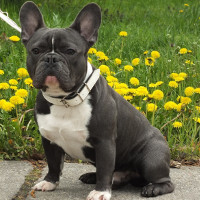
The type is of a small-sized molossian. A powerful dog for its small size, short, stocky, compact in all its proportions, smooth-coated, with a snub nose, erect ears and a naturally short tail. Must have the appearance of an active, intelligent, very muscular dog, of a compact build with a solid bone structure. No point is exaggerated compared to the others, which could spoil the dog’s general harmony, in appearance and in movement.

Important proportions

The length of the body – between the point of the shoulder and the point of the buttocks – slightly surpasses the height at the withers.
The length of muzzle is about 1/6 of the total length of the head. Short face

Behaviour / temperament

Sociable, lively, playful, possessive and keen companion dog.

Head

Cranial region

Head
Must be strong, broad and square, covered by the skin of the head which forms symmetrical folds and wrinkles, without excess.
Skull
Broad, almost flat from ear to ear, domed forehead. Proeminent superciliary arches, separated by a particularly developed furrow between the eyes. The furrow must not extend onto the skull. External occipital protuberance is barely developed.  
Stop
Pronounced.

Facial region

Foreface
The head of the Bulldog is characterized by a shortening of the maxillary-nasal part as well as a slight to moderate slope of the nose backwards. The nose is slightly upturned (“snub nose”).
Nose
Black, broad, snubbed, with symmetrical and well opened nostrils, slanting towards the rear. The slope of the nostrils as well as the upturned nose must, however, allow normal nasal breathing.
Muzzle
Very short, broad, with concentric symmetrical folds.
Lips
Thick, a little loose and black. The upper lip meets the lower lip at its middle, completely covering the teeth.
The profile of the upper lip is descending and rounded. The tongue must never show when the dog is not excited.
Jaws and teeth
Broad and powerful jaws. The lower jaw projects in front of the upper jaw and turns up. The arch of the lower incisors is rounded. The jaw must not show lateral deviation, or torsion. The gap between the incisors of the upper and the lower jaw should not be strictly delimited, the essential condition being that the upper and the lower lips meet to completely cover the teeth. The lower incisors surpass the upper incisors. Sufficiently developed incisives and canines. Complete bite is desirable.
Cheeks
Well developed.
Eyes
Clearly visible eyes, striking with lively expression, set low, quite far from the nose and the ears, dark coloured, rather large, rounded, showing no trace of white (sclera) when the dog is looking straight forward. Rims of eyelids must be black.
Ears
Medium size, wide at the base and rounded at the top. Set high on the head, but not too close together, carried erect. The ear is open towards the front. The skin must be fine and soft to the touch.

Neck

Short, powerful, slightly arched, without dewlap, broadens towards the shoulder.

Body

Topline
Rising progressively, but not excessively, from the withers towards the loin. That conformation – also called roach-back – is typical for the breed.
Back
Broad and muscular, firm without slackness.
Loin
Short, broad and arched.
Croup
Well sloping.
Chest
Cylindrical and well let down (slightly under the elbows); very well sprung ribs, so-called “barrel shaped”. Fore chest, broad and square-shaped, seen from the front.
Underline and belly
Tucked up but not whippety.

Tail

Naturally short, ideally long enough to cover the anus, set low, rather straight, thick at the base and tapering at the tip.
A kinked, knotted, broken or relatively long tail that does not reach beyond the point of the hocks, is admitted. It is carried low. Even in action, the tail must not rise above the horizontal.

Limbs

Forequarters

Generality
Forelegs upright (and straight) seen in profile and from the front.
Shoulders
Must be well laid back.
Upper arm
Short, thick, muscular, slightly curved.
Elbows
Close and tight to the body.
Forearm
Short, straight and muscular.
Carpal
Solid and short.
Pastern
Short and slightly oblique seen in profile.
Forefeet
Round, compact, of small dimension, i.e. «cat feet», turning slightly outward. The toes are tight, nails short, thick and black.

Hindquarters

Generality
The hindlegs are strong and muscular, a little longer than the forelegs, thus raising the hindquarters. The legs are upright as seen both in profile and from behind.
Upper thigh
Well muscled, firm.
Metatarsus
Short, tarsus solid.
Hock
Quite well let down, neither too angulated nor too straight.
Hind feet
Round, compact, turning neither inward nor outward.

Gait and movement

The legs moving parallel to the median plane of the body, whether seen in front or from behind. Free, movement with good hind leg thrust.

Skin

Firm.

Coat

Hair
Smooth coat, close, glossy and soft, without undercoat.
Colour
Fawn, brindled or not, with or without white spotting.
Coat with colouring :
Brindle : Fawn coat moderately characterized by transversal dark brindling creating a ‘tiger-marked’ effect, strongly brindled coats must not cover out the fawn ground colour. A black mask may be present. Limited white spotting is admissible.
Fawn : Solid coat, from light fawn to dark fawn, sometimes presenting a paler colouring of the inclined parts, with or without a black mask, although masked subjects are preferred. Sometimes accompanied by limited white spotting.
Coat with white spotting :
Brindled with moderate or important white spotting : So-called ‘pied’, the spotting being ideally distributed over the entire subject. Some blotches on the skin are admissible.
Fawn with moderate or important white spotting : So-called ‘fawn and white’, the spotting being ideally distributed over the entire dog. Some blotches of the skin are tolerated.
The nose is always black, in all coat colours, never brown or blue.
The all-white subjects provided the edge of eyelids and nose are black – are admitted but not bred for, because of a risk of deafness.

Size and weight

Height at withers
Males: 27–35 cm. Females: 24–32 cm. A deviation of 1 cm above and below the standard is tolerated.
Weight
Males: 9–14 kg. Females: 8–13 kg. 500 g more than the standard weight is allowed when the subject is typical.

Faults

• Any departure from the foregoing points should be considered a fault and the seriousness with which the fault should be regarded should be in exact proportion to its degree and its effect upon the health and welfare of the dog and its ability to perform its traditional work.
• Faults listed should be in degree of seriousness.

General faults

 Strongly flecked with black brindle with white coat.
 Fawn and white coat strongly red speckled.
 In fawn coats, deep black trace extending along the spine.
 White stockings in brindles and fawns.
 Light-coloured nails in brindle and fawn.
 No roach back.

Serious faults

 Overtyped, exaggerated breed characteristics.
 Muzzle too long or excessively short.
 Tongue visible when mouth is closed.
 Light eyes (hawk eye).
 Horizontal topline from withers to loin.
 Excessive depigmentation of the lips, nose, eyelids, the rim of which should never be entirely depigmented.
 Pincer bite.
 Arch back (camel back).

Disqualifying faults

 Aggressive or overly shy dog.
 Lacks type: insufficient ethnic characteristics which result in the dog not really resembling other subjects of the breed.
 Completely closed nostrils.
 Torsion or lateral deviation of the jaw, resulting in the tongue constantly being visible.
 Dog with lower incisors articulating behind upper incisors.
 Dog with permanently visible canines (fangs), mouth being closed.
 Heterochrome eyes (wall eye).
 Colour of nose other than black.
 Ears not carried erect.
 Taillessness or ingrown tail.
 Dewclaw on hindquarters.
 Reversed hock.
 Long, wired-haired or woolly coat.
 Colour not in accordance with what is prescribed in the standard, namely black, black with fawn markings (black and tan) and all dilutions of black with or without white spotting.
 Size and weight outside the standard limits.
 Respiratory distress.
 Deafness.

NB :

• Any dog clearly showing physical or behavioural abnormalities shall be disqualified.
• The above mentioned faults when occurring to a highly marked degree or frequently are disqualifying.
• Male animals should have two apparently normal testicles fully descended into the scrotum.
• Only functionally and clinically healthy dogs, with breed typical conformation should be used for breeding.

Bibliography

https://www.fci.be/


Detailed history

If we know precisely that the Bulldog appeared in France in its modern form at the end of the nineteenth century only, its distant origins remain, they, very contested and continue to arouse intense but rewarding discussions among cynologists.

In fact, three schools compete. According to a first hypothesis, the Bulldog would be a miniaturized version of the English Bulldog obtained from crossings of this race with small Terriers. The sturdy Bulldog had indeed been selected for his valor in the fighting against his congeners and bulls, "entertainment" much appreciated by the British until the mid-eighteenth century.

But his size became a handicap when he had to reconvert as a watchdog and companion after a decree of the Parliament of London had put an end to these barbaric practices. Some breeders therefore selected smaller and smaller Bulls. Called English Toy Bulldogs, these dogs quickly became popular in the Nottingham area, so much so that lace makers, who, subject to the vagaries of the economic crisis of the nineteenth century, had to move to the Calais region, took with them their faithful companions, whose small, shell-shaped ears were not the least of the features. Crusaders with small Terriers, the English Toy Bulldogs then gave birth to straight-eared Bulldogs who, after long hesitation, ended up being recognized by the Kennel Club under the name of French Bulldogs.

Supported by Pierre Mégnin, the second hypothesis about the origins of the French Bulldog completes the previous one more than it contradicts. According to this enlightened cynophile, the butchers and forts of Les Halles at the end of the nineteenth century had for a long time elected for companion the Doguin, a type of dog smaller than the Dogue, thus less cumbersome, and especially more agile. This animal had earned a solid reputation among "combaters", owners of battle arenas and organizers of circus games between animals, bloody shows that, according to the writings of J. Dhers, passionate crowds: "We saw fighting in Paris, but especially in the South West region - Bordeaux, Toulouse and the Pyrenees. These fighting arenas were fairgrounds where the dogs were fought against each other, against the donkey and especially against the bear."

Towards the end of the second Empire) the Doguins were gradually replaced by Terriers Boules (not to be confused with the Bull Terriers), sort of small ratiers very short body, well muscled, with ears and cut whip, which, crossed with Toy Terriers, and presumably Pugs, were to give birth to the French Bulldog. It seems, moreover, that the Toy Bulldogs imported from Great Britain and the Bulldogs born in the district of Les Halles mutually enriched each other, which would have made it possible to fix the breed and to establish its official standard in 1898. The contribution Carlin blood; which was long disputed by "historical" amateurs; would explain the rather particular eyes of the Ball, as it is commonly called. As for his right ears, it should be seen the influence of the Terriers.

The last hypothesis makes the French Bulldog the direct descendant of the Dogue de Burgos, himself a close relative of the Dogue de Bordeaux. This is the idea defended by George R. Krehl, an English cynologist, after a rigorous investigation into the origins of this "Frenchie" came, according to the cynophiles of the Channel, denature the national race . His argument is based on the discovery of a cast bronze plate in 1625 showing small mastiffs, resembling the British Bulldogs but "capped" with bat ears like the French Bulldog, with a legend (written in French). French) identifying them as Burgos's Mastiffs.

Whatever the genealogy of the French Bulldog, there is little doubt that it was in the Paris of the Belle Epoque that this dog knew his first success, which should never be denied.

The butchers and runners of the slaughterhouses of La Villette were the first to raise the French Bulldog, soon followed by the coachmen, the cobblers, the merchants of the four seasons, even the town sergeants, who were passionate about the little Ball. We met at the cafe terraces to compare the most beautiful subjects; advice was exchanged, and above all efforts were made, often at the price of heavy sacrifices, to produce the largest puppies. A star of the Paris of the small trades, the Bulldog haunted the popular districts of Pantin, Belleville and Les Halles, and his physique, his small size, his surprising pace and his particularly endearing character began to impose themselves and to seduce the amateurs of more in addition to many dogs with flat faces.

Shortly after, the Ball was going to enter the brothels, where the tenants and half-mundane of the Belle Epoque adopted it for its eccentric appearance. Immortalized in 1901 by Toulouse-Lautrec in the canvas The Merchant of chestnuts, the Bulldog paced conquering the Champs-Elysees, the grand boulevards, the Bois de Boulogne. Mistinguett, Colette, Mac Orlan, King Edward VII, certain Grand Dukes of the Russian court succumbed in their turn to the charm of this little comical dog, whose muscular body and gaiety stubbornly evoked the fair hercules. This sudden infatuation, nourished by the All-Paris, was to contribute largely to the rise of the Bulldog, which, even today and although the breed is not widespread, enjoys a very high reputation, especially abroad.

It was in 1880 that began the real dog career of the French Bulldog, with the founding of a friendly that gathered every week about fifty amateurs and breeders in Paris. In 1885, a first provisional register was opened. In 1887, the French Bulldog participated for the first time under this name in an official exhibition. The following year, the statutes of the club were developed under the leadership of Mr. Marcel Roger, precursor of the breeding in France and first elected president. It was, however, ten years before the dog society was really interested in this breed. At the origin of this recognition, two men: the Baron Carayon de Latour, who liked to present himself in public with his Balls, and the American patron Gordon Benett, who, accessing the head of the club, was also to promote the implantation of the breed in the United States. The role of the second was decisive, if we are to believe Pierre Mégnin, who in 1922 was to pay him a vibrant and deserved homage: "Breeders of French Bulldogs, greet the memory of Gordon Benett, the American dog-dog who dedicated your dogs and made your fortune. He knew how to get them out of the rut where they were vegetating."

Those who practice it are formal: the French Bulldog is an amazing dog in every way. This animal, whose ancestors were fierce fighters, is now one of the most affectionate and sensitive dogs ever, one of the most sought-after dogs, too.

It is important to recognize, however, that the Ball has not very good reputation with the general public. His prominent eyebrows protruding from each other, his powerful masticatory muscles, his scowl look unjustly helped to make him look like an aggressive dog. In caricatures, in comics, the animal that bites the bottoms of the breeches, who barks without reason, is almost always a Dogue, big or small. However, many artists have lived in the company of these dogs they highly valued and they are pleased to describe, in one sentence or several pages, the exceptional character. So Pierre Mac Orlan, who had several, and who left us a beautiful formula: "The little French Bulldog is a dog if you want, but it is rather what is called someone."

The Ball seduces from the first meeting: the penetrating gaze of this little dog that comes quietly sniff the newcomer, then accompanies the four corners of the house, explains more than one love story. Naturally kind, he needs the presence of his masters, and he will often model his attitude on theirs. In the company of elderly or sick people, he will be able to remain calm; he will share with pleasure the sometimes turbulent games of children; with the guests, he will never be hostile and will show exemplary courtesy. As Colette has quite rightly said, it is a dog that only enjoys the company of the man, a dog who will always prefer a modest but warm home to a palace where he would be abandoned to himself.

It is still said of him that, like a human being, he is capable of vexing himself, bursting out laughing, or sulking if he is not given enough attention. What is certain is that the Ball needs to communicate. By the game. By caresses. Through the silent exchanges he weaves with his master. It is a dog that adapts very well to living in an apartment and can be taken on a trip; even if he does not tolerate heat enough. Only flaw perhaps, he does not like baths, but his short hair makes its easy maintenance.

True to its origins, the French Bulldog, especially the male, shows a surprising courage. A courage that is similar to recklessness. He is so curious and eager to meet the expectations of those with whom he lives that he can meet dangers he is rarely aware of, so much so that his master sometimes has to intervene to protect him from himself. But is it not in this, too, that lies the charm of this admirable dog, who had seduced the humble and aesthetes of the new century?

Comments

Latest page updates

  • Yorkshire Terrier

    Yorkshire Terrier FCI Standard No. 86 Origin Great Britain Group Group 3 Terriers Section Section 4 Toy Terriers Working Without working trial Date of acceptance on a definitive basis by the FCI Saturday 30 October 1954 Date of publication of the official valid standard Tuesday 08 September 2026 Date of the last update Tuesday 06 October 2026 En...
  • West Highland White Terrier

    West Highland White Terrier FCI Standard No. 85 Origin Great Britain Group Group 3 Terriers Section Section 2 Small-sized Terriers Working Without working trial Date of acceptance on a definitive basis by the FCI Friday 29 October 1954 Date of publication of the official valid standard Tuesday 08 September 2026 Date of the last update Tuesday 06...
  • Welsh Terrier

    Welsh Terrier FCI Standard No. 78 Origin Great Britain Group Group 3 Terriers Section Section 1 Large- and medium sized Terriers Working Without working trial Date of acceptance on a definitive basis by the FCI Saturday 23 October 1954 Date of publication of the official valid standard Tuesday 08 September 2026 Date of the last update Tuesday 06...
  • Welsh Springer Spaniel

    Welsh Springer Spaniel FCI Standard No. 126 Origin Great Britain Group Group 8 Retrievers-Flushing Dogs-Water Dogs Section Section 2 Flushing Dogs Working With working trial Date of acceptance on a definitive basis by the FCI Thursday 30 December 1954 Date of publication of the official valid standard Tuesday 08 September 2026 Date of the last...
  • Welsh Corgi Pembroke

    Welsh Corgi Pembroke FCI Standard No. 39 Origin Great Britain Group Group 1 Sheepdogs and Cattle Dogs (except Swiss Cattle Dogs) Section Section 2 Cattledogs (except Swiss Cattledogs) Working Without working trial Date of acceptance on a definitive basis by the FCI Wednesday 13 November 1963 Date of publication of the official valid standard Tuesday 08...
  • Welsh Corgi Cardigan

    Welsh Corgi Cardigan FCI Standard No. 38 Origin Great Britain Group Group 1 Sheepdogs and Cattle Dogs (except Swiss Cattle Dogs) Section Section 2 Cattledogs (except Swiss Cattledogs) Working Without working trial Date of acceptance on a definitive basis by the FCI Tuesday 12 November 1963 Date of publication of the official valid standard Tuesday 08...
  • Sussex Spaniel

    Sussex Spaniel FCI Standard No. 127 Origin Great Britain Group Group 8 Retrievers, Flushing dogs, Water dogs. Section Section 2 Flushing dogs Working With working trial Date of acceptance on a definitive basis by the FCI Friday 31 December 1954 Date of publication of the official valid standard Tuesday 08 September 2026 Date of the last update Tuesday 06...
  • Staffordshire Bull Terrier

    Staffordshire Bull Terrier FCI Standard No. 76 Origin Great Britain Group Group 3 Terriers Section Section 3 Bull type Terriers Working Without working trial Date of acceptance on a definitive basis by the FCI Thursday 21 October 1954 Date of publication of the official valid standard Tuesday 08 September 2026 Date of the last update Tuesday 06...
  • Skye Terrier

    Skye Terrier FCI Standard No. 75 Origin Great Britain Group Group 3 Terriers Section Section 2 Small-sized Terriers Working Without working trial Date of acceptance on a definitive basis by the FCI Wednesday 20 October 1954 Date of publication of the official valid standard Tuesday 08 September 2026 Date of the last update Tuesday 06 October 2026 En...
  • Shetland Sheepdog

    Shetland Sheepdog FCI Standard No. 88 Origin Great Britain Group Group 1 Sheepdogs and Cattle Dogs Section Section 1 Sheepdogs Working Without working trial Date of acceptance on a definitive basis by the FCI Tuesday 09 November 1954 Date of publication of the official valid standard Tuesday 08 September 2026 Date of the last update Tuesday 06...
  • Sealyham Terrier

    Sealyham Terrier FCI Standard No. 74 Origin Great Britain Group Group 3 Terriers Section Section 2 Small sized Terriers Working Without working trial Date of acceptance on a definitive basis by the FCI Tuesday 19 October 1954 Date of publication of the official valid standard Tuesday 08 September 2026 Date of the last update Tuesday 06 October...
  • Scottish Terrier

    Scottish Terrier FCI Standard No. 73 Origin Great Britain Group Group 3 Terriers Section Section 2 Small-sized Terriers Working Without working trial Date of acceptance on a definitive basis by the FCI Monday 18 October 1954 Date of publication of the official valid standard Tuesday 08 September 2026 Date of the last update Tuesday 06 October...
  • Old English Sheepdog (Bobtail)

      Old English Sheepdog (Bobtail) FCI Standard No. 16     Origin   Great Britain Group   Group 1 Sheepdogs and Cattle Dogs (except Swiss Cattle Dogs) Section   Section 1 Sheepdogs Working   Without working trial Date of acceptance on a definitive basis by the FCI   Monday 25 November 1963 Date of publication of the official valid standard   Tuesday 08 September...
  • Norwich Terrier

    Norwich Terrier FCI Standard No. 72 Origin Great Britain Group Group 3 Terriers Section Section 2 Small-sized Terriers Working Without working trial Date of acceptance on a definitive basis by the FCI Saturday 16 October 1954 Date of publication of the official valid standard Tuesday 08 September 2026 Date of the last update Tuesday 06 October...
  • Norfolk Terrier

    Norfolk Terrier FCI Standard No. 272 Origin Great Britain Group Group 3 Terriers Section Section 2 Small-sized Terriers Working Without working trial Date of acceptance on a definitive basis by the FCI Saturday 01 October 1966 Date of publication of the official valid standard Tuesday 08 September 2026 Date of the last update Tuesday 06 October...
  • Manchester Terrier

    Manchester Terrier FCI Standard No. 71 Origin Great Britain Group Group 3 Terriers Section Section 1 Large and medium sized Terriers Working Without working trial Date of acceptance on a definitive basis by the FCI Friday 15 October 1954 Date of publication of the official valid standard Tuesday 08 September 2026 Date of the last update Tuesday 06 October...
  • Lakeland Terrier

    Lakeland Terrier FCI Standard No. 70 Origin Great Britain Group Group 3 Terriers Section Section 1 Large and medium-sized Terriers Working Without working trial Date of acceptance on a definitive basis by the FCI Thursday 14 October 1954 Date of publication of the official valid standard Tuesday 08 September 2026 Date of the last update Tuesday 06 October...
  • Labrador Retriever

      Labrador Retriever FCI Standard No. 122     Origin   Canada Group   Group 8 Retrievers, Flushing dogs, Water dogs Section   Section 1 Retrievers Working   With working trial Date of acceptance on a definitive basis by the FCI   Friday 24 December 1954 Date of publication of the official valid standard   Tuesday 08 September 2026 Date of the last update   Tuesday 06...
  • King Charles Spaniel

    King Charles Spaniel FCI Standard No. 128 Origin Great Britain Group Group 9 Companion and Toy Dogs Section Section 7 English Toy Spaniels Working Without working trial Date of acceptance on a definitive basis by the FCI Monday 03 January 1955 Date of publication of the official valid standard Tuesday 08 September 2026 Date of the last update Tuesday 06...
  • Harrier

      Harrier FCI Standard No. 295     Origin   Great Britain Translation   Mrs. Peggy Davis, brought up to day by Dr. Paschoud Group   Group 6 Scenthounds and related breeds Section   Section 1.2 Medium-sized Hounds Working   With working trial Date of acceptance on a definitive basis by the FCI   Wednesday 27 November 1974 Date of publication of the official valid...
  • Greyhound

    Greyhound FCI Standard No. 158 Origin Great Britain Group Group 10 Sighthounds Section Section 3 Short-haired sighthounds Working Without working trial Date of acceptance on a definitive basis by the FCI Saturday 23 April 1955 Date of publication of the official valid standard Tuesday 08 September 2026 Date of the last update Tuesday 06 October...
  • Gordon Setter

    Gordon Setter FCI Standard No. 6 Origin Great Britain Group Group 7 Pointing Dogs Section Section 2.2 British and Irish Pointers and Setters; Setters Working With working trial Date of acceptance on a definitive basis by the FCI Tuesday 28 May 1963 Date of publication of the official valid standard Tuesday 08 September 2026 Date of the last...
  • Golden Retriever

    Golden Retriever FCI Standard No. 111 Origin Great Britain Group Group 8 Retrievers, Flushing Dogs, Water Dogs Section Section 1 Retrievers Working With working trial Date of acceptance on a definitive basis by the FCI Thursday 02 December 1954 Date of publication of the official valid standard Tuesday 28 July 2009 Date of the last update Wednesday...
  • Fox Terrier Wire

    Fox Terrier Wire FCI Standard No. 169 Origin Great Britain Group Group 3 Terriers Section Section 1 Large and medium-sized Terriers Working Working trial optional Date of acceptance on a definitive basis by the FCI Friday 13 May 1955 Date of publication of the official valid standard Tuesday 08 September 2026 Date of the last update Tuesday 06...
  • Fox Terrier Smooth

    Fox Terrier Smooth FCI Standard No. 12 Origin Great Britain Group Group Terriers Section Section 1 Large and medium sized Terriers Working Working trial optional Date of acceptance on a definitive basis by the FCI Wednesday 26 June 1963 Date of publication of the official valid standard Tuesday 08 September 2026 Date of the last update Tuesday 06...
  • Flat Coated Retriever

    Flat Coated Retriever FCI Standard No. 121 Origin Great Britain Group Group 8 Retrievers-Flushing Dogs-Water Dogs Section Section 1 Retrievers Working With working trial Date of acceptance on a definitive basis by the FCI Thursday 23 December 1954 Date of publication of the official valid standard Tuesday 08 September 2026 Date of the last update Tuesday...
  • Field Spaniel

    Field Spaniel FCI Standard No. 123 Origin Great-Britain Group Group 8 Retrievers, Flushing Dogs, Water Dogs Section Section 2 Flushing Dogs Working With working trial Date of acceptance on a definitive basis by the FCI Monday 27 December 1954 Date of publication of the official valid standard Tuesday 08 September 2026 Date of the last update Tuesday...
  • English Toy Terrier

    English Toy Terrier FCI Standard No. 13 Origin Great Britain Group Group 3 Terriers Section Section 4 Toy Terriers Working Without working trial Date of acceptance on a definitive basis by the FCI Tuesday 17 September 1963 Date of publication of the official valid standard Tuesday 08 September 2026 Date of the last update Tuesday 06 October 2026 En...
  • English Springer Spaniel

    English Springer Spaniel FCI Standard No. 125 Origin Great Britain Group Group 8 Retrievers-Flushing Dogs-Water Dogs Section Section 2 Flushing Dogs Working With working trial Date of acceptance on a definitive basis by the FCI Wednesday 29 December 1954 Date of publication of the official valid standard Tuesday 08 September 2026 Date of the last...
  • English Setter

    English Setter FCI Standard No. 2 Origin Great Britain Group Group 7 Pointing Dogs Section Section 2.2 British and Irish Pointers and Setters, Setter Working With working trial Date of acceptance on a definitive basis by the FCI Wednesday 06 March 1963 Date of publication of the official valid standard Tuesday 08 September 2026 Date of the last...
  • English Pointer

    English Pointer FCI Standard No. 1 Origin Great Britain Group Group 7 Pointing Dogs Section Section 2.1 British and Irish Pointers and Setters, Pointer Working With working trial Date of acceptance on a definitive basis by the FCI Tuesday 05 March 1963 Date of publication of the official valid standard Tuesday 08 September 2026 Date of the last...
  • English Foxhound

    English Foxhound FCI Standard No. 159 Origin Great Britain Group Group 6 Scenthounds and related breeds Section Section 1.1 Large-sized Scent hounds Working With working trial Date of acceptance on a definitive basis by the FCI Monday 25 April 1955 Date of publication of the official valid standard Thursday 26 March 2009 Date of the last update Wednesday...
  • English Cocker Spaniel

    English Cocker Spaniel FCI Standard No. 5 Origin Great Britain Group Group 8 Retrievers, Flushing Dogs, Water Dogs Section Section 2 Flushing dogs Working With working trial Date of acceptance on a definitive basis by the FCI Wednesday 10 April 1963 Date of publication of the official valid standard Tuesday 08 September 2026 Date of the last...
  • Tibetan Mastiff

    Tibetan Mastiff FCI Standard No. 230 Origin Tibet (China)Patronage FCI Group Group 2 Pinscher and Schnauzer- Molossoid breeds- Swiss Mountain and Cattle Dogs Section Section 2.2 Molossoid breeds, Mountain type Working Without working trial Date of acceptance on a definitive basis by the FCI Tuesday 22 August 1961 Date of publication of the...
  • Deerhound

    Deerhound FCI Standard No. 164 Origin Great Britain Group Group 10 Sighthounds Section Section 2 Rough-haired Sighthounds Working Without working trial Date of acceptance on a definitive basis by the FCI Friday 29 April 1955 Date of publication of the official valid standard Tuesday 08 September 2026 Date of the last update Tuesday 06 October...
  • Dandie Dinmont Terrier

    Dandie Dinmont Terrier FCI Standard No. 168 Origin Great Britain Group Group 3 Terriers Section Section 2 Small-sized Terriers Working Without working trial Date of acceptance on a definitive basis by the FCI Thursday 12 May 1955 Date of publication of the official valid standard Tuesday 08 September 2026 Date of the last update Tuesday 06...
  • Curly Coated Retriever

    Curly Coated Retriever FCI Standard No. 110 Origin Great Britain Group Group 8 Retrievers, Flushing Dogs, Water Dogs Section Section 1 Retrievers Working With working trial Date of acceptance on a definitive basis by the FCI Friday 10 December 1954 Date of publication of the official valid standard Tuesday 08 September 2026 Date of the last...
  • Collie Smooth

    Collie Smooth FCI Standard No. 296 Origin Great Britain Group Group 1 Sheepdogs and Cattle Dogs (except Swiss Cattle Dogs) Section Section 1 Sheepdogs Working Without working trial Date of acceptance on a definitive basis by the FCI Wednesday 18 December 1974 Date of publication of the official valid standard Tuesday 08 September 2026 Date of the...
  • Collie Rough

    Collie Rough FCI Standard No. 156 Origin Great Britain Group Group 1 Sheepdogs and Cattle Dogs (except Swiss Cattle Dogs) Section Section 1 Sheepdogs Working Without working trial Date of acceptance on a definitive basis by the FCI Wednesday 13 April 1955 Date of publication of the official valid standard Tuesday 08 September 2026 Date of the...
  • Clumber Spaniel

    Clumber Spaniel FCI Standard No. 109 Origin Great Britain Group Group 8 Retrievers, Flushing dogs, Water dogs Section Section 2 Flushing dogs Working With working trial Date of acceptance on a definitive basis by the FCI Thursday 09 December 1954 Date of publication of the official valid standard Tuesday 08 September 2026 Date of the last update Tuesday...
  • Chow Chow

    Chow Chow FCI Standard No. 205 Origin China, patronage : Great Britain Group Group 5 Spitz and primitive type Section Section 5 Asian Spitz and related breeds Working Without working trial Date of acceptance on a definitive basis by the FCI Tuesday 10 December 1957 Date of publication of the official valid standard Tuesday 08 September 2026 Date...
  • Chinese Crested Dog

    Chinese Crested Dog FCI Standard No. 288 Origin China, patronage Great Britain Group Group 9 Companion and Toy Dogs Section Section 4 Hairless breeds Working Without working trial Date of acceptance on a definitive basis by the FCI Monday 17 July 1972 Date of publication of the official valid standard Tuesday 08 September 2026 Date of the last...
  • Cairn Terrier

    Cairn Terrier FCI Standard No. 4 Origin Great Britain Group Group 3 Terriers Section Section 2 Small-sized Terriers Working Without working trial Date of acceptance on a definitive basis by the FCI Saturday 06 April 1963 Date of publication of the official valid standard Tuesday 08 September 2026 Date of the last update Tuesday 06 October 2026 En...
  • Bullmastiff

    Bullmastiff FCI Standard No. 157 Origin Great Britain Group Group 2 Pinscher and Schnauzer Molossoid breeds - Swiss Mountain and Cattle Dogs Section Section 2.1 Molossoid breeds, Mastiff Type Working Without working trial Date of acceptance on a definitive basis by the FCI Saturday 23 April 1955 Date of publication of the official valid standard Tuesday...
  • English Bulldog

    English Bulldog FCI Standard No. 149 Origin Great Britain Group Group 2 Pinscher and Schnauzer Molossoid breeds-Swiss Mountain and Cattle Dogs Section Section 2.1 Molossoid breeds, Mastiff Type Working Without working trial Date of acceptance on a definitive basis by the FCI Monday 14 March 1955 Date of publication of the official valid standard Tuesday...
  • Bull Terrier

    Bull Terrier FCI Standard No. 11 Origin Grande-Bretagne Group Group 3 Terriers Section Section 3 Bull type Terriers Working Working trial optional Date of acceptance on a definitive basis by the FCI Saturday 26 June 1993 Date of publication of the official valid standard Tuesday 08 September 2026 Date of the last update Tuesday 06 October 2026 En...
  • Border Terrier

    Border Terrier FCI Standard No. 10 Origin Great Britain Group Group 3 Terriers Section Section 1 Large and medium-sized terriers Working Without working trial Date of acceptance on a definitive basis by the FCI Wednesday 26 June 1963 Date of publication of the official valid standard Tuesday 08 September 2026 Date of the last update Tuesday 06...
  • Bedlington Terrier

    Bedlington Terrier FCI Standard No. 9 Origin Great Britain Group Group 3 Terriers Section Section 1 Large and medium sized Terriers Working Without working trial Date of acceptance on a definitive basis by the FCI Thursday 20 June 1963 Date of publication of the official valid standard Tuesday 08 September 2026 Date of the last update Tuesday 06...
  • Bearded Collie

    Bearded Collie FCI Standard No. 271 Origin Great-Britain Group Group 1 Sheepdogs and Cattle Dogs (except Swiss Cattle Dogs) Section Section 1 Sheepdogs Working Without working trial Date of acceptance on a definitive basis by the FCI Wednesday 30 August 1967 Date of publication of the official valid standard Tuesday 08 September 2026 Date of the...
  • Beagle

    Beagle FCI Standard No. 161 Origin Great Britain Translation Prof. R. Triquet Group Group 6 Scent hounds and related breeds Section Section 1.3 Small-sized hounds Date of acceptance on a definitive basis by the FCI Tuesday 26 April 1955 Date of publication of the official valid standard Tuesday 08 September 2026 Date of the last update Tuesday 06...
  • Basset Hound

    Basset Hound FCI Standard No. 163 Origin Great Britain Group Group 6 Scent hounds and related breeds Section Section 1.3 Small-sized hounds Working With working trial Date of acceptance on a definitive basis by the FCI Thursday 28 April 1955 Date of publication of the official valid standard Tuesday 08 September 2026 Date of the last update Tuesday...
  • Basenji

    Basenji FCI Standard No. 43 Origin Democratic Republic of Congo, under the patronage of Great Britain Group Group 5 Spitz and primitive types Section Section 6 Primitive type Working Without working trial Date of acceptance on a definitive basis by the FCI Thursday 26 March 1964 Date of publication of the official valid standard Tuesday 08...
  • Airedale Terrier

    Airedale Terrier FCI Standard No. 7 Origin Great Britain Group Group 3 Terriers Section Section 1 Large and medium sized Terriers Working Working trial optional Date of acceptance on a definitive basis by the FCI Tuesday 28 May 1963 Date of publication of the official valid standard Tuesday 08 September 2026 Date of the last update Tuesday 06...
  • Afghan Hound

    Afghan Hound FCI Standard No. 228 Origin AfghanistanPatronage Great Britain Group Group 10 Sighthounds Section Section 1 Long-haired or fringed sighthounds Working Without working trial Date of acceptance on a definitive basis by the FCI Tuesday 12 December 1961 Date of publication of the official valid standard Tuesday 08 September 2026 Date of the...
  • Romagna Water Dog

    Romagna Water Dog FCI Standard No. 298 Origin Italy Translation Antonio Morsiani, Renée Sporre-Willes and Prof. R. TriquetRevised by ENCI and Renée Sporre-WillesRevised by the FCI Head OfficeOfficial language (EN). Group Group 8 Retrievers –Flushing Dogs –Water Dogs Section Section 3 Water Dogs Working Working trial optional Date of acceptance on a...
  • Whippet

    Whippet FCI Standard No. 162 Origin Great Britain Group Group 10 Sighthounds Section Section 3 Short-haired Sighthounds Working Without working trial Date of acceptance on a definitive basis by the FCI Wednesday 27 April 1955 Date of publication of the official valid standard Tuesday 08 September 2026 Date of the last update Tuesday 06 October...
  • Tibetan Terrier

    Tibetan Terrier FCI Standard No. 209 Origin Tibet, patronage Great Britain Group Group 9 Companion and Toy Dogs Section Section 5 Tibetan breeds Working Without working trial Date of acceptance on a definitive basis by the FCI Wednesday 18 December 1957 Date of publication of the official valid standard Tuesday 08 September 2026 Date of the last...
  • Tibetan Spaniel

    Tibetan Spaniel FCI Standard No. 231 Origin Tibet (China)Patronage Great Britain Group Group 9 Companion and Toy Dogs Section Section 5 Tibetan breeds Working Without working trial Date of acceptance on a definitive basis by the FCI Tuesday 22 August 1961 Date of publication of the official valid standard Tuesday 08 September 2026 Date of the...
  • Shih Tzu

    Shih Tzu FCI Standard No. 208 Origin Tibet, patronage Great Britain Group Group 9 Companion and Toy Dogs Section Section 5 Tibetan breeds Working Without working trial Date of acceptance on a definitive basis by the FCI Monday 16 December 1957 Date of publication of the official valid standard Tuesday 08 September 2026 Date of the last update Tuesday 06...
  • Pug

    Pug FCI Standard No. 253 Origin China, patronage Great Britain Group Group 9 Companion and Toy Dogs Section Section 11 Small Molossian type dogs Working Without working trial Date of acceptance on a definitive basis by the FCI Friday 04 November 1966 Date of publication of the official valid standard Tuesday 08 September 2026 Date of the last...
  • Pharaoh Hound

    Pharaoh Hound FCI Standard No. 248 Origin Malta, patronage Great Britain Group Group 5 Spitz and primitive types Section Section 6 Primitive type Working Without working trial Date of acceptance on a definitive basis by the FCI Friday 09 August 1963 Date of publication of the official valid standard Tuesday 08 September 2026 Date of the last...
  • Pekingese

    Pekingese FCI Standard No. 207 Origin China, patronage Great Britain Group Group 9 Companion and Toy Dogs Section Section 8 Japan Chin and Pekingese Working Without working trial Date of acceptance on a definitive basis by the FCI Thursday 03 November 1966 Date of publication of the official valid standard Tuesday 08 September 2026 Date of the last...
  • Parson Russell Terrier

    Parson Russell Terrier FCI Standard No. 339 Origin Great Britain Group Group 3 Terriers Section Section 1 Large and medium sized Terriers Working Working trial optional Date of acceptance on a definitive basis by the FCI Monday 04 June 2001 Date of acceptance on a provisional basis by the FCI Monday 02 July 1990 Date of publication of the...
  • Otterhound

    Otterhound FCI Standard No. 294 Origin Great Britain Group Group 6 Scenthounds and related breeds Section Section 1.1 Large-sized hounds Working Without working trial Date of acceptance on a definitive basis by the FCI Thursday 12 September 1974 Date of publication of the official valid standard Tuesday 08 September 2026 Date of the last update Tuesday 06...
  • Miniature Bull Terrier

    Miniature Bull Terrier FCI Standard No. 359 Origin Grande-Bretagne Group Group 3 Terriers Section Section 3 Bull type Terriers Working Working trial optional Date of acceptance on a definitive basis by the FCI Tuesday 05 July 2011 Date of acceptance on a provisional basis by the FCI Tuesday 05 July 2011 Date of publication of the official valid...
  • Mastiff

    Mastiff FCI Standard No. 264 Origin Great Britain Group Group 2 Pinscher and Schnauzer – Molossoid breeds - Swiss Mountain and Cattle Dogs Section Section 2.1 Molossoid breeds, Mastiff Type Working Without working trial Date of acceptance on a definitive basis by the FCI Thursday 05 November 1964 Date of publication of the official valid standard Tuesday 08...
  • Lhassa Apso

    Lhassa Apso FCI Standard No. 227 Origin Tibet (China)Patronage Great Britain Group Group 9 Companion and Toy Dogs Section Section 5 Tibetan breeds Working Without working trial Date of acceptance on a definitive basis by the FCI Saturday 19 November 1960 Date of publication of the official valid standard Tuesday 08 September 2026 Date of the last...
  • Lancashire-Heeler

    Lancashire-Heeler FCI Standard No. 360 Origin England, patronage : FCI Group Group 1 Sheepdogs and Cattle Dogs (except Swiss Cattle Dogs) Section Section 1 Sheepdogs Working Without working trial Date of acceptance on a provisional basis by the FCI Sunday 01 May 2016 Date of publication of the official valid standard Tuesday 08 September 2026 Date...

© 2026 Groupe Milouchouchou ASBL. Tous droits réservés. En savoir plus

Protected by Copyright01
