Skye Terrier

FCI Standard No. 75

Origin
Great Britain
Group
Group 3 Terriers
Section
Section 2 Small-sized Terriers
Working
Without working trial
Date of acceptance on a definitive basis by the FCI
Wednesday 20 October 1954
Date of publication of the official valid standard
Tuesday 08 September 2026
Date of the last update
Tuesday 06 October 2026
En français, cette race se dit
Skye Terrier
Diese Norm ist in deutscher Sprache sichtbar
Skye Terrier
En español, esta raza se dice
Skye Terrier
In het Nederlands, wordt dit ras gezegd
Skye Terrier

Usage

Terrier.
 

Brief historical summary

One of the oldest Scottish breeds; The Skye was once known as the Terrier of the Western Isles, evolving into what we now call the Skye Terrier, with a mix of breeds behind him, including Cairn Terrier prototypes. One of the most famed of the breed was Greyfriars Bobby who, in Edinburgh, around 1858 took up a vigil at his master’s grave in Greyfriars Churchyard until he too died. Greyfriars Bobby was buried in un-consecrated ground in the churchyard and his devotion is commemorated by a memorial plaque in the street and by a tablet on his grave. Although the majority of Skye Terriers are prick-eared, there is also a variety known as ‘drop-eared’, and then the ears hang flat against the skull.

General appearance

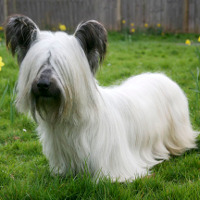
Long; twice as long as high, with coat of good length, Moves with seemingly effortless gait. Strong in quarters, body and jaw.

Important proportions

Body long, low, twice as long as high.

Behaviour / temperament

Elegant and dignified. A ‘one-man’ dog, distrustful of strangers, never vicious.

Head

Cranial region

Head
Long and powerful, strength not sacrificed for extreme length.
Skull
Of moderate width at the back of skull, tapering gradually to strong muzzle.
Stop
Slight.

Facial region

Nose
Black.
Muzzle
Strong.
Jaws and teeth
Jaws strong and level with perfect, regular scissor bite, i. e. upper teeth closely overlapping the lower teeth and set square to the jaws.sont implantées à l'aplomb des mâchoires.
Eyes
Brown, preferably dark brown, medium in size, close-set and full of expression.
Ears
Prick or drop. When prick, gracefully feathered, not large, erect at outer edges and slanting towards each other at inner edge, from peak to skull. When drop, larger, hanging straight, lying flat and close at front.

Neck

Long and slightly crested.

Body

Body
Long and low. Sides appear flattish due to straight falling coat.
Back
Level.
Loin
Short.
Chest
Deep; ribcage oval, deep and long.

Tail

When hanging, upper part pendulous and lower half thrown back in a curve. When raised, a prolongation of incline of back, not rising higher nor curling up. Gracefully feathered.

Limbs

Forequarters

Shoulders
Broad, close to body.
Forearm
Legs short and muscular.
Forefeet
Forefeet larger than hind, pointing truly forward. Pads thick, nails strong.

Hindquarters

Generality
Strong, full, well developed and well angulated. Legs short, muscular and straight when viewed from behind.
Stifle
Well angulated.
Metatarsus
No dewclaws.
Hock
Well angulated.
Hind feet
Hind feet smaller than forefeet, pointing truly forward. Pads thick, nails strong.

Gait and movement

Legs proceed straight forward when travelling. When approaching, forelegs form a continuation of straight line of front, feet being same distance apart as elbows. Principal propelling power is furnished by hind legs which travel straight forward. Forelegs moving well forward, without too much lift. Whole movement termed free, active and effortless and gives a more or less fluid picture.

Coat

Hair
Double. Undercoat short, close, soft and woolly. Outer coat of reasonable length, hard, straight, flat and free from curl, never impeding action. Hair on head shorter, softer, veiling forehead and eyes, but not obscuring vision. Mingling with side locks, surrounding ears like a fringe and allowing their shape to appear.
Colour
Black, dark or light grey, fawn, cream, all with black points. Any self colour allowing shading of same colour and lighter undercoat, so long as nose and ears are black. A small white spot on chest may occur.
Any other colour or combination of colours unacceptable.

Size and weight

Height at withers
Ideal height at the withers: 25 - 26 cms, length from tip of nose to tip of tail 105 cms. Females slightly smaller in same proportions.

Faults

• Any departure from the foregoing points should be considered a fault and the seriousness with which the fault should be regarded should be in exact proportion to its degree and its effect upon the health and welfare of the dog and its ability to perform its traditional work.
• Faults listed should be in degree of seriousness.
 

Disqualifying faults

Aggressive or overly shy dogs.

NB :

• Any dog clearly showing physical or behavioural abnormalities shall be disqualified.
• The above mentioned faults when occurring to a highly marked degree or frequently are disqualifying.
• Male animals should have two apparently normal testicles fully descended into the scrotum.
• Only functionally and clinically healthy dogs, with breed typical conformation should be used for breeding.


Detailed history

This is an original dog that deserves to be better known. Its singularity is not accompanied by health problems or huge maintenance constraints, and it combines great strength with a lot of chic. Moreover, as befits an unusual animal, its history lacks neither interest nor anecdotes.

Was it necessary to invoke the sinking of a ship of the Invincible Armada on the rocks of the Minch Canal, off the Isle of Skye, in 1588, to add to the history of the race? The legend is as follows: there were only survivors of this shipwreck that a few small dogs very long hair, probably Bichon sorts, given their Spanish origin. They crossed at the local Terriers and were therefore at the origin of the Skye Terrier, one of the characteristics of which is the abundant and long pelisse.

Race historians consider this adventure an "almost certainty", although it does not fit with other facts, some of which are convincing. We may find it curious, first of all, that there is an almost similar legend about the origin of another Terrier, Irish this time, Kerry Blue; there is also a shipwreck, a ship from the Spanish Armada, but in Tralee Bay, on the south-west coast of Ireland, and a surviving dog bringing, this time, the blue color of her dress.

A more solid argument, the date of the supposed shipwreck is posterior to that of a description of what seems to be an ancestor of the Skye Terrier. In 1570, in fact, eighteen years before a Spanish ship ran aground off the Hebrides, Dr. Johannes Caius, the famous author of De Canibus Britannicis, describes a "dog from the barbaric regions of the North who, because of the length of his hair, shows neither his face nor his body. The "barbarous regions of the North" being, for the august scholar, the foggy Scotland.

The hairy development of the Skye did not need the intervention of a Bichon to appear. Finally, we must not lose sight of the fact that the extreme length of the Skye Terrier dress was accentuated only at a relatively recent date: in the middle of the 19th century, the subjects of the race were far from showing a fur as developed as those of today.

It seems that this legend survives only thanks to the authority of the one who told it in a work published in 1859, The Dog in Realth and Desease. Its author, Henry Walsh, better known by his pseudonym Stonehenge, was one of the greatest cynologists of the last century.

It is however indisputable that the Skye Terrier is the oldest Terrier of Scotland. It is only necessary to recall, for example, that for a long time the other Scottish Terriers have been called "Short-haired Skyes". Hugh Dalziel, also a prominent British cynologist, still used this phrase in 1880 to describe Scottish as well as Cairns.

Much earlier, around 1740, Georg Maim, in a travelogue on the Isle of Skye, said: "One hunts there with two or three pairs of Fox Hounds at the beginning; then we send a couple of long-haired dogs, peculiar to the island, into the burrow. When the quest is long, these dogs are worn on the hunting master's horse. "

In The Natural History of Dogs by Charles Hamilton Smith, a work published in Edinburgh in 1839, there is the first detailed description of the breed. Others will follow, from which it appears that the Skye Terrier was widespread in a large part of Scotland and that, in certain litters, dogs were born with long hair and others with rough hair and shorter.

From all the above, we can conclude, with Mrs. Wawra, president of the French Terrier Club of Scotland, that "the origins of the Scottish Terriers are more or less common and that only individual preferences, always dictated by considerations The practical, aesthetic and cynological aspects of the clan leaders have determined the diversification of the appearance of these dogs ".

For its part, the Skye Terrier is distinguished by the selection made by the MacDonald family, originally from the Isle of Skye. As the MacDonalds gave them to other Scottish notables, the race gradually spread throughout the Highlands. The Duke of Argyll, in particular, had a large pack at the beginning of the nineteenth century and helped to make it known.

But the popularity of Skye in the British public is due to two significant episodes of its recent history. Around 1840, a certain Mrs. Pratt was walking in Hyde Park, central London, with a couple of Skye Terriers. Suddenly, his dogs escaped him to follow in the footsteps of a badger (there were still badgers in London at the time) and take him to the burrow. The event, one suspects it, excited all the dog lovers of the capital, and Queen Victoria herself insisted on having these famous specimens presented to her. Their proprietor could do no less, before so much honor, than to offer one to his sovereign. From then on, the breed enjoyed a prestigious sponsorship. In 1842, Nicholson painted the Queen with his favorite Skye, Rona, and the favorite animal painter of the time, Sir Edwin Landseer, did not fail to represent the Terrier.

The second episode is set in Edinburgh. In 1858 a poor shepherd died, abandoned by all except his dog Bobby, a Skye Terrier, who not only followed the modest funeral procession, but also came to watch over his master's grave every night. Such fidelity moved the Lord Mayor of the city, who had him make a necklace with an inscription stating that Bobby was allowed to frequent the cemetery. For ten years, it is said, Bobby spent his nights in front of the shepherd's grave. At his death, Baroness Burdett-Couttes had him erect a statue facing the entrance to the cemetery. Bobby the Skye Terrier is thus one of the few dogs having been statufiés. Long after (in 1961), this extraordinary story inspired WaIt Disney, who made a film of it: GrayJriars Bobby.

Equipped with such support, this Terrier, who was present from the first dog shows (in 1860 in Birmingham, in 1861 in Manchester) was promised a good career in the Anglo-Saxon countries. At least we could think so. However, it is not. As Stanley Dangerfield has noted, "our century is witnessing the decline of this Terrier". Is it a fashion issue? Do we prefer smaller sized Terriers?

In France, the film WaIt Disney was not presented and could not influence the public. On the other hand, for several years, the young children in particular were able to watch on television the adventures of a puppet who looked like a Skye Terrier: Pollux, the "Magic Roundabout", a mischievous, greedy dog, as if mounted on wheels Because of the length of his hair, and eminently British by his strong accent. No doubt, the breed has seized the opportunity to establish itself modestly in France; but, curiously, another dog seems to have taken full advantage of this television promotion, the Yorkshire Terrier.

However, it is not by his behavior that the Skye could deserve a certain reserve. Certainly, he is quite wary of strangers, but it is not to displease his masters: who would like to see his dog lavishing his friendships to the first comer? As, moreover, he is vigilant and above all not very impressionable, brave if need be, he can become a first-rate guardian, never malicious or vicious, it must be made clear. On the other hand, he shows himself to be full of affection, thoughtfulness and fidelity towards his relatives. He is both sensitive and dignified, with sometimes a tendency to become exclusive.

Player at his leisure, loving the company of children, he enjoys above all walks in the countryside. What a pleasure it then takes to follow a rabbit casting in a hedge. Indeed, the delicacy of his flair is completed by an atavism of hunter. He remains a calm animal, neither excited nor difficult to drive.

His current position as a luxury dog, perfectly adapted to city life (provided he can get enough exercise), is not without some regrets to some specialists his past worker. In The Book 0f Dogs, published in 1963 by Country Life magazine, Sonia M. Lampson hopes that "all the admirers of this breed have the concern to restore to it the place it originally occupied and that was the one of a burrow ". Be that as it may, the Skye can conform to many lifestyles, just because of its assertive and assured temperament. Her long, very long, sumptuous dress needs regular maintenance (one or two brushings a week, depending on the environment and the activity of the dog), but not a special grooming. This is within the reach of all masters. The Skye, contrary to what one might think, remains "natural".

The motto of the Skye Terrier Club of Scotland, Wha dour meddle wi 'me? (Who dares to spawn with me?), Provides an explanation to the curious destiny of this dog. His very strong physical and "moral" personality makes him not everyone's dog. Obviously, it is neither a toy nor a race that is galvaude. The Skye is a genuine original that knows how to be respected by all.

Although classified in the "Small Terriers", it is not a Toy. Of course, its height is reduced (26 centimeters at most), but its length is much less (more than 1 meter of truffle at the end of the tail), and its weight (from 10.5 to 11, Approximately 4 kg) indicates finally that it is about a well built and strongly muscled animal. The Skye is truly a "big" dog, full of character and dignity, that nature, in the past, has provided with short legs to enable it to better hunt the "stink". Thanks to what, today, he can adapt to modern life. Although of sophisticated appearance, it is a dog remained true: the selection has somewhat lengthened the body and the coat, but without really changing it deeply. There lies all its charm.

Comments

Latest page updates

  • Yorkshire Terrier

    Yorkshire Terrier FCI Standard No. 86 Origin Great Britain Group Group 3 Terriers Section Section 4 Toy Terriers Working Without working trial Date of acceptance on a definitive basis by the FCI Saturday 30 October 1954 Date of publication of the official valid standard Tuesday 08 September 2026 Date of the last update Tuesday 06 October 2026 En...
  • West Highland White Terrier

    West Highland White Terrier FCI Standard No. 85 Origin Great Britain Group Group 3 Terriers Section Section 2 Small-sized Terriers Working Without working trial Date of acceptance on a definitive basis by the FCI Friday 29 October 1954 Date of publication of the official valid standard Tuesday 08 September 2026 Date of the last update Tuesday 06...
  • Welsh Terrier

    Welsh Terrier FCI Standard No. 78 Origin Great Britain Group Group 3 Terriers Section Section 1 Large- and medium sized Terriers Working Without working trial Date of acceptance on a definitive basis by the FCI Saturday 23 October 1954 Date of publication of the official valid standard Tuesday 08 September 2026 Date of the last update Tuesday 06...
  • Welsh Springer Spaniel

    Welsh Springer Spaniel FCI Standard No. 126 Origin Great Britain Group Group 8 Retrievers-Flushing Dogs-Water Dogs Section Section 2 Flushing Dogs Working With working trial Date of acceptance on a definitive basis by the FCI Thursday 30 December 1954 Date of publication of the official valid standard Tuesday 08 September 2026 Date of the last...
  • Welsh Corgi Pembroke

    Welsh Corgi Pembroke FCI Standard No. 39 Origin Great Britain Group Group 1 Sheepdogs and Cattle Dogs (except Swiss Cattle Dogs) Section Section 2 Cattledogs (except Swiss Cattledogs) Working Without working trial Date of acceptance on a definitive basis by the FCI Wednesday 13 November 1963 Date of publication of the official valid standard Tuesday 08...
  • Welsh Corgi Cardigan

    Welsh Corgi Cardigan FCI Standard No. 38 Origin Great Britain Group Group 1 Sheepdogs and Cattle Dogs (except Swiss Cattle Dogs) Section Section 2 Cattledogs (except Swiss Cattledogs) Working Without working trial Date of acceptance on a definitive basis by the FCI Tuesday 12 November 1963 Date of publication of the official valid standard Tuesday 08...
  • Sussex Spaniel

    Sussex Spaniel FCI Standard No. 127 Origin Great Britain Group Group 8 Retrievers, Flushing dogs, Water dogs. Section Section 2 Flushing dogs Working With working trial Date of acceptance on a definitive basis by the FCI Friday 31 December 1954 Date of publication of the official valid standard Tuesday 08 September 2026 Date of the last update Tuesday 06...
  • Staffordshire Bull Terrier

    Staffordshire Bull Terrier FCI Standard No. 76 Origin Great Britain Group Group 3 Terriers Section Section 3 Bull type Terriers Working Without working trial Date of acceptance on a definitive basis by the FCI Thursday 21 October 1954 Date of publication of the official valid standard Tuesday 08 September 2026 Date of the last update Tuesday 06...
  • Shetland Sheepdog

    Shetland Sheepdog FCI Standard No. 88 Origin Great Britain Group Group 1 Sheepdogs and Cattle Dogs Section Section 1 Sheepdogs Working Without working trial Date of acceptance on a definitive basis by the FCI Tuesday 09 November 1954 Date of publication of the official valid standard Tuesday 08 September 2026 Date of the last update Tuesday 06...
  • Sealyham Terrier

    Sealyham Terrier FCI Standard No. 74 Origin Great Britain Group Group 3 Terriers Section Section 2 Small sized Terriers Working Without working trial Date of acceptance on a definitive basis by the FCI Tuesday 19 October 1954 Date of publication of the official valid standard Tuesday 08 September 2026 Date of the last update Tuesday 06 October...
  • Scottish Terrier

    Scottish Terrier FCI Standard No. 73 Origin Great Britain Group Group 3 Terriers Section Section 2 Small-sized Terriers Working Without working trial Date of acceptance on a definitive basis by the FCI Monday 18 October 1954 Date of publication of the official valid standard Tuesday 08 September 2026 Date of the last update Tuesday 06 October...
  • Old English Sheepdog (Bobtail)

      Old English Sheepdog (Bobtail) FCI Standard No. 16     Origin   Great Britain Group   Group 1 Sheepdogs and Cattle Dogs (except Swiss Cattle Dogs) Section   Section 1 Sheepdogs Working   Without working trial Date of acceptance on a definitive basis by the FCI   Monday 25 November 1963 Date of publication of the official valid standard   Tuesday 08 September...
  • Norwich Terrier

    Norwich Terrier FCI Standard No. 72 Origin Great Britain Group Group 3 Terriers Section Section 2 Small-sized Terriers Working Without working trial Date of acceptance on a definitive basis by the FCI Saturday 16 October 1954 Date of publication of the official valid standard Tuesday 08 September 2026 Date of the last update Tuesday 06 October...
  • Norfolk Terrier

    Norfolk Terrier FCI Standard No. 272 Origin Great Britain Group Group 3 Terriers Section Section 2 Small-sized Terriers Working Without working trial Date of acceptance on a definitive basis by the FCI Saturday 01 October 1966 Date of publication of the official valid standard Tuesday 08 September 2026 Date of the last update Tuesday 06 October...
  • Manchester Terrier

    Manchester Terrier FCI Standard No. 71 Origin Great Britain Group Group 3 Terriers Section Section 1 Large and medium sized Terriers Working Without working trial Date of acceptance on a definitive basis by the FCI Friday 15 October 1954 Date of publication of the official valid standard Tuesday 08 September 2026 Date of the last update Tuesday 06 October...
  • Lakeland Terrier

    Lakeland Terrier FCI Standard No. 70 Origin Great Britain Group Group 3 Terriers Section Section 1 Large and medium-sized Terriers Working Without working trial Date of acceptance on a definitive basis by the FCI Thursday 14 October 1954 Date of publication of the official valid standard Tuesday 08 September 2026 Date of the last update Tuesday 06 October...
  • Labrador Retriever

      Labrador Retriever FCI Standard No. 122     Origin   Canada Group   Group 8 Retrievers, Flushing dogs, Water dogs Section   Section 1 Retrievers Working   With working trial Date of acceptance on a definitive basis by the FCI   Friday 24 December 1954 Date of publication of the official valid standard   Tuesday 08 September 2026 Date of the last update   Tuesday 06...
  • King Charles Spaniel

    King Charles Spaniel FCI Standard No. 128 Origin Great Britain Group Group 9 Companion and Toy Dogs Section Section 7 English Toy Spaniels Working Without working trial Date of acceptance on a definitive basis by the FCI Monday 03 January 1955 Date of publication of the official valid standard Tuesday 08 September 2026 Date of the last update Tuesday 06...
  • Harrier

      Harrier FCI Standard No. 295     Origin   Great Britain Translation   Mrs. Peggy Davis, brought up to day by Dr. Paschoud Group   Group 6 Scenthounds and related breeds Section   Section 1.2 Medium-sized Hounds Working   With working trial Date of acceptance on a definitive basis by the FCI   Wednesday 27 November 1974 Date of publication of the official valid...
  • Greyhound

    Greyhound FCI Standard No. 158 Origin Great Britain Group Group 10 Sighthounds Section Section 3 Short-haired sighthounds Working Without working trial Date of acceptance on a definitive basis by the FCI Saturday 23 April 1955 Date of publication of the official valid standard Tuesday 08 September 2026 Date of the last update Tuesday 06 October...
  • Gordon Setter

    Gordon Setter FCI Standard No. 6 Origin Great Britain Group Group 7 Pointing Dogs Section Section 2.2 British and Irish Pointers and Setters; Setters Working With working trial Date of acceptance on a definitive basis by the FCI Tuesday 28 May 1963 Date of publication of the official valid standard Tuesday 08 September 2026 Date of the last...
  • Golden Retriever

    Golden Retriever FCI Standard No. 111 Origin Great Britain Group Group 8 Retrievers, Flushing Dogs, Water Dogs Section Section 1 Retrievers Working With working trial Date of acceptance on a definitive basis by the FCI Thursday 02 December 1954 Date of publication of the official valid standard Tuesday 28 July 2009 Date of the last update Wednesday...
  • Fox Terrier Wire

    Fox Terrier Wire FCI Standard No. 169 Origin Great Britain Group Group 3 Terriers Section Section 1 Large and medium-sized Terriers Working Working trial optional Date of acceptance on a definitive basis by the FCI Friday 13 May 1955 Date of publication of the official valid standard Tuesday 08 September 2026 Date of the last update Tuesday 06...
  • Fox Terrier Smooth

    Fox Terrier Smooth FCI Standard No. 12 Origin Great Britain Group Group Terriers Section Section 1 Large and medium sized Terriers Working Working trial optional Date of acceptance on a definitive basis by the FCI Wednesday 26 June 1963 Date of publication of the official valid standard Tuesday 08 September 2026 Date of the last update Tuesday 06...
  • Flat Coated Retriever

    Flat Coated Retriever FCI Standard No. 121 Origin Great Britain Group Group 8 Retrievers-Flushing Dogs-Water Dogs Section Section 1 Retrievers Working With working trial Date of acceptance on a definitive basis by the FCI Thursday 23 December 1954 Date of publication of the official valid standard Tuesday 08 September 2026 Date of the last update Tuesday...
  • Field Spaniel

    Field Spaniel FCI Standard No. 123 Origin Great-Britain Group Group 8 Retrievers, Flushing Dogs, Water Dogs Section Section 2 Flushing Dogs Working With working trial Date of acceptance on a definitive basis by the FCI Monday 27 December 1954 Date of publication of the official valid standard Tuesday 08 September 2026 Date of the last update Tuesday...
  • English Toy Terrier

    English Toy Terrier FCI Standard No. 13 Origin Great Britain Group Group 3 Terriers Section Section 4 Toy Terriers Working Without working trial Date of acceptance on a definitive basis by the FCI Tuesday 17 September 1963 Date of publication of the official valid standard Tuesday 08 September 2026 Date of the last update Tuesday 06 October 2026 En...
  • English Springer Spaniel

    English Springer Spaniel FCI Standard No. 125 Origin Great Britain Group Group 8 Retrievers-Flushing Dogs-Water Dogs Section Section 2 Flushing Dogs Working With working trial Date of acceptance on a definitive basis by the FCI Wednesday 29 December 1954 Date of publication of the official valid standard Tuesday 08 September 2026 Date of the last...
  • English Setter

    English Setter FCI Standard No. 2 Origin Great Britain Group Group 7 Pointing Dogs Section Section 2.2 British and Irish Pointers and Setters, Setter Working With working trial Date of acceptance on a definitive basis by the FCI Wednesday 06 March 1963 Date of publication of the official valid standard Tuesday 08 September 2026 Date of the last...
  • English Pointer

    English Pointer FCI Standard No. 1 Origin Great Britain Group Group 7 Pointing Dogs Section Section 2.1 British and Irish Pointers and Setters, Pointer Working With working trial Date of acceptance on a definitive basis by the FCI Tuesday 05 March 1963 Date of publication of the official valid standard Tuesday 08 September 2026 Date of the last...
  • English Foxhound

    English Foxhound FCI Standard No. 159 Origin Great Britain Group Group 6 Scenthounds and related breeds Section Section 1.1 Large-sized Scent hounds Working With working trial Date of acceptance on a definitive basis by the FCI Monday 25 April 1955 Date of publication of the official valid standard Thursday 26 March 2009 Date of the last update Wednesday...
  • English Cocker Spaniel

    English Cocker Spaniel FCI Standard No. 5 Origin Great Britain Group Group 8 Retrievers, Flushing Dogs, Water Dogs Section Section 2 Flushing dogs Working With working trial Date of acceptance on a definitive basis by the FCI Wednesday 10 April 1963 Date of publication of the official valid standard Tuesday 08 September 2026 Date of the last...
  • Tibetan Mastiff

    Tibetan Mastiff FCI Standard No. 230 Origin Tibet (China)Patronage FCI Group Group 2 Pinscher and Schnauzer- Molossoid breeds- Swiss Mountain and Cattle Dogs Section Section 2.2 Molossoid breeds, Mountain type Working Without working trial Date of acceptance on a definitive basis by the FCI Tuesday 22 August 1961 Date of publication of the...
  • Deerhound

    Deerhound FCI Standard No. 164 Origin Great Britain Group Group 10 Sighthounds Section Section 2 Rough-haired Sighthounds Working Without working trial Date of acceptance on a definitive basis by the FCI Friday 29 April 1955 Date of publication of the official valid standard Tuesday 08 September 2026 Date of the last update Tuesday 06 October...
  • Dandie Dinmont Terrier

    Dandie Dinmont Terrier FCI Standard No. 168 Origin Great Britain Group Group 3 Terriers Section Section 2 Small-sized Terriers Working Without working trial Date of acceptance on a definitive basis by the FCI Thursday 12 May 1955 Date of publication of the official valid standard Tuesday 08 September 2026 Date of the last update Tuesday 06...
  • Curly Coated Retriever

    Curly Coated Retriever FCI Standard No. 110 Origin Great Britain Group Group 8 Retrievers, Flushing Dogs, Water Dogs Section Section 1 Retrievers Working With working trial Date of acceptance on a definitive basis by the FCI Friday 10 December 1954 Date of publication of the official valid standard Tuesday 08 September 2026 Date of the last...
  • Collie Smooth

    Collie Smooth FCI Standard No. 296 Origin Great Britain Group Group 1 Sheepdogs and Cattle Dogs (except Swiss Cattle Dogs) Section Section 1 Sheepdogs Working Without working trial Date of acceptance on a definitive basis by the FCI Wednesday 18 December 1974 Date of publication of the official valid standard Tuesday 08 September 2026 Date of the...
  • Collie Rough

    Collie Rough FCI Standard No. 156 Origin Great Britain Group Group 1 Sheepdogs and Cattle Dogs (except Swiss Cattle Dogs) Section Section 1 Sheepdogs Working Without working trial Date of acceptance on a definitive basis by the FCI Wednesday 13 April 1955 Date of publication of the official valid standard Tuesday 08 September 2026 Date of the...
  • Clumber Spaniel

    Clumber Spaniel FCI Standard No. 109 Origin Great Britain Group Group 8 Retrievers, Flushing dogs, Water dogs Section Section 2 Flushing dogs Working With working trial Date of acceptance on a definitive basis by the FCI Thursday 09 December 1954 Date of publication of the official valid standard Tuesday 08 September 2026 Date of the last update Tuesday...
  • Chow Chow

    Chow Chow FCI Standard No. 205 Origin China, patronage : Great Britain Group Group 5 Spitz and primitive type Section Section 5 Asian Spitz and related breeds Working Without working trial Date of acceptance on a definitive basis by the FCI Tuesday 10 December 1957 Date of publication of the official valid standard Tuesday 08 September 2026 Date...
  • Chinese Crested Dog

    Chinese Crested Dog FCI Standard No. 288 Origin China, patronage Great Britain Group Group 9 Companion and Toy Dogs Section Section 4 Hairless breeds Working Without working trial Date of acceptance on a definitive basis by the FCI Monday 17 July 1972 Date of publication of the official valid standard Tuesday 08 September 2026 Date of the last...
  • Cairn Terrier

    Cairn Terrier FCI Standard No. 4 Origin Great Britain Group Group 3 Terriers Section Section 2 Small-sized Terriers Working Without working trial Date of acceptance on a definitive basis by the FCI Saturday 06 April 1963 Date of publication of the official valid standard Tuesday 08 September 2026 Date of the last update Tuesday 06 October 2026 En...
  • Bullmastiff

    Bullmastiff FCI Standard No. 157 Origin Great Britain Group Group 2 Pinscher and Schnauzer Molossoid breeds - Swiss Mountain and Cattle Dogs Section Section 2.1 Molossoid breeds, Mastiff Type Working Without working trial Date of acceptance on a definitive basis by the FCI Saturday 23 April 1955 Date of publication of the official valid standard Tuesday...
  • English Bulldog

    English Bulldog FCI Standard No. 149 Origin Great Britain Group Group 2 Pinscher and Schnauzer Molossoid breeds-Swiss Mountain and Cattle Dogs Section Section 2.1 Molossoid breeds, Mastiff Type Working Without working trial Date of acceptance on a definitive basis by the FCI Monday 14 March 1955 Date of publication of the official valid standard Tuesday...
  • Bull Terrier

    Bull Terrier FCI Standard No. 11 Origin Grande-Bretagne Group Group 3 Terriers Section Section 3 Bull type Terriers Working Working trial optional Date of acceptance on a definitive basis by the FCI Saturday 26 June 1993 Date of publication of the official valid standard Tuesday 08 September 2026 Date of the last update Tuesday 06 October 2026 En...
  • Border Terrier

    Border Terrier FCI Standard No. 10 Origin Great Britain Group Group 3 Terriers Section Section 1 Large and medium-sized terriers Working Without working trial Date of acceptance on a definitive basis by the FCI Wednesday 26 June 1963 Date of publication of the official valid standard Tuesday 08 September 2026 Date of the last update Tuesday 06...
  • Bedlington Terrier

    Bedlington Terrier FCI Standard No. 9 Origin Great Britain Group Group 3 Terriers Section Section 1 Large and medium sized Terriers Working Without working trial Date of acceptance on a definitive basis by the FCI Thursday 20 June 1963 Date of publication of the official valid standard Tuesday 08 September 2026 Date of the last update Tuesday 06...
  • Bearded Collie

    Bearded Collie FCI Standard No. 271 Origin Great-Britain Group Group 1 Sheepdogs and Cattle Dogs (except Swiss Cattle Dogs) Section Section 1 Sheepdogs Working Without working trial Date of acceptance on a definitive basis by the FCI Wednesday 30 August 1967 Date of publication of the official valid standard Tuesday 08 September 2026 Date of the...
  • Beagle

    Beagle FCI Standard No. 161 Origin Great Britain Translation Prof. R. Triquet Group Group 6 Scent hounds and related breeds Section Section 1.3 Small-sized hounds Date of acceptance on a definitive basis by the FCI Tuesday 26 April 1955 Date of publication of the official valid standard Tuesday 08 September 2026 Date of the last update Tuesday 06...
  • Basset Hound

    Basset Hound FCI Standard No. 163 Origin Great Britain Group Group 6 Scent hounds and related breeds Section Section 1.3 Small-sized hounds Working With working trial Date of acceptance on a definitive basis by the FCI Thursday 28 April 1955 Date of publication of the official valid standard Tuesday 08 September 2026 Date of the last update Tuesday...
  • Basenji

    Basenji FCI Standard No. 43 Origin Democratic Republic of Congo, under the patronage of Great Britain Group Group 5 Spitz and primitive types Section Section 6 Primitive type Working Without working trial Date of acceptance on a definitive basis by the FCI Thursday 26 March 1964 Date of publication of the official valid standard Tuesday 08...
  • Airedale Terrier

    Airedale Terrier FCI Standard No. 7 Origin Great Britain Group Group 3 Terriers Section Section 1 Large and medium sized Terriers Working Working trial optional Date of acceptance on a definitive basis by the FCI Tuesday 28 May 1963 Date of publication of the official valid standard Tuesday 08 September 2026 Date of the last update Tuesday 06...
  • Afghan Hound

    Afghan Hound FCI Standard No. 228 Origin AfghanistanPatronage Great Britain Group Group 10 Sighthounds Section Section 1 Long-haired or fringed sighthounds Working Without working trial Date of acceptance on a definitive basis by the FCI Tuesday 12 December 1961 Date of publication of the official valid standard Tuesday 08 September 2026 Date of the...
  • Romagna Water Dog

    Romagna Water Dog FCI Standard No. 298 Origin Italy Translation Antonio Morsiani, Renée Sporre-Willes and Prof. R. TriquetRevised by ENCI and Renée Sporre-WillesRevised by the FCI Head OfficeOfficial language (EN). Group Group 8 Retrievers –Flushing Dogs –Water Dogs Section Section 3 Water Dogs Working Working trial optional Date of acceptance on a...
  • Whippet

    Whippet FCI Standard No. 162 Origin Great Britain Group Group 10 Sighthounds Section Section 3 Short-haired Sighthounds Working Without working trial Date of acceptance on a definitive basis by the FCI Wednesday 27 April 1955 Date of publication of the official valid standard Tuesday 08 September 2026 Date of the last update Tuesday 06 October...
  • Tibetan Terrier

    Tibetan Terrier FCI Standard No. 209 Origin Tibet, patronage Great Britain Group Group 9 Companion and Toy Dogs Section Section 5 Tibetan breeds Working Without working trial Date of acceptance on a definitive basis by the FCI Wednesday 18 December 1957 Date of publication of the official valid standard Tuesday 08 September 2026 Date of the last...
  • Tibetan Spaniel

    Tibetan Spaniel FCI Standard No. 231 Origin Tibet (China)Patronage Great Britain Group Group 9 Companion and Toy Dogs Section Section 5 Tibetan breeds Working Without working trial Date of acceptance on a definitive basis by the FCI Tuesday 22 August 1961 Date of publication of the official valid standard Tuesday 08 September 2026 Date of the...
  • Shih Tzu

    Shih Tzu FCI Standard No. 208 Origin Tibet, patronage Great Britain Group Group 9 Companion and Toy Dogs Section Section 5 Tibetan breeds Working Without working trial Date of acceptance on a definitive basis by the FCI Monday 16 December 1957 Date of publication of the official valid standard Tuesday 08 September 2026 Date of the last update Tuesday 06...
  • Pug

    Pug FCI Standard No. 253 Origin China, patronage Great Britain Group Group 9 Companion and Toy Dogs Section Section 11 Small Molossian type dogs Working Without working trial Date of acceptance on a definitive basis by the FCI Friday 04 November 1966 Date of publication of the official valid standard Tuesday 08 September 2026 Date of the last...
  • Pharaoh Hound

    Pharaoh Hound FCI Standard No. 248 Origin Malta, patronage Great Britain Group Group 5 Spitz and primitive types Section Section 6 Primitive type Working Without working trial Date of acceptance on a definitive basis by the FCI Friday 09 August 1963 Date of publication of the official valid standard Tuesday 08 September 2026 Date of the last...
  • Pekingese

    Pekingese FCI Standard No. 207 Origin China, patronage Great Britain Group Group 9 Companion and Toy Dogs Section Section 8 Japan Chin and Pekingese Working Without working trial Date of acceptance on a definitive basis by the FCI Thursday 03 November 1966 Date of publication of the official valid standard Tuesday 08 September 2026 Date of the last...
  • Parson Russell Terrier

    Parson Russell Terrier FCI Standard No. 339 Origin Great Britain Group Group 3 Terriers Section Section 1 Large and medium sized Terriers Working Working trial optional Date of acceptance on a definitive basis by the FCI Monday 04 June 2001 Date of acceptance on a provisional basis by the FCI Monday 02 July 1990 Date of publication of the...
  • Otterhound

    Otterhound FCI Standard No. 294 Origin Great Britain Group Group 6 Scenthounds and related breeds Section Section 1.1 Large-sized hounds Working Without working trial Date of acceptance on a definitive basis by the FCI Thursday 12 September 1974 Date of publication of the official valid standard Tuesday 08 September 2026 Date of the last update Tuesday 06...
  • Miniature Bull Terrier

    Miniature Bull Terrier FCI Standard No. 359 Origin Grande-Bretagne Group Group 3 Terriers Section Section 3 Bull type Terriers Working Working trial optional Date of acceptance on a definitive basis by the FCI Tuesday 05 July 2011 Date of acceptance on a provisional basis by the FCI Tuesday 05 July 2011 Date of publication of the official valid...
  • Mastiff

    Mastiff FCI Standard No. 264 Origin Great Britain Group Group 2 Pinscher and Schnauzer – Molossoid breeds - Swiss Mountain and Cattle Dogs Section Section 2.1 Molossoid breeds, Mastiff Type Working Without working trial Date of acceptance on a definitive basis by the FCI Thursday 05 November 1964 Date of publication of the official valid standard Tuesday 08...
  • Lhassa Apso

    Lhassa Apso FCI Standard No. 227 Origin Tibet (China)Patronage Great Britain Group Group 9 Companion and Toy Dogs Section Section 5 Tibetan breeds Working Without working trial Date of acceptance on a definitive basis by the FCI Saturday 19 November 1960 Date of publication of the official valid standard Tuesday 08 September 2026 Date of the last...
  • Lancashire-Heeler

    Lancashire-Heeler FCI Standard No. 360 Origin England, patronage : FCI Group Group 1 Sheepdogs and Cattle Dogs (except Swiss Cattle Dogs) Section Section 1 Sheepdogs Working Without working trial Date of acceptance on a provisional basis by the FCI Sunday 01 May 2016 Date of publication of the official valid standard Tuesday 08 September 2026 Date...

© 2026 Groupe Milouchouchou ASBL. Tous droits réservés. En savoir plus

Protected by Copyright01
