Great Swiss Mountain Dog

FCI standard Nº 58

Origin
Switzerland
Translation
Mrs. C.Seidler, revised by Elke Peper
Group
Group 2 Pinscher and Schnauzer- Molossoid breeds- Swiss Mountain- and Cattle Dogs
Section
Section 3 Swiss Mountain- and Cattle Dogs
Working
Without working trial
Acceptance on a definitive basis by the FCI
Friday 13 August 1954
Publication of the official valid standard
Tuesday 25 March 2003
Last update
Monday 05 May 2003
En français, cette race se dit
Grand bouvier suisse
Diese Norm ist in deutscher Sprache sichtbar
Grosser Schweizer Sennenhund
En español, esta raza se dice
Gran boyero suizo
In het Nederlands, wordt dit ras gezegd
Grote Zwitserse Sennenhond

Usage

Originally watch- and draught dog. Nowadays also companion, guard- and family dog.

Brief historical summary

In 1908, at Langenthal, on the occasion of the jubilee show to mark 25 years of existence of the “Schweizerische Kynologische Gesellschaft” (Swiss Kennel Club) SKG, two short-haired Bernese Mountain Dogs were presented to the great promotor of the Swiss Mountain Dogs, Prof. Albert Heim. He recognized them to be representatives of the old, vanishing, large Mountain Dog or butcher’s dog, whose ancestors had in the past been widely spread across Europe, bred as guard-, draught- or droving-cattle dogs. In 1909 they were recognized by the SKG as a separate breed being registered in volume 12 of the Swiss Stud Book. In 1912, the club for “Grosse Schweizer Sennenhunde” was founded in order to promote this breed and keep it purebred. The first standard was published by the FCI not before February 5th, 1939. Today these dogs are also bred in other European countries, they are especially appreciated as family dogs due to their calm, reliable temperament.

General appearance

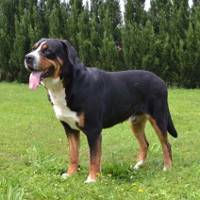
A tricolour, sturdy, heavy boned and well muscled dog. In spite of his size and weight, he presents endurance and agility. The difference between the sexes is distinctly obvious.

Important proportions

Body length (measured from the point of the shoulder to the point of the buttock) to height at withers = 10 : 9.
Depth of chest to height at withers = 1 : 2.
Length of skull to length of muzzle = 1 : 1.
Width of skull to width of muzzle = 2 : 1.

Behaviour / temperament

Self-confident, alert, watchful and fearless in everyday situations. Good-natured and devoted towards people familiar to him. Self-assured with strangers. Medium temperament.

Head

Cranial region

Head
Strong corresponding to the body, but not heavy. Dogs stronger in head than bitches.
Skull
Flat and broad. The frontal furrow beginning at the stop gradually runs out towards the top. 
Stop
Hardly pronounced.

Facial region

Nose
Black.
Muzzle
Strong, longer than its depth. Must not be pointed, seen either from above or in profile. Nasal bridge straight, without furrow.
Lips
Barely developed, well fitting. Black pigmentation. Not pendulous.
Jaws and teeth
Strong jaws; complete, strong and regular scissor bite. The absence of two teeth (premolar 1 and/or premolar 2) is tolerated. Absence of the molars 3 (M3) is not taken into account.
Eyes
Almond-shaped, of medium size, neither deep set nor protruding. Hazel to chestnut brown, with alert, friendly expression. Lids close fitting. Eye rims dark.
Ears
Of medium size, triangular and set on fairly high. In repose hanging flat and close to the cheeks, but raised forward when attentive. Well covered with hair, both inside and outside.

Neck

Strong, muscular, rather thick-set. Without dewlap.

Body

Body
Slightly longer than its height at the withers.
Back
Moderately long, strong and straight.
Loin
Broad and well muscled.
Croup
Long and broad. Gently sloping. Never higher than the withers or abruptly slanting.
Chest
Strong, broad, reaching to the elbows. Seen in cross section, the ribcage is roundish oval shaped, neither flat nor barrel-shaped. Forechest well developed.
Underline and belly
Belly and flanks barely tucked up.

Tail

Set-on harmoniously following the croup, fairly heavy and reaching to the hocks. Pendulous in repose; when alert and in movement carried higher and slightly curved upwards, but never curled or tilted over the back.

Limbs

Forequarters

Generality
Straight and parallel when seen from the front, set rather broad.
Shoulders
Shoulder blade long, strong, well laid back, close-fitting to the body and well muscled, forming a not too obtuse angle with the upper arm.
Forearm
Heavy boned and straight.
Pastern
Firm, seen from the front in straight line with the forearm; seen from the side almost vertical.

Hindquarters

Generality
Straight and not too close when seen from the back. Metatarsus and feet turning neither in nor out. Dewclaws must be removed except in countries where their removal is forbidden by law.
Upper thigh
Fairly long, broad, strong and well muscled.
Lower thigh
Fairly long.
Stifle
Forming a distinctly obtuse angle.
Hock
Strong and well angulated.

Feet

Strong, pointing straight ahead, with well-knit, well arched toes and strong nails.

Gait and movement

In all gaits, balanced movement with good reach. Free stride reaching well out in front with good drive from the hindquarters. At the trot, coming and going, legs moving forward in a straight line.

Coat

Hair
Double coat consisting of thick, outer coat of medium length and dense undercoat. The latter as dark grey or black as possible. Short outer coat permissible if there is undercoat.
Colour
Typically tricolour. Main colour black with symmetrical, reddish-brown (tan) markings and clean white markings. The reddish-brown colour is situated between the black and the white markings on the cheeks, above the eyes, on the inside of the ears, on both sides of the forechest, on all four legs and underneath the tail. The white markings are on the head (blaze and muzzle), running down unbroken from the throat to the chest, also on the feet and the tip of the tail. Between the blaze and the reddish-brown markings above the eyes, a band of black should remain. A white patch on the neck or a white collar around the neck are tolerated.

Size and weight

Height at withers
For males 65 – 72 cm, for bitches : 60 – 68 cm.

Faults

• Any departure from the foregoing points should be considered a fault and the seriousness with which the fault should be regarded should be in exact proportion to its degree and its effect upon the health and welfare of the dog and its ability to perform its traditional work.
• Faults listed should be in degree of seriousness.

General faults

 Unreliable behaviour.
 Absence of any teeth other than 2 PM1 and /or PM2 (Premolar 1 or 2), the M3 are not taken into account.
 Level bite.
 Light eyes.
 Lids not close fitting.
Coat :
 Visible yellow-brownish or light grey undercoat.
 Colour and markings not clear.
Mismarking :
 Absence of white markings on the head; blaze too wide.
 White marking on muzzle reaching distinctly beyond the corners of the mouth.
 White pasterns or hocks (“boots”) reaching beyond the pastern joints or hock joints.
 Noticeably asymmetrical markings.

Disqualifying faults

 Serious faults in temperament (fear, aggressiveness).
 Over- or undershot mouth, wry mouth.
 Entropion, ectropion.
 One or two blue eyes (Wall eye).
 Short coat without undercoat.
 Long coat.
 Other than tricolour coat.
 Main colour other than black.

NB :

• Any dog clearly showing physical or behavioural abnormalities shall be disqualified.
• The above mentioned faults when occurring to a highly marked degree or frequently are disqualifying.
• Male animals should have two apparently normal testicles fully descended into the scrotum.
• Only functionally and clinically healthy dogs, with breed typical conformation should be used for breeding.

Bibliography

https://www.fci.be/


Detailed history

We know in France only one Swiss Mountain Dog, the Bernese, who is a dog with long hair, black, fire and white. There are, however, three others, also tricolor but short-haired, including the Great Bouvier, which, as the name suggests, is the one with the tallest stature. Swiss Bouviers, despite their morphological differences, have a common origin. Although some believe that dogs of this type already existed in prehistoric Switzerland, by virtue of the discovery of skulls of dogs comparable to those of the Bernese, this hypothesis remains unconvincing, and it seems that the ancestors of the Bouviers were rather imported. in the region by the Romans. Swiss dogs would descend from large Asian mountain dogs, generally known by the generic name of "Tibetan Mastiffs".

First of all, Phoenician and Greek navigators spread in the Mediterranean basin these Molossers originating from Persia, Assyria and perhaps even India or the Himalayas. Xerxes then Alexander the Great made them famous and formidable war dogs. As for the Romans, who received them as an inheritance, they of course made them fight in the arena, and they joined them to their legions, to go to the assault of the barbarians or to keep their military posts, but also like dogs of conduct herds. In fact, an army as organized as theirs never moved without assuring itself of its food autonomy and, to do this, was accompanied by herds of oxen and sheep.

The Roman troops have thus largely contributed to make known these dogs of great size and strong character, which also come from Berger de Beauce in France and Rottweiler in Germany. The Bouviers reached the Swiss valleys via the passes of St. Bernard and St. Gotthard. Their presence is attested in particular in Vindonissa (today Windisch), one of the capitals of Roman Helvetia, where we found some remains.

The Great Bouvier is undoubtedly the direct descendant of the type of herding dog that has spread the most in Switzerland, leaving traces in the history. We know, for example, that a part of the victories that the Confederates won against the Habsburgs and against Charles the Bold is due not only to their skill in handling the crossbow, but also to the large dogs that escorted them.

In addition, there is an edict of the mayor of Zurich, Hans Waldmann, dating from 1489, which reveals the local spread of this dog and its popularity in rural areas. Indeed, this edict, which required the disappearance of this animal on the pretext that it harmed the game and the vineyard, triggered a wave of protests among the cowherds, cheese makers and farmers who had made their favorite companion. Also, despite the use of force, Hans Waldmann could not enforce his rules.

Until the middle of the nineteenth century, the Great Bouvier was part of the Swiss landscape, and he was gladly entrusted with the care of cows, sheep and even goats, and the man was walking around the pasture accompanied by his dog, who He understood very well how much he would have to contain the flock during the day and knew that he would have to bring home any animal leaving the assigned territory, without the shepherd or cowherd having to intervene. to search for the cow whose name was only indicated to him, or to maintain discipline in the stable.

Elsewhere, he became a draft dog, pulling a small cart loaded with cans of milk, because in Switzerland as well as in Belgium, canine traction was very widespread. A dog of the Great Bouvier's stature easily managed to shoot up to 300 kilos of load, easily competing with the horse and being more docile than a donkey.

In the countryside, he was generally entrusted with the guard of the farm, and in the markets, peasants, horse traders or butchers made use of his power and his authority to lead and maintain the cattle which, once torn from their pastures, panicked easily.

Despite his many abilities, Swiss cynophiles showed indifference for the Great Bouvier, as for other Helvetian Bouviers: "We saw in them only vulgar dogs butchers, countrymen," said Fred Rufer. It is true that the peasants were not very concerned about the selection of these dogs, which was due only to the maintenance of the traditions and the isolation of the valleys. In addition, the development of technical progress helped, the Great Bouvier and other "Swiss cottage dogs", as they are sometimes called, became scarce, and, at the time when the Swiss Cynological Society was born, in 1883, breed lovers Pure people were primarily interested in foreign dogs.

However, some personalities happily searched for specifically Swiss dogs, as was the case of Professor Albert Heim and Franz Schertenleib, from Berthoud, Emmental. The latter, in memory of his father's praise of the magnificent long-haired dogs, undertook to search for them: about 1880, he was able to present some specimens found at Dürrbach, in the canton of Berne, which were recognized as being purebred by Professor Heim. Encouraged by this first success, Schertenleib continued his research and brought back two years later a tri-colored shorthair subject. The teacher immediately made the connection between this specimen and the war dogs that accompanied the Confederates in the fifteenth century. He therefore identified it as the dog once spread in the countryside and called it Grand Bouvier Switzerland. A little later, these two specialists characterized the Appenzell Bouvier and the Bouvier of Entlebuch (Canton Lucerne). Professor Heim continued to play a major role until the 1920s, advising Swiss cynophiles.

It must be confessed, however, that only the Dürrbachler (named after the hamlet where he was discovered), called the Bouvier Bernois in 1913, has known, both in his own country and abroad; some development. The Great Bouvier, which did not possess the rich coat of the Bernese and the Saint Bernard surpassed in stature, had only a modest destiny.

The Great Swiss Mountain Dog has great qualities. Without reaching gigantic proportions, it imposes by its strength and its size. Note that the latter, initially 70 cm for the male, was subsequently slightly downward and is currently contained between 66 and 70 cm, thus finding that of the Bernese. The Great Bouvier reassures and protects with as much vivacity as attention his family and his territory, without terrorizing passers-by. One must not fear any gratuitous acts of violence on his part: he will not bite a stranger, nor will he disturb the neighborhood by incessant barking. Finally, he combines a vigilance of every moment with a calm at any test.

This dog obviously requires a minimum of firmness and perseverance, on the part of the one who would like to control it and inculcate a basic education. But the Great Bouvier is a much more docile and manageable dog than most Great Dane dogs and mountain dogs, and even the Bernese Mountain Dog. He retains everything, thanks to his extraordinary memory, and obeys all the demands of his master whom he venerates. Thus, the impressive and dissuasive size of this dog combines with its receptivity to education and training to make it an active and effective defender.

The Great Bouvier is sufficiently balanced and sociable not to have imperatively needed a country environment and vast spaces. It adapts very well to a garden and regular walks. However, if a rather sedentary way of life is not contrary to his temperament, he nevertheless particularly appreciates the work and the activity: one can, for example, train him to the tracking, the research and the report of object, or even hitch it to a small vehicle with which, safely, it will take pleasure to walk small children. He is indeed a real "nanny", very patient and gentle, but we do not think of touching his protégés, because it could become terrible.

Comments

Latest page updates

  • Yorkshire Terrier

    Yorkshire Terrier FCI Standard No. 86 Origin Great Britain Group Group 3 Terriers Section Section 4 Toy Terriers Working Without working trial Date of acceptance on a definitive basis by the FCI Saturday 30 October 1954 Date of publication of the official valid standard Tuesday 08 September 2026 Date of the last update Tuesday 06 October 2026 En...
  • West Highland White Terrier

    West Highland White Terrier FCI Standard No. 85 Origin Great Britain Group Group 3 Terriers Section Section 2 Small-sized Terriers Working Without working trial Date of acceptance on a definitive basis by the FCI Friday 29 October 1954 Date of publication of the official valid standard Tuesday 08 September 2026 Date of the last update Tuesday 06...
  • Welsh Terrier

    Welsh Terrier FCI Standard No. 78 Origin Great Britain Group Group 3 Terriers Section Section 1 Large- and medium sized Terriers Working Without working trial Date of acceptance on a definitive basis by the FCI Saturday 23 October 1954 Date of publication of the official valid standard Tuesday 08 September 2026 Date of the last update Tuesday 06...
  • Welsh Springer Spaniel

    Welsh Springer Spaniel FCI Standard No. 126 Origin Great Britain Group Group 8 Retrievers-Flushing Dogs-Water Dogs Section Section 2 Flushing Dogs Working With working trial Date of acceptance on a definitive basis by the FCI Thursday 30 December 1954 Date of publication of the official valid standard Tuesday 08 September 2026 Date of the last...
  • Welsh Corgi Pembroke

    Welsh Corgi Pembroke FCI Standard No. 39 Origin Great Britain Group Group 1 Sheepdogs and Cattle Dogs (except Swiss Cattle Dogs) Section Section 2 Cattledogs (except Swiss Cattledogs) Working Without working trial Date of acceptance on a definitive basis by the FCI Wednesday 13 November 1963 Date of publication of the official valid standard Tuesday 08...
  • Welsh Corgi Cardigan

    Welsh Corgi Cardigan FCI Standard No. 38 Origin Great Britain Group Group 1 Sheepdogs and Cattle Dogs (except Swiss Cattle Dogs) Section Section 2 Cattledogs (except Swiss Cattledogs) Working Without working trial Date of acceptance on a definitive basis by the FCI Tuesday 12 November 1963 Date of publication of the official valid standard Tuesday 08...
  • Sussex Spaniel

    Sussex Spaniel FCI Standard No. 127 Origin Great Britain Group Group 8 Retrievers, Flushing dogs, Water dogs. Section Section 2 Flushing dogs Working With working trial Date of acceptance on a definitive basis by the FCI Friday 31 December 1954 Date of publication of the official valid standard Tuesday 08 September 2026 Date of the last update Tuesday 06...
  • Staffordshire Bull Terrier

    Staffordshire Bull Terrier FCI Standard No. 76 Origin Great Britain Group Group 3 Terriers Section Section 3 Bull type Terriers Working Without working trial Date of acceptance on a definitive basis by the FCI Thursday 21 October 1954 Date of publication of the official valid standard Tuesday 08 September 2026 Date of the last update Tuesday 06...
  • Skye Terrier

    Skye Terrier FCI Standard No. 75 Origin Great Britain Group Group 3 Terriers Section Section 2 Small-sized Terriers Working Without working trial Date of acceptance on a definitive basis by the FCI Wednesday 20 October 1954 Date of publication of the official valid standard Tuesday 08 September 2026 Date of the last update Tuesday 06 October 2026 En...
  • Shetland Sheepdog

    Shetland Sheepdog FCI Standard No. 88 Origin Great Britain Group Group 1 Sheepdogs and Cattle Dogs Section Section 1 Sheepdogs Working Without working trial Date of acceptance on a definitive basis by the FCI Tuesday 09 November 1954 Date of publication of the official valid standard Tuesday 08 September 2026 Date of the last update Tuesday 06...
  • Sealyham Terrier

    Sealyham Terrier FCI Standard No. 74 Origin Great Britain Group Group 3 Terriers Section Section 2 Small sized Terriers Working Without working trial Date of acceptance on a definitive basis by the FCI Tuesday 19 October 1954 Date of publication of the official valid standard Tuesday 08 September 2026 Date of the last update Tuesday 06 October...
  • Scottish Terrier

    Scottish Terrier FCI Standard No. 73 Origin Great Britain Group Group 3 Terriers Section Section 2 Small-sized Terriers Working Without working trial Date of acceptance on a definitive basis by the FCI Monday 18 October 1954 Date of publication of the official valid standard Tuesday 08 September 2026 Date of the last update Tuesday 06 October...
  • Old English Sheepdog (Bobtail)

      Old English Sheepdog (Bobtail) FCI Standard No. 16     Origin   Great Britain Group   Group 1 Sheepdogs and Cattle Dogs (except Swiss Cattle Dogs) Section   Section 1 Sheepdogs Working   Without working trial Date of acceptance on a definitive basis by the FCI   Monday 25 November 1963 Date of publication of the official valid standard   Tuesday 08 September...
  • Norwich Terrier

    Norwich Terrier FCI Standard No. 72 Origin Great Britain Group Group 3 Terriers Section Section 2 Small-sized Terriers Working Without working trial Date of acceptance on a definitive basis by the FCI Saturday 16 October 1954 Date of publication of the official valid standard Tuesday 08 September 2026 Date of the last update Tuesday 06 October...
  • Norfolk Terrier

    Norfolk Terrier FCI Standard No. 272 Origin Great Britain Group Group 3 Terriers Section Section 2 Small-sized Terriers Working Without working trial Date of acceptance on a definitive basis by the FCI Saturday 01 October 1966 Date of publication of the official valid standard Tuesday 08 September 2026 Date of the last update Tuesday 06 October...
  • Manchester Terrier

    Manchester Terrier FCI Standard No. 71 Origin Great Britain Group Group 3 Terriers Section Section 1 Large and medium sized Terriers Working Without working trial Date of acceptance on a definitive basis by the FCI Friday 15 October 1954 Date of publication of the official valid standard Tuesday 08 September 2026 Date of the last update Tuesday 06 October...
  • Lakeland Terrier

    Lakeland Terrier FCI Standard No. 70 Origin Great Britain Group Group 3 Terriers Section Section 1 Large and medium-sized Terriers Working Without working trial Date of acceptance on a definitive basis by the FCI Thursday 14 October 1954 Date of publication of the official valid standard Tuesday 08 September 2026 Date of the last update Tuesday 06 October...
  • Labrador Retriever

      Labrador Retriever FCI Standard No. 122     Origin   Canada Group   Group 8 Retrievers, Flushing dogs, Water dogs Section   Section 1 Retrievers Working   With working trial Date of acceptance on a definitive basis by the FCI   Friday 24 December 1954 Date of publication of the official valid standard   Tuesday 08 September 2026 Date of the last update   Tuesday 06...
  • King Charles Spaniel

    King Charles Spaniel FCI Standard No. 128 Origin Great Britain Group Group 9 Companion and Toy Dogs Section Section 7 English Toy Spaniels Working Without working trial Date of acceptance on a definitive basis by the FCI Monday 03 January 1955 Date of publication of the official valid standard Tuesday 08 September 2026 Date of the last update Tuesday 06...
  • Harrier

      Harrier FCI Standard No. 295     Origin   Great Britain Translation   Mrs. Peggy Davis, brought up to day by Dr. Paschoud Group   Group 6 Scenthounds and related breeds Section   Section 1.2 Medium-sized Hounds Working   With working trial Date of acceptance on a definitive basis by the FCI   Wednesday 27 November 1974 Date of publication of the official valid...
  • Greyhound

    Greyhound FCI Standard No. 158 Origin Great Britain Group Group 10 Sighthounds Section Section 3 Short-haired sighthounds Working Without working trial Date of acceptance on a definitive basis by the FCI Saturday 23 April 1955 Date of publication of the official valid standard Tuesday 08 September 2026 Date of the last update Tuesday 06 October...
  • Gordon Setter

    Gordon Setter FCI Standard No. 6 Origin Great Britain Group Group 7 Pointing Dogs Section Section 2.2 British and Irish Pointers and Setters; Setters Working With working trial Date of acceptance on a definitive basis by the FCI Tuesday 28 May 1963 Date of publication of the official valid standard Tuesday 08 September 2026 Date of the last...
  • Golden Retriever

    Golden Retriever FCI Standard No. 111 Origin Great Britain Group Group 8 Retrievers, Flushing Dogs, Water Dogs Section Section 1 Retrievers Working With working trial Date of acceptance on a definitive basis by the FCI Thursday 02 December 1954 Date of publication of the official valid standard Tuesday 28 July 2009 Date of the last update Wednesday...
  • Fox Terrier Wire

    Fox Terrier Wire FCI Standard No. 169 Origin Great Britain Group Group 3 Terriers Section Section 1 Large and medium-sized Terriers Working Working trial optional Date of acceptance on a definitive basis by the FCI Friday 13 May 1955 Date of publication of the official valid standard Tuesday 08 September 2026 Date of the last update Tuesday 06...
  • Fox Terrier Smooth

    Fox Terrier Smooth FCI Standard No. 12 Origin Great Britain Group Group Terriers Section Section 1 Large and medium sized Terriers Working Working trial optional Date of acceptance on a definitive basis by the FCI Wednesday 26 June 1963 Date of publication of the official valid standard Tuesday 08 September 2026 Date of the last update Tuesday 06...
  • Flat Coated Retriever

    Flat Coated Retriever FCI Standard No. 121 Origin Great Britain Group Group 8 Retrievers-Flushing Dogs-Water Dogs Section Section 1 Retrievers Working With working trial Date of acceptance on a definitive basis by the FCI Thursday 23 December 1954 Date of publication of the official valid standard Tuesday 08 September 2026 Date of the last update Tuesday...
  • Field Spaniel

    Field Spaniel FCI Standard No. 123 Origin Great-Britain Group Group 8 Retrievers, Flushing Dogs, Water Dogs Section Section 2 Flushing Dogs Working With working trial Date of acceptance on a definitive basis by the FCI Monday 27 December 1954 Date of publication of the official valid standard Tuesday 08 September 2026 Date of the last update Tuesday...
  • English Toy Terrier

    English Toy Terrier FCI Standard No. 13 Origin Great Britain Group Group 3 Terriers Section Section 4 Toy Terriers Working Without working trial Date of acceptance on a definitive basis by the FCI Tuesday 17 September 1963 Date of publication of the official valid standard Tuesday 08 September 2026 Date of the last update Tuesday 06 October 2026 En...
  • English Springer Spaniel

    English Springer Spaniel FCI Standard No. 125 Origin Great Britain Group Group 8 Retrievers-Flushing Dogs-Water Dogs Section Section 2 Flushing Dogs Working With working trial Date of acceptance on a definitive basis by the FCI Wednesday 29 December 1954 Date of publication of the official valid standard Tuesday 08 September 2026 Date of the last...
  • English Setter

    English Setter FCI Standard No. 2 Origin Great Britain Group Group 7 Pointing Dogs Section Section 2.2 British and Irish Pointers and Setters, Setter Working With working trial Date of acceptance on a definitive basis by the FCI Wednesday 06 March 1963 Date of publication of the official valid standard Tuesday 08 September 2026 Date of the last...
  • English Pointer

    English Pointer FCI Standard No. 1 Origin Great Britain Group Group 7 Pointing Dogs Section Section 2.1 British and Irish Pointers and Setters, Pointer Working With working trial Date of acceptance on a definitive basis by the FCI Tuesday 05 March 1963 Date of publication of the official valid standard Tuesday 08 September 2026 Date of the last...
  • English Foxhound

    English Foxhound FCI Standard No. 159 Origin Great Britain Group Group 6 Scenthounds and related breeds Section Section 1.1 Large-sized Scent hounds Working With working trial Date of acceptance on a definitive basis by the FCI Monday 25 April 1955 Date of publication of the official valid standard Thursday 26 March 2009 Date of the last update Wednesday...
  • English Cocker Spaniel

    English Cocker Spaniel FCI Standard No. 5 Origin Great Britain Group Group 8 Retrievers, Flushing Dogs, Water Dogs Section Section 2 Flushing dogs Working With working trial Date of acceptance on a definitive basis by the FCI Wednesday 10 April 1963 Date of publication of the official valid standard Tuesday 08 September 2026 Date of the last...
  • Tibetan Mastiff

    Tibetan Mastiff FCI Standard No. 230 Origin Tibet (China)Patronage FCI Group Group 2 Pinscher and Schnauzer- Molossoid breeds- Swiss Mountain and Cattle Dogs Section Section 2.2 Molossoid breeds, Mountain type Working Without working trial Date of acceptance on a definitive basis by the FCI Tuesday 22 August 1961 Date of publication of the...
  • Deerhound

    Deerhound FCI Standard No. 164 Origin Great Britain Group Group 10 Sighthounds Section Section 2 Rough-haired Sighthounds Working Without working trial Date of acceptance on a definitive basis by the FCI Friday 29 April 1955 Date of publication of the official valid standard Tuesday 08 September 2026 Date of the last update Tuesday 06 October...
  • Dandie Dinmont Terrier

    Dandie Dinmont Terrier FCI Standard No. 168 Origin Great Britain Group Group 3 Terriers Section Section 2 Small-sized Terriers Working Without working trial Date of acceptance on a definitive basis by the FCI Thursday 12 May 1955 Date of publication of the official valid standard Tuesday 08 September 2026 Date of the last update Tuesday 06...
  • Curly Coated Retriever

    Curly Coated Retriever FCI Standard No. 110 Origin Great Britain Group Group 8 Retrievers, Flushing Dogs, Water Dogs Section Section 1 Retrievers Working With working trial Date of acceptance on a definitive basis by the FCI Friday 10 December 1954 Date of publication of the official valid standard Tuesday 08 September 2026 Date of the last...
  • Collie Smooth

    Collie Smooth FCI Standard No. 296 Origin Great Britain Group Group 1 Sheepdogs and Cattle Dogs (except Swiss Cattle Dogs) Section Section 1 Sheepdogs Working Without working trial Date of acceptance on a definitive basis by the FCI Wednesday 18 December 1974 Date of publication of the official valid standard Tuesday 08 September 2026 Date of the...
  • Collie Rough

    Collie Rough FCI Standard No. 156 Origin Great Britain Group Group 1 Sheepdogs and Cattle Dogs (except Swiss Cattle Dogs) Section Section 1 Sheepdogs Working Without working trial Date of acceptance on a definitive basis by the FCI Wednesday 13 April 1955 Date of publication of the official valid standard Tuesday 08 September 2026 Date of the...
  • Clumber Spaniel

    Clumber Spaniel FCI Standard No. 109 Origin Great Britain Group Group 8 Retrievers, Flushing dogs, Water dogs Section Section 2 Flushing dogs Working With working trial Date of acceptance on a definitive basis by the FCI Thursday 09 December 1954 Date of publication of the official valid standard Tuesday 08 September 2026 Date of the last update Tuesday...
  • Chow Chow

    Chow Chow FCI Standard No. 205 Origin China, patronage : Great Britain Group Group 5 Spitz and primitive type Section Section 5 Asian Spitz and related breeds Working Without working trial Date of acceptance on a definitive basis by the FCI Tuesday 10 December 1957 Date of publication of the official valid standard Tuesday 08 September 2026 Date...
  • Chinese Crested Dog

    Chinese Crested Dog FCI Standard No. 288 Origin China, patronage Great Britain Group Group 9 Companion and Toy Dogs Section Section 4 Hairless breeds Working Without working trial Date of acceptance on a definitive basis by the FCI Monday 17 July 1972 Date of publication of the official valid standard Tuesday 08 September 2026 Date of the last...
  • Cairn Terrier

    Cairn Terrier FCI Standard No. 4 Origin Great Britain Group Group 3 Terriers Section Section 2 Small-sized Terriers Working Without working trial Date of acceptance on a definitive basis by the FCI Saturday 06 April 1963 Date of publication of the official valid standard Tuesday 08 September 2026 Date of the last update Tuesday 06 October 2026 En...
  • Bullmastiff

    Bullmastiff FCI Standard No. 157 Origin Great Britain Group Group 2 Pinscher and Schnauzer Molossoid breeds - Swiss Mountain and Cattle Dogs Section Section 2.1 Molossoid breeds, Mastiff Type Working Without working trial Date of acceptance on a definitive basis by the FCI Saturday 23 April 1955 Date of publication of the official valid standard Tuesday...
  • English Bulldog

    English Bulldog FCI Standard No. 149 Origin Great Britain Group Group 2 Pinscher and Schnauzer Molossoid breeds-Swiss Mountain and Cattle Dogs Section Section 2.1 Molossoid breeds, Mastiff Type Working Without working trial Date of acceptance on a definitive basis by the FCI Monday 14 March 1955 Date of publication of the official valid standard Tuesday...
  • Bull Terrier

    Bull Terrier FCI Standard No. 11 Origin Grande-Bretagne Group Group 3 Terriers Section Section 3 Bull type Terriers Working Working trial optional Date of acceptance on a definitive basis by the FCI Saturday 26 June 1993 Date of publication of the official valid standard Tuesday 08 September 2026 Date of the last update Tuesday 06 October 2026 En...
  • Border Terrier

    Border Terrier FCI Standard No. 10 Origin Great Britain Group Group 3 Terriers Section Section 1 Large and medium-sized terriers Working Without working trial Date of acceptance on a definitive basis by the FCI Wednesday 26 June 1963 Date of publication of the official valid standard Tuesday 08 September 2026 Date of the last update Tuesday 06...
  • Bedlington Terrier

    Bedlington Terrier FCI Standard No. 9 Origin Great Britain Group Group 3 Terriers Section Section 1 Large and medium sized Terriers Working Without working trial Date of acceptance on a definitive basis by the FCI Thursday 20 June 1963 Date of publication of the official valid standard Tuesday 08 September 2026 Date of the last update Tuesday 06...
  • Bearded Collie

    Bearded Collie FCI Standard No. 271 Origin Great-Britain Group Group 1 Sheepdogs and Cattle Dogs (except Swiss Cattle Dogs) Section Section 1 Sheepdogs Working Without working trial Date of acceptance on a definitive basis by the FCI Wednesday 30 August 1967 Date of publication of the official valid standard Tuesday 08 September 2026 Date of the...
  • Beagle

    Beagle FCI Standard No. 161 Origin Great Britain Translation Prof. R. Triquet Group Group 6 Scent hounds and related breeds Section Section 1.3 Small-sized hounds Date of acceptance on a definitive basis by the FCI Tuesday 26 April 1955 Date of publication of the official valid standard Tuesday 08 September 2026 Date of the last update Tuesday 06...
  • Basset Hound

    Basset Hound FCI Standard No. 163 Origin Great Britain Group Group 6 Scent hounds and related breeds Section Section 1.3 Small-sized hounds Working With working trial Date of acceptance on a definitive basis by the FCI Thursday 28 April 1955 Date of publication of the official valid standard Tuesday 08 September 2026 Date of the last update Tuesday...
  • Basenji

    Basenji FCI Standard No. 43 Origin Democratic Republic of Congo, under the patronage of Great Britain Group Group 5 Spitz and primitive types Section Section 6 Primitive type Working Without working trial Date of acceptance on a definitive basis by the FCI Thursday 26 March 1964 Date of publication of the official valid standard Tuesday 08...
  • Airedale Terrier

    Airedale Terrier FCI Standard No. 7 Origin Great Britain Group Group 3 Terriers Section Section 1 Large and medium sized Terriers Working Working trial optional Date of acceptance on a definitive basis by the FCI Tuesday 28 May 1963 Date of publication of the official valid standard Tuesday 08 September 2026 Date of the last update Tuesday 06...
  • Afghan Hound

    Afghan Hound FCI Standard No. 228 Origin AfghanistanPatronage Great Britain Group Group 10 Sighthounds Section Section 1 Long-haired or fringed sighthounds Working Without working trial Date of acceptance on a definitive basis by the FCI Tuesday 12 December 1961 Date of publication of the official valid standard Tuesday 08 September 2026 Date of the...
  • Romagna Water Dog

    Romagna Water Dog FCI Standard No. 298 Origin Italy Translation Antonio Morsiani, Renée Sporre-Willes and Prof. R. TriquetRevised by ENCI and Renée Sporre-WillesRevised by the FCI Head OfficeOfficial language (EN). Group Group 8 Retrievers –Flushing Dogs –Water Dogs Section Section 3 Water Dogs Working Working trial optional Date of acceptance on a...
  • Whippet

    Whippet FCI Standard No. 162 Origin Great Britain Group Group 10 Sighthounds Section Section 3 Short-haired Sighthounds Working Without working trial Date of acceptance on a definitive basis by the FCI Wednesday 27 April 1955 Date of publication of the official valid standard Tuesday 08 September 2026 Date of the last update Tuesday 06 October...
  • Tibetan Terrier

    Tibetan Terrier FCI Standard No. 209 Origin Tibet, patronage Great Britain Group Group 9 Companion and Toy Dogs Section Section 5 Tibetan breeds Working Without working trial Date of acceptance on a definitive basis by the FCI Wednesday 18 December 1957 Date of publication of the official valid standard Tuesday 08 September 2026 Date of the last...
  • Tibetan Spaniel

    Tibetan Spaniel FCI Standard No. 231 Origin Tibet (China)Patronage Great Britain Group Group 9 Companion and Toy Dogs Section Section 5 Tibetan breeds Working Without working trial Date of acceptance on a definitive basis by the FCI Tuesday 22 August 1961 Date of publication of the official valid standard Tuesday 08 September 2026 Date of the...
  • Shih Tzu

    Shih Tzu FCI Standard No. 208 Origin Tibet, patronage Great Britain Group Group 9 Companion and Toy Dogs Section Section 5 Tibetan breeds Working Without working trial Date of acceptance on a definitive basis by the FCI Monday 16 December 1957 Date of publication of the official valid standard Tuesday 08 September 2026 Date of the last update Tuesday 06...
  • Pug

    Pug FCI Standard No. 253 Origin China, patronage Great Britain Group Group 9 Companion and Toy Dogs Section Section 11 Small Molossian type dogs Working Without working trial Date of acceptance on a definitive basis by the FCI Friday 04 November 1966 Date of publication of the official valid standard Tuesday 08 September 2026 Date of the last...
  • Pharaoh Hound

    Pharaoh Hound FCI Standard No. 248 Origin Malta, patronage Great Britain Group Group 5 Spitz and primitive types Section Section 6 Primitive type Working Without working trial Date of acceptance on a definitive basis by the FCI Friday 09 August 1963 Date of publication of the official valid standard Tuesday 08 September 2026 Date of the last...
  • Pekingese

    Pekingese FCI Standard No. 207 Origin China, patronage Great Britain Group Group 9 Companion and Toy Dogs Section Section 8 Japan Chin and Pekingese Working Without working trial Date of acceptance on a definitive basis by the FCI Thursday 03 November 1966 Date of publication of the official valid standard Tuesday 08 September 2026 Date of the last...
  • Parson Russell Terrier

    Parson Russell Terrier FCI Standard No. 339 Origin Great Britain Group Group 3 Terriers Section Section 1 Large and medium sized Terriers Working Working trial optional Date of acceptance on a definitive basis by the FCI Monday 04 June 2001 Date of acceptance on a provisional basis by the FCI Monday 02 July 1990 Date of publication of the...
  • Otterhound

    Otterhound FCI Standard No. 294 Origin Great Britain Group Group 6 Scenthounds and related breeds Section Section 1.1 Large-sized hounds Working Without working trial Date of acceptance on a definitive basis by the FCI Thursday 12 September 1974 Date of publication of the official valid standard Tuesday 08 September 2026 Date of the last update Tuesday 06...
  • Miniature Bull Terrier

    Miniature Bull Terrier FCI Standard No. 359 Origin Grande-Bretagne Group Group 3 Terriers Section Section 3 Bull type Terriers Working Working trial optional Date of acceptance on a definitive basis by the FCI Tuesday 05 July 2011 Date of acceptance on a provisional basis by the FCI Tuesday 05 July 2011 Date of publication of the official valid...
  • Mastiff

    Mastiff FCI Standard No. 264 Origin Great Britain Group Group 2 Pinscher and Schnauzer – Molossoid breeds - Swiss Mountain and Cattle Dogs Section Section 2.1 Molossoid breeds, Mastiff Type Working Without working trial Date of acceptance on a definitive basis by the FCI Thursday 05 November 1964 Date of publication of the official valid standard Tuesday 08...
  • Lhassa Apso

    Lhassa Apso FCI Standard No. 227 Origin Tibet (China)Patronage Great Britain Group Group 9 Companion and Toy Dogs Section Section 5 Tibetan breeds Working Without working trial Date of acceptance on a definitive basis by the FCI Saturday 19 November 1960 Date of publication of the official valid standard Tuesday 08 September 2026 Date of the last...
  • Lancashire-Heeler

    Lancashire-Heeler FCI Standard No. 360 Origin England, patronage : FCI Group Group 1 Sheepdogs and Cattle Dogs (except Swiss Cattle Dogs) Section Section 1 Sheepdogs Working Without working trial Date of acceptance on a provisional basis by the FCI Sunday 01 May 2016 Date of publication of the official valid standard Tuesday 08 September 2026 Date...

© 2026 Groupe Milouchouchou ASBL. Tous droits réservés. En savoir plus

Protected by Copyright01
