Bull Terrier

FCI Standard No. 11

Origin
Grande-Bretagne
Group
Group 3 Terriers
Section
Section 3 Bull type Terriers
Working
Working trial optional
Date of acceptance on a definitive basis by the FCI
Saturday 26 June 1993
Date of publication of the official valid standard
Tuesday 08 September 2026
Date of the last update
Tuesday 06 October 2026
En français, cette race se dit
Bull Terrier
Diese Norm ist in deutscher Sprache sichtbar
Bull Terrier
En español, esta raza se dice
Bull Terrier
In het Nederlands, wordt dit ras gezegd
Bull Terrier

Usage

Terrier.
 

Brief historical summary

It was a certain James Hinks who first standardised the breed type in the 1850s, selecting the egg-shaped head. The breed was first shown in its present form at Birmingham in 1862. The Bull Terrier Club was formed in 1887. The truly interesting thing about the breed is that the standard says quite deliberately, “There are neither weight nor height limits, but there should be the impression of maximum substance for size of dog consistent with quality and sex. Dog should at all times be balanced”.
A smaller example of the Bull Terrier has been known since the early 19th century but fell out of favour prior to the First World War and was removed from the Kennel Club Breed Register in 1918. In 1938, a revival was spearheaded by Colonel Richard Glyn and a group of fellow enthusiasts who formed the Miniature Bull Terrier Club. The standard is the same as that of the Bull Terrier with the exception of a height limit.

General appearance

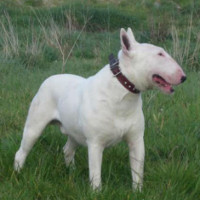
Strongly built, muscular, well balanced and active with a keen, determined and intelligent expression. A unique feature is a downfaced, egg-shaped head. Irrespective of size dogs should look masculine and bitches feminine.

Behaviour / temperament

Courageous, full of spirit, with a fun loving attitude. Of even temperament and amenable to discipline. Although obstinate is particularly good with people.

Head

Cranial region

Head
Long, strong and deep right to end of muzzle, but not coarse. Viewed from front egg-shaped and completely filled, its surface free from hollows or indentations. Profile curves gently downwards from top of skull to tip of nose.
Skull
Top of skull almost flat from ear to ear.

Facial region

Nose
Should be black. Bent downwards at tip. Nostrils well developed.
Lips
Clean and tight.
Jaws and teeth
Under-jaw deep and strong. Teeth sound, clean, strong, of good size, regular with a perfect, regular and complete scissor bite, i. e. upper teeth closely overlapping lower teeth and set square to the jaws.
Eyes
Appearing narrow and triangular, obliquely placed, black or as dark brown as possible so as to appear almost black and with a piercing glint. Distance from tip of nose to eyes perceptibly greater than that from eyes to top of skull. Blue or partly blue undesirable.
Ears
Small, thin and placed close together. Dog should be able to hold them stiffly erect, when they point straight upwards.

Neck

Very muscular, long, arched, tapering from shoulders to head and free from loose skin.

Body

Body
Well rounded with marked spring of rib and great depth from withers to brisket, so that latter nearer ground than belly.
Back
Short, strong, with backline behind withers level, arching or roaching slightly over loins.
Loin
Broad, well muscled.
Chest
Broad when viewed from front.
Underline and belly
From brisket to belly forms a graceful upward curve.

Tail

Short, set on low and carried horizontally. Thick at root, it tapers to a fine point.

Limbs

Forequarters

Generality
Dog should stand solidly upon legs and they should be perfectly parallel. In mature dogs length of forelegs should be approximately equal to depth of chest.
Shoulders
Strong and muscular without loading. Shoulder blades wide, flat and held closely to chest wall and have a very pronounced backward slope of front edge from bottom to top, forming almost a right angle with upper arm.
Elbows
Held straight and strong.
Forearm
Forelegs have strongest type of round, quality bone.
Pastern
Upright.
Forefeet
Round and compact with well arched toes.

Hindquarters

Generality
Hind legs parallel when viewed from behind.
Upper thigh
Muscular.
Lower thigh
Well developed.
Stifle
Joint well bent.
Metatarsus
Bone to foot short and strong.
Hock
Well angulated.
Hind feet
Round and compact with well arched toes.

Gait and movement

When moving appears well knit, smoothly covering ground with free, easy strides and with a typical jaunty air. When trotting, movement parallel, front and back, only converging towards centre line at faster speeds, forelegs reaching out well and hind legs moving smoothly at hip, flexing well at stifle and hock, with great thrust.

Skin

Fitting dog tightly.

Coat

Hair
Short, flat, even and harsh to touch with a fine gloss. A soft textured undercoat may be present in winter.
Colour
For White, pure white coat. Skin pigmentation and markings on head not to be penalised. For Coloured, colour predominates; all other things being equal, brindle preferable. Black brindle, red, fawn and tricolour acceptable. Tick markings in white coat undesirable. Blue and liver highly undesirable.
Any other colour or combination of colours unacceptable.

Size and weight

Height at withers
There are neither weight nor height limits, but there should be the impression of maximum substance for size of dog consistent with quality and sex.

Faults

• Any departure from the foregoing points should be considered a fault and the seriousness with which the fault should be regarded should be in exact proportion to its degree and its effect upon the health and welfare of the dog and its ability to perform its traditional work.
• Faults listed should be in degree of seriousness.
 

Disqualifying faults

Aggressive or overly shy dogs.

NB :

• Any dog clearly showing physical or behavioural abnormalities shall be disqualified.
• The above mentioned faults when occurring to a highly marked degree or frequently are disqualifying.
• Male animals should have two apparently normal testicles fully descended into the scrotum.
• Only functionally and clinically healthy dogs, with breed typical conformation should be used for breeding.

Detailed history

The Bull Terrier, also known as White Cavalier, is one of the oldest breeds of Terriers, since, as early as 1822, his name is mentioned by Pierce Egan in the Annals of Sporting. The nickname of this dog, on the other hand, does not deceive on his qualities and his aptitudes: "gladiator of the canine gent", a nickname which comes to him from very far, when he had to fight other dogs in the pits with the wooded walls called pits.

This "sport", whose origins date back to the Middle Ages, was very popular in Britain. For a very long time, these shows, known as bull baitings, did, in fact, only oppose dogs, especially Bulldogs, to bulls (maintained by a strong loin), then, in the eighteenth century, under the impulse of kings and lords who had reserved the exclusivity of the Mastiffs' use, other equally sanguinary combats were organized, where these dogs fought with bears and wild animals.

With the industrial revolution and the development of great cities, where miners, metallurgists and weavers lived, the traditional and rustic bull baiting diversified greatly. The bull was substituted for all kinds of wild animals or goshawks - badgers, bears, donkeys, horses, monkeys, sometimes lions or leopards - always with the intention of renewing the interest of the shows and increase the sums on the paris engaged, but also to compete with the very popular cock fights and rats killing matches, dog breeds ratiers.

These fights were mainly organized in London, Birmingham, the Midlands, and in the north of England. In the capital, two arenas had been built: Westminster Pit and Paddington Pit. Raymond Triquet also gives us an idea of what were the programs proposed at the beginning of the nineteenth century (exactly in 1821), by publishing the text of an advertising poster: "Combat against a bear and a bull, fight between two dogs , and, as main attraction, the fight of the monkey Jacco Maccacco, already thirteen times winner, against a bitch."

Although the names of the committed breeds are nowhere mentioned, it is important to note that fighting dogs were generally bred between Bull Dogs and various Terriers, such as the Fox, the Black and Tan Terrier (ancestor of the Manchester Terrier) and especially the Old English White Terrier (Old White English Terrier). These subjects, as Hamilton Smith wrote in 1843 in his Naturalist's Library, "were the most stubborn and ferocious ever" or, according to Clifford Hubbard, in Dogs in Britain, "were larger and stronger than the Bull-Terriers of today, and especially with a very different head, close to that of the old Bulldog, "particularly ugly bastards," as Henry Davis once again pointed out in The Modern Dog Encyclopedia. The multiple denominations under which these dogs were designated - Bull and Terriers Dogs, Half and Half, Pit Dogs, Pit Bulls - also showed which breeds had been used: in the Bulldog, which was considered too heavy, Terrier blood had been added. animal considered stubborn and agile.

Anyway, by the time the Bull Baitings were banned in 1835 by the British Parliament the Bull Terrier seemed already close to the one we know today. This fighting dog, in fact, looked quite like a Staffordshire Bull Terrier, with very short cut ears and an often larger gauge: 45 cm at the withers for a weight of 20 kg. The ban on animal fighting, decreed by the government of His Gracious Majesty, did not however put an end to the struggles between dogs, and this for three essential reasons: the British could not be forbidden to possess such dogs or to make them practice intensive training, especially since their aggressiveness was directed exclusively against their fellow creatures; Finally, it was difficult to control the places, barns, backyards of pubs or quarries (especially those of Bodmin Moor in Cornwall) where the fighting was taking place, which could thus be organized without any real risk until the fifties - some dog owners like R. Triquet, even say that it still exists today in the north of England.

It was in 1860 that appeared the first dog directly from the Pit Dogs and worthy of appearing in exhibitions. This White Cavalier, which was quickly called Bull Terrier, belonged to a man named James Hinks, dog merchant of his state and living in Birmingham. It was a subject with an all-white dress, a thinner head and longer than other fighting dogs. If James Hinks never gave his "recipe" to create such a dog, there is little doubt that it came from a cross between a Bulldog and an Old English White Terrier, probably enriched later by blood of Dalmatian, or to a lesser degree of Greyhound, Whippet, or even Pointer blood.

The cynologists have in fact tried to explain by these various enrichments, moreover quite hypothetical, the ovoid profile of the race (in "rugby ball"), which was to be accentuated a little later.

Some, like Edward Ash in his Practical Dog Book, even mentioned Collie (Collie). J. Dhers, a famous French cynologist, expressed a very different opinion from that of his British counterparts: "If we find in the Bull Terrier something of Dalmatian and Greyhound, I find him little resemblance to the Bassets Terriers (we have spoken of the Cairn and the West Highland White Terriers) and even less with the Collie, of which, whatever one may say, the shape of the skull is not that of the Greyhound. The ovoid skull of the Bull Terrier seems to me to be reminiscent of that of the Whippet, himself the son of Terrier. And it must be admitted that Dhers' analysis was based on unmistakable facts, since, around 1860, the Collie did not yet have the long and fine head which the race prides itself today, just as it seems certain that the role played by the Old English White Terrier, which had been extensively crossed with small greyhounds to refine their lines, was not sufficiently emphasized.

Still, the "new" Bull Terrier attracted the regulars of dog shows and lovers of originality, especially a youth that a certain aestheticism took to think outside the box by choosing for companion a dog that had been that of miners and cabaret pillars. This quest for eccentricity did not fail to arouse the anger and criticism of the "old-fashioned" Bull Terrier defenders, who blamed Hinks for escalating this famous fighting dog into a subject for dress exposure. immaculate white and elegant head. Hinks then proposed to his detractors to oppose his dog Pussy to any other fighting Bull Terrier, promising the winner not less than five pounds (a nice sum at the time) and a box of champagne. The meeting was organized by Tuppers at Long Acre in the London Borough of Covent Garden. In thirty minutes of a fierce fight, Pussy put to death his adversary, so that the next day, all haloed by his victory and very little marked by his meeting, the dog obtained his first dog show price.

A beautiful career opened for the race. At the end of the last century, the Bull Terrier had become a faithful guardian, well brought up in addition, and quite naturally its name of "gladiator" was replaced by that of "gentleman". As for the old Bull Terriers, they had nothing left but clandestine fighting, hunting rats in the stables or during timed competitions, as well as badger and wild boar hunting.

At that time, the Hinks-created Bull Terrier could still vary considerably in volume, and although a special class for subjects weighing less than twelve pounds (about 5.4 kg) would have been expected at the Islington Show. In 1863, the judges only took large dogs. In his book Modern Dogs published in 1903, Rawdon Lee rebelled against such discrimination, since the miniature Bull Terrier existed from the beginning of the race. In the same way, it was not until the end of the nineteenth century that the doumface was fixed, that is to say, that head so peculiar, without any stop, presenting no model and with the profile curving slowly.

A first stunt was to be given to the Bull Terrier in 1895. At that time, King Edward VII asked the Kennel Club to forbid the cutting of the ears, which removed the silhouette of the Bull Terrier, until there provided ears cut in point (inheritance of a common practice in the fighting dogs), part of its charm. The breeders did not get discouraged, and by selection they managed to produce dogs with naturally straight ears, which, at least at first, were the only ones - with those with sterni-folded ears - to be allowed.

The breeders did not win the game, however, and they soon found themselves in another problem, which for the future of the breed was even more worrying: a large number of Bull Terriers were deafness at birth. To stem the progression of this disability, in addition to an effort to eradicate it by eliminating the subjects transmitting it, the standard was revised in 1920, which put an end to the exclusion of white subjects - it seems that the color white was linked to this tare (although geneticists have refuted this thesis) -, finally allowing the colorful Bull Terrier. This decision not only solved the problem of deafness but also resolved the issue of invasive depigmentation, very unsightly, whose race was then frequently afflicted. Finally, the greater variety of colors gave the Bull Terrier more popularity.

In 1943, after many vicissitudes, the "miniature" variety was added to the standard by the Kennel Club, but it was scarcely better disseminated for that purpose. Although its existence was very old - one can read indeed in the catalog of Cruft that "small Bull Terriers existed at the beginning of the XIXe century and that the miniature Bull Terrier is resulting from this old small Bull Terrier and the old Toy Bull Terrier" - it was almost endangered in the aftermath of the First World War. Under these conditions, miniature Bull Terrier enthusiasts had no choice but to increase their weight, which in exhibitions was increased to 18 pounds (about 8.2 kg).

The success of the Bull Terrier was at its zenith after the Second World War, during which time it was used as a police dog and big game dog in Africa, because it was particularly resistant to tropical climates. Since then, the Bull Terrier has been established in the United States and in all Commonwealth countries; it is one of the favorite breeds in South Africa, as well as in Germany, the Netherlands and Belgium.

Comments

Latest page updates

  • Yorkshire Terrier

    Yorkshire Terrier FCI Standard No. 86 Origin Great Britain Group Group 3 Terriers Section Section 4 Toy Terriers Working Without working trial Date of acceptance on a definitive basis by the FCI Saturday 30 October 1954 Date of publication of the official valid standard Tuesday 08 September 2026 Date of the last update Tuesday 06 October 2026 En...
  • West Highland White Terrier

    West Highland White Terrier FCI Standard No. 85 Origin Great Britain Group Group 3 Terriers Section Section 2 Small-sized Terriers Working Without working trial Date of acceptance on a definitive basis by the FCI Friday 29 October 1954 Date of publication of the official valid standard Tuesday 08 September 2026 Date of the last update Tuesday 06...
  • Welsh Terrier

    Welsh Terrier FCI Standard No. 78 Origin Great Britain Group Group 3 Terriers Section Section 1 Large- and medium sized Terriers Working Without working trial Date of acceptance on a definitive basis by the FCI Saturday 23 October 1954 Date of publication of the official valid standard Tuesday 08 September 2026 Date of the last update Tuesday 06...
  • Welsh Springer Spaniel

    Welsh Springer Spaniel FCI Standard No. 126 Origin Great Britain Group Group 8 Retrievers-Flushing Dogs-Water Dogs Section Section 2 Flushing Dogs Working With working trial Date of acceptance on a definitive basis by the FCI Thursday 30 December 1954 Date of publication of the official valid standard Tuesday 08 September 2026 Date of the last...
  • Welsh Corgi Pembroke

    Welsh Corgi Pembroke FCI Standard No. 39 Origin Great Britain Group Group 1 Sheepdogs and Cattle Dogs (except Swiss Cattle Dogs) Section Section 2 Cattledogs (except Swiss Cattledogs) Working Without working trial Date of acceptance on a definitive basis by the FCI Wednesday 13 November 1963 Date of publication of the official valid standard Tuesday 08...
  • Welsh Corgi Cardigan

    Welsh Corgi Cardigan FCI Standard No. 38 Origin Great Britain Group Group 1 Sheepdogs and Cattle Dogs (except Swiss Cattle Dogs) Section Section 2 Cattledogs (except Swiss Cattledogs) Working Without working trial Date of acceptance on a definitive basis by the FCI Tuesday 12 November 1963 Date of publication of the official valid standard Tuesday 08...
  • Sussex Spaniel

    Sussex Spaniel FCI Standard No. 127 Origin Great Britain Group Group 8 Retrievers, Flushing dogs, Water dogs. Section Section 2 Flushing dogs Working With working trial Date of acceptance on a definitive basis by the FCI Friday 31 December 1954 Date of publication of the official valid standard Tuesday 08 September 2026 Date of the last update Tuesday 06...
  • Staffordshire Bull Terrier

    Staffordshire Bull Terrier FCI Standard No. 76 Origin Great Britain Group Group 3 Terriers Section Section 3 Bull type Terriers Working Without working trial Date of acceptance on a definitive basis by the FCI Thursday 21 October 1954 Date of publication of the official valid standard Tuesday 08 September 2026 Date of the last update Tuesday 06...
  • Skye Terrier

    Skye Terrier FCI Standard No. 75 Origin Great Britain Group Group 3 Terriers Section Section 2 Small-sized Terriers Working Without working trial Date of acceptance on a definitive basis by the FCI Wednesday 20 October 1954 Date of publication of the official valid standard Tuesday 08 September 2026 Date of the last update Tuesday 06 October 2026 En...
  • Shetland Sheepdog

    Shetland Sheepdog FCI Standard No. 88 Origin Great Britain Group Group 1 Sheepdogs and Cattle Dogs Section Section 1 Sheepdogs Working Without working trial Date of acceptance on a definitive basis by the FCI Tuesday 09 November 1954 Date of publication of the official valid standard Tuesday 08 September 2026 Date of the last update Tuesday 06...
  • Sealyham Terrier

    Sealyham Terrier FCI Standard No. 74 Origin Great Britain Group Group 3 Terriers Section Section 2 Small sized Terriers Working Without working trial Date of acceptance on a definitive basis by the FCI Tuesday 19 October 1954 Date of publication of the official valid standard Tuesday 08 September 2026 Date of the last update Tuesday 06 October...
  • Scottish Terrier

    Scottish Terrier FCI Standard No. 73 Origin Great Britain Group Group 3 Terriers Section Section 2 Small-sized Terriers Working Without working trial Date of acceptance on a definitive basis by the FCI Monday 18 October 1954 Date of publication of the official valid standard Tuesday 08 September 2026 Date of the last update Tuesday 06 October...
  • Old English Sheepdog (Bobtail)

      Old English Sheepdog (Bobtail) FCI Standard No. 16     Origin   Great Britain Group   Group 1 Sheepdogs and Cattle Dogs (except Swiss Cattle Dogs) Section   Section 1 Sheepdogs Working   Without working trial Date of acceptance on a definitive basis by the FCI   Monday 25 November 1963 Date of publication of the official valid standard   Tuesday 08 September...
  • Norwich Terrier

    Norwich Terrier FCI Standard No. 72 Origin Great Britain Group Group 3 Terriers Section Section 2 Small-sized Terriers Working Without working trial Date of acceptance on a definitive basis by the FCI Saturday 16 October 1954 Date of publication of the official valid standard Tuesday 08 September 2026 Date of the last update Tuesday 06 October...
  • Norfolk Terrier

    Norfolk Terrier FCI Standard No. 272 Origin Great Britain Group Group 3 Terriers Section Section 2 Small-sized Terriers Working Without working trial Date of acceptance on a definitive basis by the FCI Saturday 01 October 1966 Date of publication of the official valid standard Tuesday 08 September 2026 Date of the last update Tuesday 06 October...
  • Manchester Terrier

    Manchester Terrier FCI Standard No. 71 Origin Great Britain Group Group 3 Terriers Section Section 1 Large and medium sized Terriers Working Without working trial Date of acceptance on a definitive basis by the FCI Friday 15 October 1954 Date of publication of the official valid standard Tuesday 08 September 2026 Date of the last update Tuesday 06 October...
  • Lakeland Terrier

    Lakeland Terrier FCI Standard No. 70 Origin Great Britain Group Group 3 Terriers Section Section 1 Large and medium-sized Terriers Working Without working trial Date of acceptance on a definitive basis by the FCI Thursday 14 October 1954 Date of publication of the official valid standard Tuesday 08 September 2026 Date of the last update Tuesday 06 October...
  • Labrador Retriever

      Labrador Retriever FCI Standard No. 122     Origin   Canada Group   Group 8 Retrievers, Flushing dogs, Water dogs Section   Section 1 Retrievers Working   With working trial Date of acceptance on a definitive basis by the FCI   Friday 24 December 1954 Date of publication of the official valid standard   Tuesday 08 September 2026 Date of the last update   Tuesday 06...
  • King Charles Spaniel

    King Charles Spaniel FCI Standard No. 128 Origin Great Britain Group Group 9 Companion and Toy Dogs Section Section 7 English Toy Spaniels Working Without working trial Date of acceptance on a definitive basis by the FCI Monday 03 January 1955 Date of publication of the official valid standard Tuesday 08 September 2026 Date of the last update Tuesday 06...
  • Harrier

      Harrier FCI Standard No. 295     Origin   Great Britain Translation   Mrs. Peggy Davis, brought up to day by Dr. Paschoud Group   Group 6 Scenthounds and related breeds Section   Section 1.2 Medium-sized Hounds Working   With working trial Date of acceptance on a definitive basis by the FCI   Wednesday 27 November 1974 Date of publication of the official valid...
  • Greyhound

    Greyhound FCI Standard No. 158 Origin Great Britain Group Group 10 Sighthounds Section Section 3 Short-haired sighthounds Working Without working trial Date of acceptance on a definitive basis by the FCI Saturday 23 April 1955 Date of publication of the official valid standard Tuesday 08 September 2026 Date of the last update Tuesday 06 October...
  • Gordon Setter

    Gordon Setter FCI Standard No. 6 Origin Great Britain Group Group 7 Pointing Dogs Section Section 2.2 British and Irish Pointers and Setters; Setters Working With working trial Date of acceptance on a definitive basis by the FCI Tuesday 28 May 1963 Date of publication of the official valid standard Tuesday 08 September 2026 Date of the last...
  • Golden Retriever

    Golden Retriever FCI Standard No. 111 Origin Great Britain Group Group 8 Retrievers, Flushing Dogs, Water Dogs Section Section 1 Retrievers Working With working trial Date of acceptance on a definitive basis by the FCI Thursday 02 December 1954 Date of publication of the official valid standard Tuesday 28 July 2009 Date of the last update Wednesday...
  • Fox Terrier Wire

    Fox Terrier Wire FCI Standard No. 169 Origin Great Britain Group Group 3 Terriers Section Section 1 Large and medium-sized Terriers Working Working trial optional Date of acceptance on a definitive basis by the FCI Friday 13 May 1955 Date of publication of the official valid standard Tuesday 08 September 2026 Date of the last update Tuesday 06...
  • Fox Terrier Smooth

    Fox Terrier Smooth FCI Standard No. 12 Origin Great Britain Group Group Terriers Section Section 1 Large and medium sized Terriers Working Working trial optional Date of acceptance on a definitive basis by the FCI Wednesday 26 June 1963 Date of publication of the official valid standard Tuesday 08 September 2026 Date of the last update Tuesday 06...
  • Flat Coated Retriever

    Flat Coated Retriever FCI Standard No. 121 Origin Great Britain Group Group 8 Retrievers-Flushing Dogs-Water Dogs Section Section 1 Retrievers Working With working trial Date of acceptance on a definitive basis by the FCI Thursday 23 December 1954 Date of publication of the official valid standard Tuesday 08 September 2026 Date of the last update Tuesday...
  • Field Spaniel

    Field Spaniel FCI Standard No. 123 Origin Great-Britain Group Group 8 Retrievers, Flushing Dogs, Water Dogs Section Section 2 Flushing Dogs Working With working trial Date of acceptance on a definitive basis by the FCI Monday 27 December 1954 Date of publication of the official valid standard Tuesday 08 September 2026 Date of the last update Tuesday...
  • English Toy Terrier

    English Toy Terrier FCI Standard No. 13 Origin Great Britain Group Group 3 Terriers Section Section 4 Toy Terriers Working Without working trial Date of acceptance on a definitive basis by the FCI Tuesday 17 September 1963 Date of publication of the official valid standard Tuesday 08 September 2026 Date of the last update Tuesday 06 October 2026 En...
  • English Springer Spaniel

    English Springer Spaniel FCI Standard No. 125 Origin Great Britain Group Group 8 Retrievers-Flushing Dogs-Water Dogs Section Section 2 Flushing Dogs Working With working trial Date of acceptance on a definitive basis by the FCI Wednesday 29 December 1954 Date of publication of the official valid standard Tuesday 08 September 2026 Date of the last...
  • English Setter

    English Setter FCI Standard No. 2 Origin Great Britain Group Group 7 Pointing Dogs Section Section 2.2 British and Irish Pointers and Setters, Setter Working With working trial Date of acceptance on a definitive basis by the FCI Wednesday 06 March 1963 Date of publication of the official valid standard Tuesday 08 September 2026 Date of the last...
  • English Pointer

    English Pointer FCI Standard No. 1 Origin Great Britain Group Group 7 Pointing Dogs Section Section 2.1 British and Irish Pointers and Setters, Pointer Working With working trial Date of acceptance on a definitive basis by the FCI Tuesday 05 March 1963 Date of publication of the official valid standard Tuesday 08 September 2026 Date of the last...
  • English Foxhound

    English Foxhound FCI Standard No. 159 Origin Great Britain Group Group 6 Scenthounds and related breeds Section Section 1.1 Large-sized Scent hounds Working With working trial Date of acceptance on a definitive basis by the FCI Monday 25 April 1955 Date of publication of the official valid standard Thursday 26 March 2009 Date of the last update Wednesday...
  • English Cocker Spaniel

    English Cocker Spaniel FCI Standard No. 5 Origin Great Britain Group Group 8 Retrievers, Flushing Dogs, Water Dogs Section Section 2 Flushing dogs Working With working trial Date of acceptance on a definitive basis by the FCI Wednesday 10 April 1963 Date of publication of the official valid standard Tuesday 08 September 2026 Date of the last...
  • Tibetan Mastiff

    Tibetan Mastiff FCI Standard No. 230 Origin Tibet (China)Patronage FCI Group Group 2 Pinscher and Schnauzer- Molossoid breeds- Swiss Mountain and Cattle Dogs Section Section 2.2 Molossoid breeds, Mountain type Working Without working trial Date of acceptance on a definitive basis by the FCI Tuesday 22 August 1961 Date of publication of the...
  • Deerhound

    Deerhound FCI Standard No. 164 Origin Great Britain Group Group 10 Sighthounds Section Section 2 Rough-haired Sighthounds Working Without working trial Date of acceptance on a definitive basis by the FCI Friday 29 April 1955 Date of publication of the official valid standard Tuesday 08 September 2026 Date of the last update Tuesday 06 October...
  • Dandie Dinmont Terrier

    Dandie Dinmont Terrier FCI Standard No. 168 Origin Great Britain Group Group 3 Terriers Section Section 2 Small-sized Terriers Working Without working trial Date of acceptance on a definitive basis by the FCI Thursday 12 May 1955 Date of publication of the official valid standard Tuesday 08 September 2026 Date of the last update Tuesday 06...
  • Curly Coated Retriever

    Curly Coated Retriever FCI Standard No. 110 Origin Great Britain Group Group 8 Retrievers, Flushing Dogs, Water Dogs Section Section 1 Retrievers Working With working trial Date of acceptance on a definitive basis by the FCI Friday 10 December 1954 Date of publication of the official valid standard Tuesday 08 September 2026 Date of the last...
  • Collie Smooth

    Collie Smooth FCI Standard No. 296 Origin Great Britain Group Group 1 Sheepdogs and Cattle Dogs (except Swiss Cattle Dogs) Section Section 1 Sheepdogs Working Without working trial Date of acceptance on a definitive basis by the FCI Wednesday 18 December 1974 Date of publication of the official valid standard Tuesday 08 September 2026 Date of the...
  • Collie Rough

    Collie Rough FCI Standard No. 156 Origin Great Britain Group Group 1 Sheepdogs and Cattle Dogs (except Swiss Cattle Dogs) Section Section 1 Sheepdogs Working Without working trial Date of acceptance on a definitive basis by the FCI Wednesday 13 April 1955 Date of publication of the official valid standard Tuesday 08 September 2026 Date of the...
  • Clumber Spaniel

    Clumber Spaniel FCI Standard No. 109 Origin Great Britain Group Group 8 Retrievers, Flushing dogs, Water dogs Section Section 2 Flushing dogs Working With working trial Date of acceptance on a definitive basis by the FCI Thursday 09 December 1954 Date of publication of the official valid standard Tuesday 08 September 2026 Date of the last update Tuesday...
  • Chow Chow

    Chow Chow FCI Standard No. 205 Origin China, patronage : Great Britain Group Group 5 Spitz and primitive type Section Section 5 Asian Spitz and related breeds Working Without working trial Date of acceptance on a definitive basis by the FCI Tuesday 10 December 1957 Date of publication of the official valid standard Tuesday 08 September 2026 Date...
  • Chinese Crested Dog

    Chinese Crested Dog FCI Standard No. 288 Origin China, patronage Great Britain Group Group 9 Companion and Toy Dogs Section Section 4 Hairless breeds Working Without working trial Date of acceptance on a definitive basis by the FCI Monday 17 July 1972 Date of publication of the official valid standard Tuesday 08 September 2026 Date of the last...
  • Cairn Terrier

    Cairn Terrier FCI Standard No. 4 Origin Great Britain Group Group 3 Terriers Section Section 2 Small-sized Terriers Working Without working trial Date of acceptance on a definitive basis by the FCI Saturday 06 April 1963 Date of publication of the official valid standard Tuesday 08 September 2026 Date of the last update Tuesday 06 October 2026 En...
  • Bullmastiff

    Bullmastiff FCI Standard No. 157 Origin Great Britain Group Group 2 Pinscher and Schnauzer Molossoid breeds - Swiss Mountain and Cattle Dogs Section Section 2.1 Molossoid breeds, Mastiff Type Working Without working trial Date of acceptance on a definitive basis by the FCI Saturday 23 April 1955 Date of publication of the official valid standard Tuesday...
  • English Bulldog

    English Bulldog FCI Standard No. 149 Origin Great Britain Group Group 2 Pinscher and Schnauzer Molossoid breeds-Swiss Mountain and Cattle Dogs Section Section 2.1 Molossoid breeds, Mastiff Type Working Without working trial Date of acceptance on a definitive basis by the FCI Monday 14 March 1955 Date of publication of the official valid standard Tuesday...
  • Border Terrier

    Border Terrier FCI Standard No. 10 Origin Great Britain Group Group 3 Terriers Section Section 1 Large and medium-sized terriers Working Without working trial Date of acceptance on a definitive basis by the FCI Wednesday 26 June 1963 Date of publication of the official valid standard Tuesday 08 September 2026 Date of the last update Tuesday 06...
  • Bedlington Terrier

    Bedlington Terrier FCI Standard No. 9 Origin Great Britain Group Group 3 Terriers Section Section 1 Large and medium sized Terriers Working Without working trial Date of acceptance on a definitive basis by the FCI Thursday 20 June 1963 Date of publication of the official valid standard Tuesday 08 September 2026 Date of the last update Tuesday 06...
  • Bearded Collie

    Bearded Collie FCI Standard No. 271 Origin Great-Britain Group Group 1 Sheepdogs and Cattle Dogs (except Swiss Cattle Dogs) Section Section 1 Sheepdogs Working Without working trial Date of acceptance on a definitive basis by the FCI Wednesday 30 August 1967 Date of publication of the official valid standard Tuesday 08 September 2026 Date of the...
  • Beagle

    Beagle FCI Standard No. 161 Origin Great Britain Translation Prof. R. Triquet Group Group 6 Scent hounds and related breeds Section Section 1.3 Small-sized hounds Date of acceptance on a definitive basis by the FCI Tuesday 26 April 1955 Date of publication of the official valid standard Tuesday 08 September 2026 Date of the last update Tuesday 06...
  • Basset Hound

    Basset Hound FCI Standard No. 163 Origin Great Britain Group Group 6 Scent hounds and related breeds Section Section 1.3 Small-sized hounds Working With working trial Date of acceptance on a definitive basis by the FCI Thursday 28 April 1955 Date of publication of the official valid standard Tuesday 08 September 2026 Date of the last update Tuesday...
  • Basenji

    Basenji FCI Standard No. 43 Origin Democratic Republic of Congo, under the patronage of Great Britain Group Group 5 Spitz and primitive types Section Section 6 Primitive type Working Without working trial Date of acceptance on a definitive basis by the FCI Thursday 26 March 1964 Date of publication of the official valid standard Tuesday 08...
  • Airedale Terrier

    Airedale Terrier FCI Standard No. 7 Origin Great Britain Group Group 3 Terriers Section Section 1 Large and medium sized Terriers Working Working trial optional Date of acceptance on a definitive basis by the FCI Tuesday 28 May 1963 Date of publication of the official valid standard Tuesday 08 September 2026 Date of the last update Tuesday 06...
  • Afghan Hound

    Afghan Hound FCI Standard No. 228 Origin AfghanistanPatronage Great Britain Group Group 10 Sighthounds Section Section 1 Long-haired or fringed sighthounds Working Without working trial Date of acceptance on a definitive basis by the FCI Tuesday 12 December 1961 Date of publication of the official valid standard Tuesday 08 September 2026 Date of the...
  • Romagna Water Dog

    Romagna Water Dog FCI Standard No. 298 Origin Italy Translation Antonio Morsiani, Renée Sporre-Willes and Prof. R. TriquetRevised by ENCI and Renée Sporre-WillesRevised by the FCI Head OfficeOfficial language (EN). Group Group 8 Retrievers –Flushing Dogs –Water Dogs Section Section 3 Water Dogs Working Working trial optional Date of acceptance on a...
  • Whippet

    Whippet FCI Standard No. 162 Origin Great Britain Group Group 10 Sighthounds Section Section 3 Short-haired Sighthounds Working Without working trial Date of acceptance on a definitive basis by the FCI Wednesday 27 April 1955 Date of publication of the official valid standard Tuesday 08 September 2026 Date of the last update Tuesday 06 October...
  • Tibetan Terrier

    Tibetan Terrier FCI Standard No. 209 Origin Tibet, patronage Great Britain Group Group 9 Companion and Toy Dogs Section Section 5 Tibetan breeds Working Without working trial Date of acceptance on a definitive basis by the FCI Wednesday 18 December 1957 Date of publication of the official valid standard Tuesday 08 September 2026 Date of the last...
  • Tibetan Spaniel

    Tibetan Spaniel FCI Standard No. 231 Origin Tibet (China)Patronage Great Britain Group Group 9 Companion and Toy Dogs Section Section 5 Tibetan breeds Working Without working trial Date of acceptance on a definitive basis by the FCI Tuesday 22 August 1961 Date of publication of the official valid standard Tuesday 08 September 2026 Date of the...
  • Shih Tzu

    Shih Tzu FCI Standard No. 208 Origin Tibet, patronage Great Britain Group Group 9 Companion and Toy Dogs Section Section 5 Tibetan breeds Working Without working trial Date of acceptance on a definitive basis by the FCI Monday 16 December 1957 Date of publication of the official valid standard Tuesday 08 September 2026 Date of the last update Tuesday 06...
  • Pug

    Pug FCI Standard No. 253 Origin China, patronage Great Britain Group Group 9 Companion and Toy Dogs Section Section 11 Small Molossian type dogs Working Without working trial Date of acceptance on a definitive basis by the FCI Friday 04 November 1966 Date of publication of the official valid standard Tuesday 08 September 2026 Date of the last...
  • Pharaoh Hound

    Pharaoh Hound FCI Standard No. 248 Origin Malta, patronage Great Britain Group Group 5 Spitz and primitive types Section Section 6 Primitive type Working Without working trial Date of acceptance on a definitive basis by the FCI Friday 09 August 1963 Date of publication of the official valid standard Tuesday 08 September 2026 Date of the last...
  • Pekingese

    Pekingese FCI Standard No. 207 Origin China, patronage Great Britain Group Group 9 Companion and Toy Dogs Section Section 8 Japan Chin and Pekingese Working Without working trial Date of acceptance on a definitive basis by the FCI Thursday 03 November 1966 Date of publication of the official valid standard Tuesday 08 September 2026 Date of the last...
  • Parson Russell Terrier

    Parson Russell Terrier FCI Standard No. 339 Origin Great Britain Group Group 3 Terriers Section Section 1 Large and medium sized Terriers Working Working trial optional Date of acceptance on a definitive basis by the FCI Monday 04 June 2001 Date of acceptance on a provisional basis by the FCI Monday 02 July 1990 Date of publication of the...
  • Otterhound

    Otterhound FCI Standard No. 294 Origin Great Britain Group Group 6 Scenthounds and related breeds Section Section 1.1 Large-sized hounds Working Without working trial Date of acceptance on a definitive basis by the FCI Thursday 12 September 1974 Date of publication of the official valid standard Tuesday 08 September 2026 Date of the last update Tuesday 06...
  • Miniature Bull Terrier

    Miniature Bull Terrier FCI Standard No. 359 Origin Grande-Bretagne Group Group 3 Terriers Section Section 3 Bull type Terriers Working Working trial optional Date of acceptance on a definitive basis by the FCI Tuesday 05 July 2011 Date of acceptance on a provisional basis by the FCI Tuesday 05 July 2011 Date of publication of the official valid...
  • Mastiff

    Mastiff FCI Standard No. 264 Origin Great Britain Group Group 2 Pinscher and Schnauzer – Molossoid breeds - Swiss Mountain and Cattle Dogs Section Section 2.1 Molossoid breeds, Mastiff Type Working Without working trial Date of acceptance on a definitive basis by the FCI Thursday 05 November 1964 Date of publication of the official valid standard Tuesday 08...
  • Lhassa Apso

    Lhassa Apso FCI Standard No. 227 Origin Tibet (China)Patronage Great Britain Group Group 9 Companion and Toy Dogs Section Section 5 Tibetan breeds Working Without working trial Date of acceptance on a definitive basis by the FCI Saturday 19 November 1960 Date of publication of the official valid standard Tuesday 08 September 2026 Date of the last...
  • Lancashire-Heeler

    Lancashire-Heeler FCI Standard No. 360 Origin England, patronage : FCI Group Group 1 Sheepdogs and Cattle Dogs (except Swiss Cattle Dogs) Section Section 1 Sheepdogs Working Without working trial Date of acceptance on a provisional basis by the FCI Sunday 01 May 2016 Date of publication of the official valid standard Tuesday 08 September 2026 Date...

© 2026 Groupe Milouchouchou ASBL. Tous droits réservés. En savoir plus

Protected by Copyright01
