
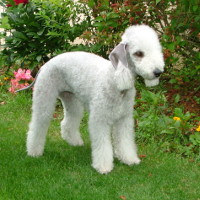
 |
Bedlington Terrier |
|
FCI Standard No. 9 |
Origin |
Great Britain | |
Group |
Group 3 Terriers | |
Section |
Section 1 Large and medium sized Terriers | |
Working |
Without working trial | |
Date of acceptance on a definitive basis by the FCI |
Thursday 20 June 1963 | |
Date of publication of the official valid standard |
Tuesday 08 September 2026 | |
Date of the last update |
Tuesday 06 October 2026 | |
En français, cette race se dit |
 |
Bedlington Terrier |
Diese Norm ist in deutscher Sprache sichtbar |
 |
Bedlington Terrier |
En español, esta raza se dice |
 |
Bedlington Terrier |
In het Nederlands, wordt dit ras gezegd |
 |
Bedlington Terrier |
Usage |
| Terrier. |
Brief historical summary |
| It is claimed that the Bedlington can boast a longer traceable pedigree than any other terrier and once was known as the Rothbury Terrier, hailing from the former mining areas of the north of England. His fame spread outside his native region and an association was started for the breed in 1877. Although his expression is mild he is quite capable of fending for himself, but will not seek a scrap. He is a tough little dog, this unique breed has a lamb-like look about it, but don’t be fooled, and he is a terrier through and through. A North Country dog, originally his role was to catch rabbits for the family pot, and a sporting dog he still remains. |
General appearance |
| A graceful, lithe, muscular dog, with no signs of either weakness or coarseness. Whole head pear or wedge-shaped, and expression in repose mild and gentle. |
Important proportions |
| Body slightly greater in length than height. |
Behaviour / temperament |
| Spirited and game, full of confidence.An intelligent companion with strong sporting instincts. Good-tempered, having an affectionate nature, dignified, not shy or nervous. Mild in repose but full of courage when roused. |
Head |
||
Cranial region |
||
Head |
Covered with profuse silky top-knot which should be nearly white. | |
Skull |
Narrow, but deep and rounded. | |
Stop |
There must be no stop: the line from occiput to nose-end straight and unbroken. | |
Facial region |
||
Nose |
Nostrils large and well defined. Blue and blue and tan must have black noses, liver and sandies must have brown noses. | |
Muzzle |
Well filled up beneath eyes. | |
Lips |
Close fitting, without flew. | |
Jaws and teeth |
Teeth large and strong. Scissor bite, i.e. upper teeth closely overlapping the lower teeth and set square to the jaws. | |
Eyes |
Relatively small, bright. Ideal eye has appearance of being triangular. Blues have a dark eye; blue and tans have lighter eye with amber lights, livers and sandies have a light hazel eye. | |
Ears |
Moderately sized, filbert-shaped, set on low, and hanging flat to cheek. Thin and velvety in texture; covered with short fine hair with fringe of whitish silky hair at tip. | |
Neck |
| Long and tapering, deep base with no tendency to throatiness. Springs well up from shoulders, and head carried rather high. |
Body |
||
Body |
Muscular and markedly flexible. | |
Back |
Has natural arch over loin. | |
Loin |
Arched loin with curved topline immediately above loins. | |
Chest |
Deep and fairly broad. Deep through brisket which reaches to elbow. | |
Ribs |
Flat ribbed. | |
Underline and belly |
Arched loin creating a definite tuck-up of underline. | |
Tail |
| Moderate length, thick at root, tapering to a point and gracefully curved. Set on low, never carried over back. |
Limbs |
Forequarters |
||
Generality |
Forelegs straight, wider apart at chest than at feet. | |
Shoulders |
Flat and sloping. | |
Pastern |
Long and slightly sloping without weakness. | |
Forefeet |
Long hare feet with thick and well closed-up pads. Pads sound and free from cracks or horny excrescences. | |
Hindquarters |
||
Generality |
Muscular and moderate length. Hindlegs have appearance of being longer than forelegs. | |
Stifle |
Moderate turn. | |
Hock |
Hocks strong and well let down, turning neither in nor out. | |
Hind feet |
Long hare feet with thick and well closed-up pads. | |
Gait and movement |
| Capable of galloping at high speed and have appearance of being able to do so. Action very distinctive, rather mincing, light and springy in slower paces and slight roll when in full stride. |
Coat |
||
Hair |
Very distinctive. Thick and linty, standing well out from skin, but not wiry. A distinct tendency to twist, particularly on head and face. | |
Colour |
Blue, liver, or sandy with or without tan. Darker pigment to be encouraged. Blues and blue and tans must have black noses; liver and sandies must have brown noses. Any other colour or combination of colours unacceptable. |
|
Size and weight |
||
Height at withers |
About 41 cms. This allows for slight variation below in the case of a bitch and above in the case of a dog. | |
Weight |
Between 8 -10 kgs. | |
Faults |
| • Any departure from the foregoing points should be considered a fault and the seriousness with which the fault should be regarded should be in exact proportion to its degree and its effect upon the health and welfare of the dog and its ability to perform its traditional work. • Faults listed should be in degree of seriousness. |
Disqualifying faults |
 Aggressive or overly shy. Aggressive or overly shy. |
NB : |
| • Any dog clearly showing physical or behavioural abnormalities shall be disqualified. • The above mentioned faults when occurring to a highly marked degree or frequently are disqualifying. • Male animals should have two apparently normal testicles fully descended into the scrotum. • Only functionally and clinically healthy dogs, with breed typical conformation should be used for breeding. |
Detailed history |
|
Originally from northern England, and more specifically from the Northumberland region, the Bedlington Terrier is one of Britain's oldest dogs. It is estimated that at the end of the eighteenth century, the breed was already stabilized in the Bedlington district and that the owners had begun systematic registration of breeding and births, thus creating true pedigrees. Several hypotheses remain as to the exact origins of the Bedlington Terrier. It is generally admitted that it was created by crossing a Poodle and a Dandie Dinmont Terrier; but it is probably the contribution of Whippet's blood which would have given him his characteristic line. First called the "Rothbury Terrier," Bedlington was much appreciated by miners in Northumberland who wanted a dog that could kill rats in the galleries. It is even said that he could detect and predict firedamps. As for the hunters, they found in him the indefatigable tracker of hares, badgers and foxes, a specialty in which, moreover, he held the dragee high at the Fox Terrier. If, afterwards, the breeders imagined crossing the Bedlingtons with greyhounds, which were then smaller than those we know today, it is that, rich or poor, all wanted to engage them in races with bets, very popular in the UK as early as the 19th century. Nothing, in these circumstances, destined the Bedlington Terrier to become the pet of salon and company that it is today. Nothing, if not, perhaps, the interest that the English high society would soon bring him. Interest that will avoid the fact that this race does not fall into oblivion. The physics of Bedlington will evolve: his neck will get longer, his pace become much more sophisticated. An English club was created in 1869, bringing together many amateurs; then, little by little, the Bedlington crosses the borders of Canada, the United States, the Netherlands, Germany, and also France, thanks to the Countess Stenbock-Fermor, of Rueil-Malmaison, who introduced in 1934 the English champion Gardener-Priee, who became one of the leading French breeders of this breed. The first imported subjects were blue; and it was not until 1951 that a farmer from Château-Thierry, Mme Couesnon, enrolled in the Book of French origins Zazou, the first French "liver". Be that as it may, the Bedlington Terrier, which is also called Sheep Dog because of its appearance, is very rare in France, since there are hardly more than five hundred today. |



 English (United Kingdom)

Comments