English Shepherd

He is not recognized by the F.C.I.

Origin
Great Britain
Translation
Francis Vandersteen
En français, cette race se dit
Berger anglais
Diese Norm ist in deutscher Sprache sichtbar
Englischer Schäferhund
En español, esta raza se dice
Pastor inglés
In het Nederlands, wordt dit ras gezegd
Engelse Herder

A brief presentation of the English Shepherd

The English Shepherd is an extremely versatile breed of working dogs of the Collie lineage, developed in the USA from farm dogs brought over by English and Scottish settlers from the 17th to the 19th century, before pedigrees became fashionable in the late 19th century. Subsistence farmers appreciated the breed for its versatility, not for its flash or strict conformation to a high standard of appearance. The English Shepherd is an extremely intelligent and versatile farm dog, used as a sheepdog, cattle guard, farm watchdog, hunting dog, vermin extirpator and child's companion. English Shepherds were not bred to specialize in one type of livestock like some recent sheepdogs. English Shepherds were bred to perform many tasks on the small, diversified farms of the 17th to early 20th centuries, with different types of livestock including cattle, sheep, pigs, goats and poultry. It was perhaps the most widespread breed in America in the 19th and early 20th centuries.

History of the English Shepherd

Originally from northern England and Scotland, these dogs came with the first settlers to reach the American colonies. American farmers appreciated this versatile breed and used dogs to protect their farms and livestock. The English Shepherd and various other Collies were also referred to as Scottish Collies in the 18th and 19th centuries, but the term Scotch Collie fell into disuse during the 20th century. The UKC apparently had another registration in progress for a type of Agricultural Shepherd distinct from the English Shepherd. Several times the names were confused, but at other times they were distinguished as different breeds. All these names, as well as Farm Collie, were applied to the Farm Shepherds of the time. As there was no breed club or registry until later, there is some doubt as to the exact name that applies to which dog. The Australian Shepherd is probably derived from these farm dogs and appeared mainly in the western United States. The English Shepherd, on the other hand, was more common in the Midwest and East. These dogs are mainly descendants of the working farm dogs of England. As the number of small, diversified farms in the mid-western and eastern USA dwindled, many being replaced by larger, less diversified operations, the English Shepherd became a rare breed.

Appearance of the English Shepherd

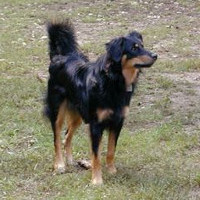
English Shepherds are similar in appearance to Border Collies and Australian Shepherds. English Shepherds generally have a less rounded tail and head than many Australians. English Shepherds are never like Australians. They are generally not square in body like an Australian. English Shepherds tend to be larger than Border Collies, but are more easily distinguished from Border Collies by their very different, straight and loose style of guarding. The English Shepherd is a medium-sized dog, usually a little longer than it is tall. They generally weigh between 20 and 30 kilograms, and their proportions are well balanced. As working dogs on small farms, English Shepherds have been selected to meet a variety of needs. This has resulted in a wide variety of regional variations. The coat is of medium length and may be straight, wavy or curly. Bangs are frequently present on the legs and tail, as well as on the ear. As a working dog, the coat should be easy to keep, requiring very little grooming. Dirt tends to fall out. English Shepherds tend to shed a lot, and fur can be found on and under furniture, clothes and carpets. The main coat colors are sand and white (light and shaded), tricolor, black and white and black and tan. Other variations, such as plain or all-colored dogs, piebalds, red-nosed tricolors and sables also exist but are not common.

Temperament of the English Shepherd

The English Shepherd's temperament is the defining characteristic of the breed, with great intelligence and often a type of kindness unique to human beings, as in him. The English Shepherd is often an independent worker. English Shepherds are adaptable and learn routines quickly. Some can be attentive to strangers and are more of a one-person dog. However, once they accept people or children or animals as their own, there are few better guardians than an English Shepherd. The English Shepherd frequently shows a tendency in its temperament towards independent, authoritarian or rule-abiding rule. If the dog's desire to enforce order is not channeled and directed toward an appropriate goal by a strong, confident leader, it can exhibit many undesirable behaviors. Nevertheless, English Shepherds can thrive as companion dogs in environments offering sufficient mental and physical stimulation. English Shepherds require a lot of exercise, at least 40 minutes of walking a day, and can become destructive if not sufficiently fed. They have a natural instinct for hunting and enjoy playing a game of fetch. They tend to become calm and relaxed at the end of the day, likely to curl up at their owner's feet. This breed has already been selected from a number of small family farms, and has been chosen to work in partnership with its owner.

Needs and activities of the English Shepherd

This dog is wired to be energetic, needing to work and work hard. If the English Shepherd doesn't get enough exercise, he can become a barker and will chew up anything in sight. An active family that likes to hike, bike or run is ideal for this dog, or a small farm plot where he can hone his skills herding their flock or people. This dog also does well as a therapy dog, or in search and rescue. As a breed, they like to keep busy. They're also very playful and will enjoy family games, make excellent pets or buddies for children, and enjoy tasks that require them to solve a problem. This is a dog that loves mental stimulation. Hide their food in a toy and watch how they find it to take care of themselves. This active dog needs a lot of socialization as a puppy, to grow and gain confidence. They're often good with other pets, as well as trying to keep them, of course. And they tend to be incredibly patient and caring with young children, picking them up and guiding them. If you can't give your English Shepherd two or three long walks every day or lots of activity, then it's not a good choice. But if you like running or living on a farm, then the English Shepherd will be your faithful and trusted companion for life.

Maintenance of the English Shepherd

The English Shepherd needs a little attention when it comes to his appearance, as his dense coat seems to shed almost all the time. If you don't like dog hair in the house, and you don't like vacuuming, this is not the dog for you. However, giving your dog two or three hair grooming sessions a week will help alleviate the problem. English Shepherds don't need regular baths, only when they've been out in the mud or rolled in something unpleasant. Using a gentle dog shampoo will help maintain the natural oil balance in the dog's skin and help prevent allergies caused by harsh products. Other points to check are your dog's teeth. They can have tooth decay just like ours, so check those pearly teeth carefully and brush them at least twice a week. If you smell something unpleasant in your dog, it could be an ear infection. These infections can produce a horrible smell, not to mention the condition can worsen your dog's health, so it's important to check their ears regularly and wipe them with a soft, damp cloth. The final task is to give your dog a manicure if they haven't worn down their nails naturally. Ask a vet to show you how to do it properly so as not to hurt your dog. Then, all they need is a cuddle and they'll be nice and soft, just like a teddy bear.

Comments

Latest page updates

  • Telomian

    Telomian He is not recognized by the F.C.I. Origin Malaysia Translation Francis Vandersteen A brief presentation of the Telomian The Telomian is a very rare breed of dog, and the only one native to Malaysia to have been bred outside the country. They were originally bred by the indigenous people of Malaysia to combat parasites such as snakes, rats,...
  • King Wheaten -- Cavalier King Charles Spaniel X Irish Soft Coated Wheaten Terrier

    King Wheaten He is not recognized by the F.C.I. Origin Great Britain <> Ireland -> U.S.A. Translation Francis Vandersteen A brief presentation of the King Wheaten The King Wheaten is a small dog with a heart this big and a playful disposition. Borrowing the energy and soft-coated waves of the Irish Soft Coated Wheaten Terrier and the size and...
  • Spanierd -- English Springer Spaniel X German Shepherd

    Spanierd He is not recognized by the F.C.I. Origin Great Britain <> Germany -> U.S.A. Translation Francis Vandersteen A brief presentation of the Spanierd The Spanierd is a hybrid dog. Its parent breeds are the English Springer Spaniel and the German Shepherd. They have an affable personality. He's known for entertaining family and friends with his...
  • Alaskan Goldenmute -- Alaskan Malamute X Golden Retriever

    Alaskan Goldenmute He is not recognized by the F.C.I. Origin U.S.A. <> Great Britain -> U.S.A. Translation Francis Vandersteen This breed is also known as Alaskan GoldenGoldenmuteAlaskan Gold Retriever     A brief presentation of the Alaskan Goldenmute The Alaskan Goldenmute is a descendant of two great dog breeds: the Alaskan Malamute and the Golden...
  • French pointing dog Pyrenean type

    French pointing dog Pyrenean type FCI standard Nº 134 Origin France Translation Mrs. Peggy Davis Group Group 7 Pointing Dogs Section Section 1.1 Continental Pointing Dogs « Braque » Type Working With working trial Acceptance on a definitive basis by the FCI Tuesday 18 January 1955 Publication of the official valid standard Tuesday 01 August 2023 Last...
  • French pointing dog Gascogne type

    French pointing dog Gascogne type FCI standard Nº 133 Origin France Translation Mrs. Peggy Davis Group Group 7 Pointing Dogs Section Section 1.1 Continental Pointing Dogs « Braque » Type Working With working trial Acceptance on a definitive basis by the FCI Monday 17 January 1955 Publication of the official valid standard Tuesday 01 August 2023 Last...
  • Vucciriscu

    Vucciriscu He is not recognized by the F.C.I. Origin Sicily Translation Francis Vandersteen En français, cette race se dit Vucciriscu Diese Norm ist in deutscher Sprache sichtbar Vucciriscu En español, esta raza se dice Vucciriscu In het Nederlands, wordt dit ras gezegd Vucciriscu This breed is also known as Sicilian Vucciriscu Sicilian Butcher...

© 2026 Groupe Milouchouchou ASBL. Tous droits réservés. En savoir plus

Protected by Copyright01
We use cookies

We use cookies on our website. Some of them are essential for the operation of the site, while others help us to improve this site and the user experience (tracking cookies). You can decide for yourself whether you want to allow cookies or not. Please note that if you reject them, you may not be able to use all the functionalities of the site.

Ok