
 |
Akita Inu |
|
FCI standard Nº 255 |
||
Origin |
Japan | |
Group |
Group 5 Spitz and primitive types | |
Section |
Section 5 Asian Spitz and related breeds | |
Working |
Without working trial | |
Acceptance on a definitive basis by the FCI |
Friday 13 March 1964 | |
Publication of the official valid standard |
Tuesday 13 March 2001 | |
Last update |
Monday 02 April 2001 | |
En français, cette race se dit |
 |
Akita Inu |
Diese Norm ist in deutscher Sprache sichtbar |
 |
Akita Inu |
En español, esta raza se dice |
 |
Akita Inu |
In het Nederlands, wordt dit ras gezegd |
 |
Akita Inu |
This breed is also known as |
Japanese Akita
|
Usage |
| Companion dog. |
Brief historical summary |
| Originally Japanese dogs were small to medium in size and no large breeds existed. Since 1603 in the Akita region, Akita Matagis (medium-sized bear-hunting dogs) were used as fighting dogs. From 1868 Akita Matagis were crossed with Tosas and Mastiffs. Consequently, the size of this breed increased but characteristics associated with Spitz type were lost. In 1908 dog fighting was prohibited, but this breed was nevertheless preserved and improved as a large Japanese breed. As a result, nine superior examples of this breed were designated as « Natural Monuments » in 1931. During World War II (1939-1945), it was common to use dogs as a source of fur for military garments. The police ordered the capture and confiscation of all dogs other than German Shepherd Dogs used for military purposes. Some fanciers tried to circumvent the order by crossbreeding their dogs with German Shepherd Dogs. When World War II ended, Akitas had been drastically reduced in number and existed as three distinct types; 1) Matagi Akitas, 2) fighting Akitas, and 3) Shepherd Akitas. This created a very confusing situation in the breed. During the restoration process of the pure breed after the war., Kongo-go, a dog of the Dewa line, which exhibited characteristics of the Mastiff and German Shepherd. However, sensible learned fanciers did not approve of this type as a proper Japanese breed, so they made efforts to eliminate the strain old foreign breeds by crossbreeding with Matagi Akitas for the purpose of restoring the original pure breed. They succeeded in stabilizing the pure strain of large sized breed as known today. |
General appearance |
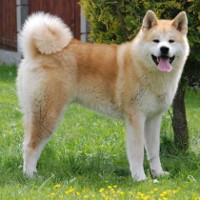
| Large-sized dog, sturdily built, well balanced and with much substance ; secondary sex characteristics strongly marked, with high nobility and dignity in modesty ; constitution tough. |
Important proportions |
| The ratio of height at withers to length of body ( from the point of the shoulders to the point of the buttock) is 10 : 11, but the body is slightly longer in bitches than in dogs. |
Behaviour / temperament |
| The temperament is composed, faithful, docile and receptive. |
Head |
||
Cranial region |
||
Skull |
The size is in proportion to the body. The forehead is broad, with distinct furrow. No wrinkle. | |
Stop |
Defined. | |
Facial region |
||
Nose |
Large and black. Slight and diffuse lack of pigment accepted in white dogs only, but black is always preferred. | |
Muzzle |
Moderately long and strong with broad base, tapering but not pointed. | |
Lips |
Tight. | |
Nasal bridge |
Nasal bridge straight. | |
Jaws and teeth |
Teeth strong with scissor bite. | |
Cheeks |
Moderately developed. | |
Eyes |
Relatively small, almost triangular in shape due to the rising of the outer eye corner, set moderately apart, dark brown : the darker, the better. | |
Ears |
Relatively small, thick, triangular, slightly rounded at tips, set moderately apart, pricked and inclining forward. | |
Neck |
| Thick and muscular, without dewlap, in balance with head. |
Body |
||
Back |
Straight and strong. | |
Loin |
Broad and muscular. | |
Chest |
Deep, forechest well developed. | |
Ribs |
Ribs moderately well sprung. | |
Underline and belly |
Belly well drawn up. | |
Tail |
| Set on high, thick, carried vigorously curled over back ; the tip nearly reaching hocks when let down. |
Limbs |
Forequarters |
||
Shoulders |
Moderately sloping and developed. | |
Elbows |
Tight. | |
Forearm |
Straight and heavy-boned. | |
Hindquarters |
||
Generality |
Well developed, strong and moderately angulated. | |
Feet |
| Thick, round, arched and tight. |
Gait and movement |
| Resilient and powerful movement. |
Coat |
||
Hair |
Outer coat harsh and straight, undercoat soft and dense ; the withers and the rump are covered with slightly longer hair ; the hair on tail is longer than on the rest of the body. | |
Colour |
Red fawn, sesame (red fawn hairs with black tips), brindle and white. All the above mentioned colours except white must have « urajiro ». | |
Size and weight |
||
Height at withers |
Dogs : 67 cm, bitches : 61 cm, there is a tolerance of 3 cm more or less. | |
Weight |
25 to 40 kg. | |
Faults |
| • Any departure from the foregoing points should be considered a fault and the seriousness with which the fault should be regarded should be in exact proportion to its degree and its effect upon the health and welfare of the dog and its ability to perform its traditional work. • Faults listed should be in degree of seriousness. |
General faults |
 Bitchy dogs / doggy bitches. Undershot or overshot mouth. Missing teeth. Blue or black spotted tongue. Iris light in colour. Short tail. Shyness. Bitchy dogs / doggy bitches. Undershot or overshot mouth. Missing teeth. Blue or black spotted tongue. Iris light in colour. Short tail. Shyness. |
Disqualifying faults |
| Aggresive or overly shy. Ears not pricked. Hanging tail. Long hair (shaggy). Black mask. Markings on white ground. |
NB : |
| • Any dog clearly showing physical or behavioural abnormalities shall be disqualified. • The above mentioned faults when occurring to a highly marked degree or frequently are disqualifying. • Male animals should have two apparently normal testicles fully descended into the scrotum. • Only functionally and clinically healthy dogs, with breed typical conformation should be used for breeding. |
Bibliography |
| https://www.fci.be/ |



 English (United Kingdom)

Comments